
On Tuesday, the Council of Ministers adopted the draft law on the National Labor Inspectorate (UD283). Adam Szłapka, government spokesman, admitted that this was a widely discussed project, but added that there was an agreement on this matter.
And although the fight was about too broad inspectors' rights, they remained. However, on the one hand, they have been slightly limited, and on the other hand, the act is intended to guarantee faster processing of disputes in labor courts. In addition, the labor inspection will gain the powers currently held by the tax office or ZUS. Here are the details, although a person close to the Prime Minister's Office points out that the government has made minor corrections.
Read also: RCL goes to court. He wants money from Krzysztof Szczucki's people
The government adopted the draft act on the National Labor Inspectorate
|
RCL
The inspector will turn the illegal assignment into a full-time job
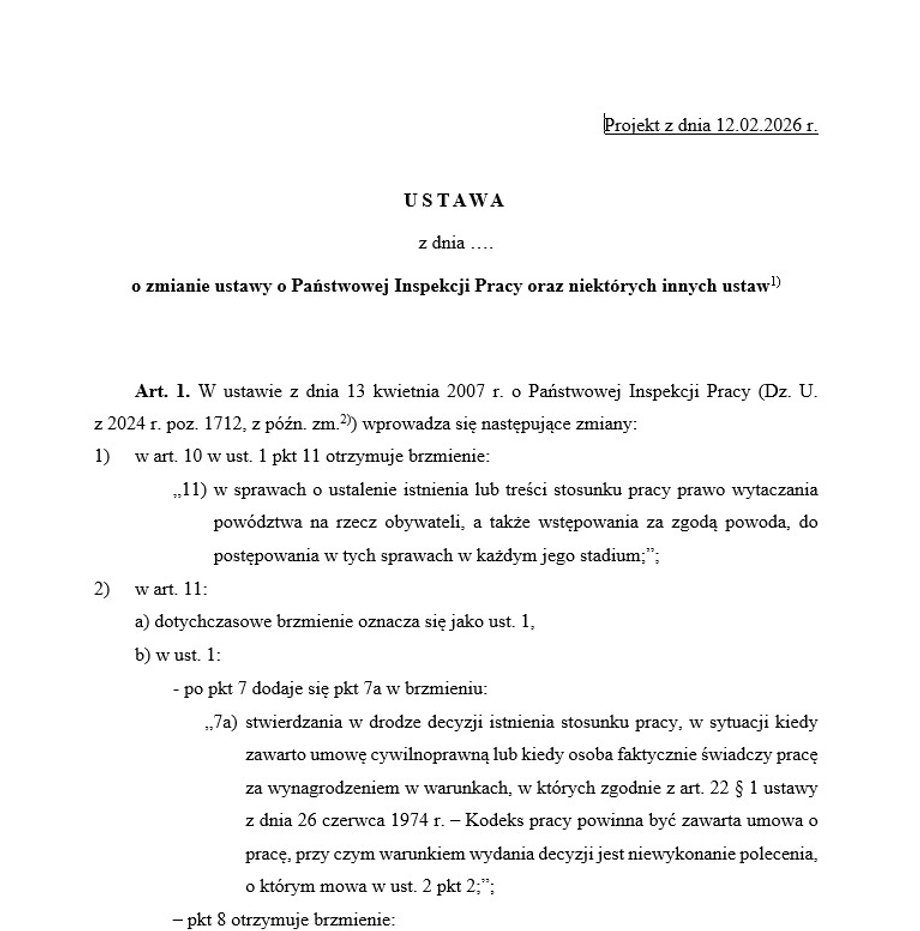
According to the draft version sent to the government on February 12 this year. the inspector will gain the right to confirm, by way of an administrative decision, the existence of an employment relationship instead of an incorrect civil law contract (orders with a natural person or a sole proprietorship). Such a decision will also specify the amount of remuneration. As a rule, the date of conclusion of the employment contract will be the date of issuance of the decision.
However, the decision will become enforceable on the date of the expiry of the deadline for filing an appeal or on the date of the final court decision. In short, if the employer appeals against the inspector's decision to court, it will not be enforced until a final judgment is issued. It will become enforceable with effect from its issuance if the entrepreneur loses in court with the National Labor Inspectorate. The inspector will also be able to make the decision immediately enforceable, which was also the subject of the dispute. However, this rigor will be imposed on general principles, i.e. if it is justified.
However, the decision can be issued under one condition. The district inspector will turn the assignment into a full-time job if the employer fails to comply with the order regarding the removal of violations in the area related to the conclusion of contracts. According to the bill, in the event of disclosing irregularities, the labor inspector will be obliged to issue such an order.
This command can be implemented in two ways. First, the parties will be able to conclude an employment contract. Secondly, the parties will be able to change the civil law contract so that it does not contain elements typical of an employment contract.
According to Agnieszka Dziemianowicz-Bąk, Minister of Labor, this project will enable effective fight against junk contracts and will strengthen National Labor Inspectorate and labor courts.
Quick case in court
It will be possible to appeal against the inspector's decision, including the decision on immediate enforceability, to the court through the district labor inspector.
The project assumes that the application to waive the immediate enforceability requirement will be considered by a single-person court in a closed session. Such a meeting may also consider an appeal against the inspector's decision.
If the court decides that the case is not suitable for closed consideration, it will schedule a hearing. The appellant, e.g. an entrepreneur, will have to present all claims and evidence in the appealand the other parties – in response to the appeal.
This is intended to speed up the proceedings, which is what entrepreneurs are seeking.
The rest of the article is below the video
Individual interpretation. New PIP rights
What's new is that At the request of the employing entity, the Chief Labor Inspector will issue an individual interpretation regarding the application of labor law provisions regarding determining whether a given legal relationship constitutes an employment contract. In short, GIP will issue interpretations as to whether a given order or B2B contract has the characteristics of an employment contract. You will have to pay for the interpretation, but only PLN 40. An individual interpretation is granted in the form of a decision which can be appealed against to the labor court.
See also: Labor market reform. The head of the National Labor Inspectorate will issue interpretations on mandate contracts. Will he gain power like the taxman?
A short history of the reform
The history of the State Labor Reform dates back to the PiS government. The government of Prime Minister Mateusz Morawiecki included in the National Reconstruction Plan the contribution of civil law contracts in order to limit the segmentation of the labor market.
Prime Minister Donald Tusk did not like this action and talks began in the fall of 2024 replacing the contribution rate for mandate contracts with two reforms: PIP and internship, which we announced in November 2024. Officially in January 2025 the government adopted a resolution on amending the KPO submitted by Katarzyna Pełczyńska-Nałęcz, Minister of Funds and Regional Policy. In June 2025, the European Commission approved the revision of the KPO. Milestone A71G states explicitly that the National Labor Inspectorate will gain the power to issue administrative decisions changing incorrect civil law contracts into employment contracts.
In September 2025, the Ministry of Family, Labor and Social Policy submitted for public consultation a draft bill reforming the National Labor Inspectorate implementing a new milestone. December 4 born After many disputes within the government and critical comments from entrepreneurs, the project was adopted by the Standing Committee of the Council of Ministers. And this despite coalition frictions, mainly between the Left and PSL.
At the beginning of January, Prime Minister Donald Tusk stated that work on the PIP reform will not be continued. After meeting with the leader of the Left, Włodzimierz Czarzasty, the project was brought back into play. Its new version was developed together with the Ministry of Justice. This is a very expensive project. People close to the ministries of funds and labor say unofficially that it is about EUR 2 billion, or about PLN 8 billion.