According to Eurostat data approx. 58 percent inhabitants of Poland in 2024 lived in single-family houses. That's it though statistics calculated in terms of “population”, not “resources”. In other words, it shows where people live, not how many buildings and premises we have.
Read also: Study: Moving causes stress, but Poles value their new life
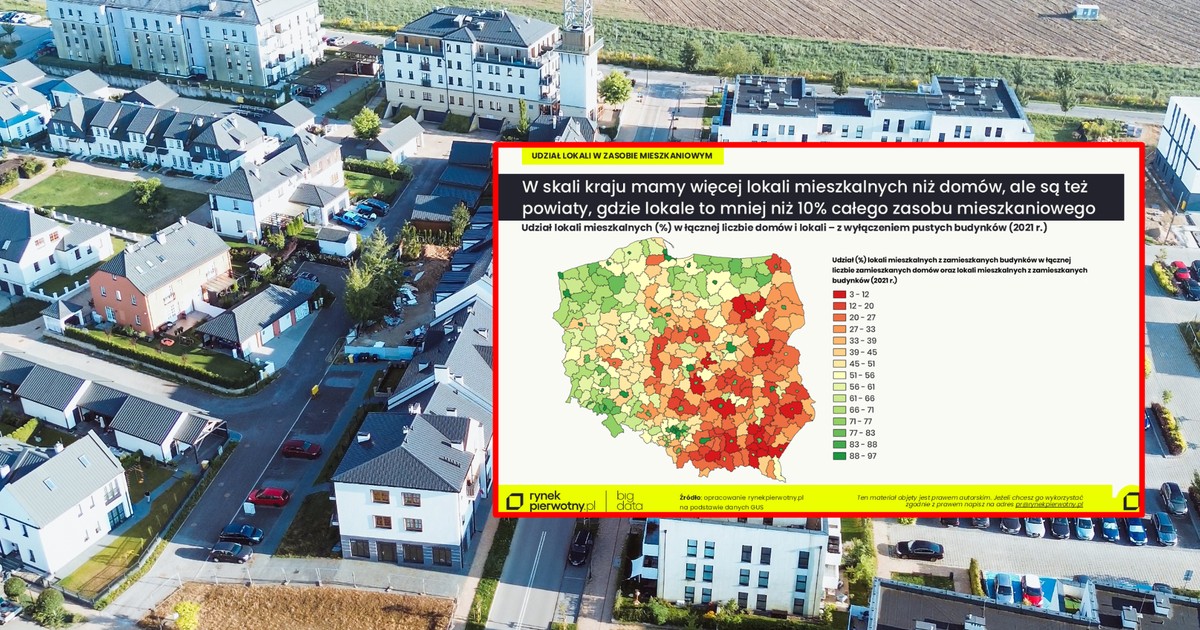
Andrzej Prajsnar, an expert of the RynekPierwotny.pl portal, used more detailed data from the Central Statistical Office from the 2021 census and analyzed structure of the housing stock divided into counties. Key Disclaimer: The cartogram includes only inhabited buildings, i.e. no vacant buildings — both in single-family and multi-family buildings.
These data show that in 2021, residential premises dominated in numbers in Poland — constituted 63 percent all inhabited housing units. Single-family houses accounted for 37 percent. resource.
However, this does not mean that more Poles live in apartment blocks. On average, premises are smaller and households in apartments are smaller than in houses. As a result, in terms of the number of inhabitants, the advantage is tilted towards houses. This explains why Eurostat data show the advantage of the “home” lifestyle.
It is also worth remembering that although several years have passed since the census, regional proportions between houses and premises are unlikely to have changed radically. New investments – both by developers and individual ones – usually consolidate the existing urban structure.
Large cities: bastions of blocks of flats and tenement houses
From a district perspective, the differences are spectacular. The largest cities are strongholds of multi-family housing. The share of units in the settled housing stock exceeds 90%.
Examples from 2021:
- Warsaw – 94 percent premises
- Kraków – 93 percent
- Wrocław – 92 percent
- Gdańsk – 92 percent
- Poznań – 89 percent
The record was broken in Chorzów – as much as 97 percent The inhabited resource consisted of premises, and houses accounted for only 3%. share. This shows how strongly urbanized and “block-like” some centers of the Upper Silesian-Zagłębie Metropolis are.
This high dominance of apartments is due to several factors: dense development, historical industrial development, limited availability of land and housing policy from the times of the Polish People's Republic, when the development of multi-family housing was a priority.
For investors, this means first of all liquid rental market and higher apartment turnover. In turn, for local governments – challenges related to the revitalization of tenement houses, modernization of prefabricated blocks of flats or increasing the energy efficiency of multi-family buildings.
See also: Supreme Administrative Court regarding family foundations. Real estate sales. What about tax?
“Home” counties: over 90 percent single-family buildings
They are at the other extreme counties where premises constitute less than 10 percent inhabited resource. In such places, houses account for over 90 percent. housing market.
This group includes, among others:
- Ostrołęka County – 3 percent premises
- Skierniewice district – 7 percent
- Tarnów poviat – 7 percent
- Łomża poviat – 7 percent
- Siedlce poviat – 7 percent
These are areas about low degree of urbanization, with domination of small towns and scattered buildings. The development market there is limited, and single-family construction is mainly carried out using an economic system.
Interestingly, the map clearly shows the division between the western and eastern parts of the country. In many regions, the line separating “local” Poland from “home” coincides with the former Prussian-Russian border, and later the German-Russian border from 1815–1914.
Although most of the buildings from that period no longer exist, historical differences in levels of urbanization have persisted. The west and north of the country industrialized and urbanized faster, which favored the development of multi-family housing. The east remained more agricultural and scattered settlements.
Real estate market: different needs, different challenges
The division into “local” and “home” Poland is not just a statistical curiosity. These also have specific consequences for the real estate market and housing policy.
In counties where single-family houses dominate, social housing or TBS are less important. The issues of thermal modernization, energy efficiency and air quality in winter become crucial. Old, uninsulated houses generate high heating costs and contribute to local smog.
In turn, in large cities, where the premises exceed 90%. resource, there is growing pressure on the development of infrastructure, public transport and the revitalization of existing multi-family buildings. Support programs for housing communities and modernization of blocks of flats from the 1970s and 1980s are also important.
For developers, the map of the share of apartments and houses is an indication of where there is potential for new multi-family projects and where the market is almost entirely dominated by individual construction..
In 2026, with rising energy costs and increasingly stringent climate standards, the structure of the housing stock may become one of the key factors influencing local real estate prices. There, where energy-intensive houses from several decades ago dominate, the modernization pressure will be greater than in cities with new development resources.
The map of “apartment” and “home” Poland shows something more than just the proportions between an apartment building and a house. It's a picture civilizational, urban and economic differenceswhich continue to shape the national housing market – and may determine it for many years to come.