The chief economist of a large bank explains the decisions of the last days of the NBR and tells what to expect. “More important than ever”

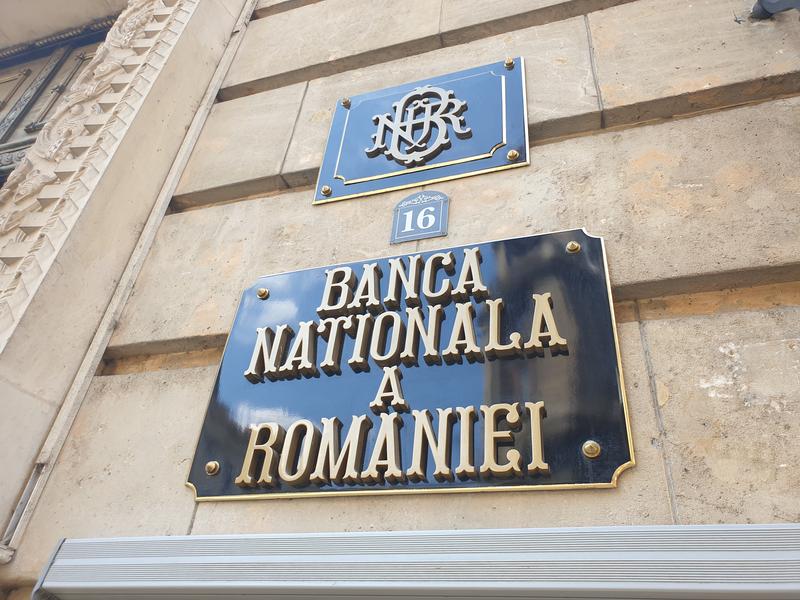
National Bank of Romania – BNR, Photo: Hotnews
Florian Libocor, BRD's chief economist, explains, for HotNews readers, what Romania needs in order for the advanced market scenario, namely the decrease in inflation in the second part of 2026, to be fulfilled.
At the last meeting on monetary policy issues, the one on February 17, 2026, the CA of the NBR decided to keep the monetary conditions unchanged:
- the monetary policy interest rate at 6.5%;
- Lombard rate at 7.50%;
- Depo rate at 5.50%;
- minimum reserve ratios.
Disinflation is insufficiently robust to argue for monetary easing (9.62% in January 2026, compared to 9.69% in December 2025). At the same time, the CORE 2 rate (core inflation) stagnated at 8.5%, driven by wages, the exchange rate and inflationary expectations. The decision is justified, the problem of high price dynamics being structural, not transitory.
“Maintaining credibility is an essential objective”
The economy is in a latent state of stagnation, with GDP contracting in the last two quarters of 2025, but with a slightly positive annual performance (GDP growth of 0.6%). An economy in technical recession and, in fact, relatively cyclically locked. Accepting the “cost” of marginal growth to regain control of inflation reflects that maintaining credibility is an essential objective.
Expectations of a slow decline in inflation in the first half of this year (removal of caps, base effects, etc.), followed by a sharp decline in the second half of the year, point to monetary conditions being maintained in the short term or until the disinflation process is clear and certain (most likely no earlier than the middle of the second half of the year).
Let's expect “inflation to fall in the second part of this year”
According to the markets, the decrease in inflation in the second part of this year is a realistic and certain scenario.
Interbank rates have fallen, government bond yields are at their lowest in the last 18 months and the perception of sovereign risk is improving (at the first assessment this year, February 13, 2026, Fitch maintained Romania's investment rating).
The assumption of the markets (which indicates the approach of the end of the restrictive cycle) was not validated by the prudent conduct of the monetary policy.
In this situation, before validating any expectations, the monetary policy decision indicates the importance of specific aspects of the internal context and the external environment on a possible change in behavior.
“The balanced and stable macroeconomic framework is more important than ever”
Internally, some immediate needs are highlighted such as:
- i) – fiscal deficit adjustment (determining factor)
- ii) – attracting European funds
- iii) – reducing the uncertainty vis-à-vis the whole and the impact of the following consolidation measures.
In other words, the balanced and stable macroeconomic framework is more important than ever at least because monetary policy can no longer compensate/substitute fiscal policy.
Among the challenges of the external environment that generate risk impulses on the Romanian economy are the geopolitical conflicts, the European defense policy (increased spending at the EU level) and the commercial tensions manifested at the global level.
In such a context, it would be more appropriate and timely for the outlook to be anchored in a domestic environment whose stability depends heavily on fiscal adjustment and an external framework with persistent volatility, rather than a linear normalization scenario.
2026 in price and cost benchmarks
CPI (y/y): 5% (+/-0.5%)
Monetary policy interest rate (year-end): 6% (+/-0.25%)
ROBOR 3M (end of year): 5.5% (+/-0.5%)
EURRON (year-end): 5.13 (+/-0.05%)