— It shouldn't be like this, it shouldn't happen. This is an exceptionally tragic story that shows serious errors in the system, which we are today obliged to deal with responsibly and as effectively as possible – Maja Nowak, government plenipotentiary for people with disabilities (subject to the Ministry of Family, Labor and Social Policy), comments on Hania's story in an interview with Business Insider Polska.
— Each such story is a story about the real suffering of specific people and their loved ones. There is a question here about the dignity of these people and the sense of security that the state and support services should provide, he adds.
Read also: “I'm giving you Hania's new address: row 8, section 3, cemetery.” Sick people in Poland do not live up to what the state promised them
Death in line for benefits. Whose fault?
I ask the government representative a question about the reasons for the current situation. I hear: the previous ruling team is to blame.
— The support service was designed to strengthen independence and provide real support. Unfortunately, the error appeared at the stage of system design by our predecessors from Law and Justice. The result was an underestimated scale of applications and insufficient preparation of the judicial system to handle them – convinces.
Nowak explains that immediately after the support benefit entered into force (January 1, 2024), the number of incoming applications turned out to be huge. — Much greater than the number of specialists prepared to adjudicate. This is the main reason for queues, he explains.
He adds: – In fact, we are still dealing with the consequences of this first period of operation of the benefit, although we are gradually emerging from them. The situation is improving, but it is still not as it should be everywhere.
Playing for time? “This is not an intentional act”
After Hania's story was published in Business Insider Polska, the editorial inbox was flooded with messages from patients and their relatives who were or are in a similar situation. There is one thought that is as incredible as it is bitter: Offices in Poland are deliberately playing for time so that as many patients as possible die before receiving benefits, thus saving the state money.
— That's absolutely not true. This is not an intentional act. I understand where such opinions come from – the helplessness, fear and enormous frustration of people who find themselves in a dramatic situation. But we found the system in the form in which it was prepared by PiS. The number of applications was huge, the committees could not cope with it – Nowak responds to the allegations. – Today, we consistently introduce solutions that shorten waiting times, but such long queues take months, not weeks to shorten – he adds.
Although the Act on Supportive Benefits has been in force for two years, the situation has not improved dramatically. How long does it take for the commission to consider an application for a support benefit? Here is the data based on the responses sent to Business Insider Polska by the Provincial Disability Assessment Teams (WZON):
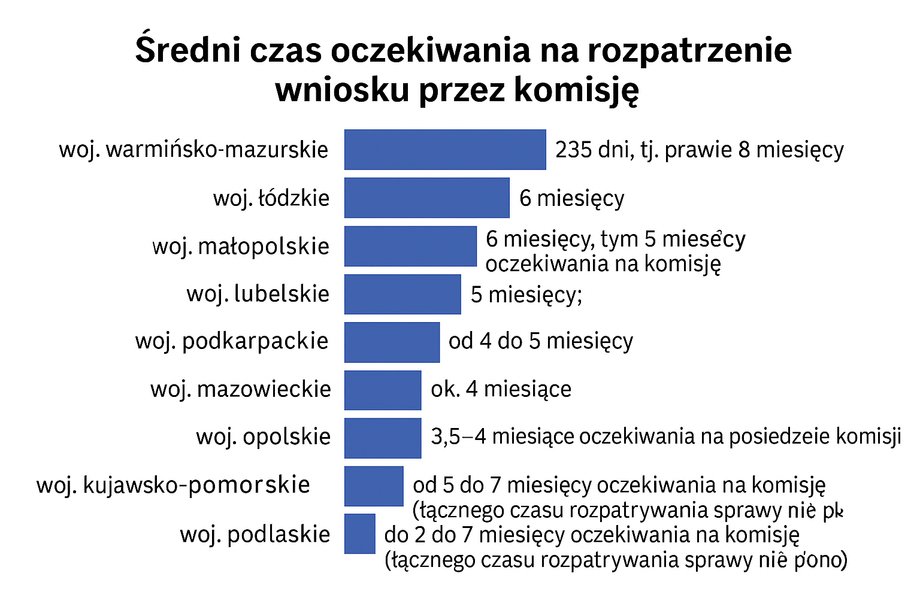
How long does it take for the commission to consider an application for a support benefit?
|
Business Insider Poland
— There are voivodeships that are already close to the statutory deadline, such as the West Pomeranian Voivodeship and the Świętokrzyskie Voivodeship. But there are also those that still require significant improvement in the adjudication process, where the waiting time is still several months – such as the Silesian Voivodeship. We have an appointment with the Silesian Voivode for an urgent conversationduring which he will present us with an action plan to shorten the deadlines and eliminate queues as quickly as possible – comments Nowak.
WZON in Katowice did not send us an official answer as to how many in the province. Silesia is currently waiting for the application for a support benefit to be considered. According to our information, it is on average 10 months – the longest in the entire country.
Read also: Patients wait months for services. “Families share cemetery addresses”
Like putting out a fire with a glass of water
The government's plenipotentiary for disabled people emphasizes that the most important task is the need to strengthen the judicial system. — In 2026, we increased the budget for this purpose by an additional PLN 39 million. We hope that this will translate into shorter waiting times and improved decision quality. We are also strengthening our staff, enabling the employment of new adjudicators and granting authorizations to other people, he enumerates.
However, no one has any doubts: systemic changes are needed. Adding several dozen million zlotys to the budget can be compared to putting out a fire with a glass of water.
So what does the government plan to do?
As Business Insider Polska learns, the disability assessment model is to be rebuilt. However, work in this area is just beginning.
— Consultations are underway to assess the current state and develop new tools. The National Consultative Council for Disabled Persons has started operating – it held its first meeting two weeks ago. A team for supporting services was established. Experts will work on changing the adjudication model to make it more efficient, predictable and sensitive to particularly difficult situations, explains Nowak.
Patients will have to wait for the changes to come into force. The consultations themselves are expected to last several months – then the amendment to the act will be prepared, it will be voted on by the parliament, and it will finally reach the president's desk. And that means that the new rules will not cover more than 200,000 people who are currently waiting for a decision on granting a support benefit.
– Today we are talking at a difficult time, because the problem is real, visible and affecting people here and now, and at the same time, work on its systemic solution is at the beginning stage – concludes Nowak.
10 percent chances of survival, brain metastases. Is a committee a necessity?
One of the key questions is whether there is a chance to change the law so that in extreme and obvious cases patients do not have to meet the commission in person, and medical documentation is enough to issue a decision?
— Current regulations do not provide for automatic granting of benefits on the basis of documents. The reason is simple: within the same disease entities, some people function better, others function much worse. Therefore, adjudication is functional in nature. At the same time, we do not limit ourselves to discussions about simplifications in special situations. We will consider all options that can improve the situation of the most vulnerable people, he replies.
During the conversation, I ask the government representative a question: in the case of Hania, a child to whom doctors gave 10 percent. chances of survival, with brain metastases, was a personal meeting with the committee necessary?
— Supportive benefits are awarded on the basis of the current system, which is based on the assessment of 32 activities of daily living. However, in extreme situations, the current model does not always correspond to the pace of life and disease – it suits me. He adds: – If we decide to change the model, we will be able to take into account other solutions, but we are only at the beginning of the road, and I cannot say at this point what the granting of support benefits will look like after the reform.
Mysterious review and unanswered questions
The “review of the application of the provisions of the Act on Supportive Benefits”, which was carried out last autumn, could help determine the necessary changes. It could if its effects were known. For some unknown reason, the results of the review are shrouded in mystery – they have not been published yet.
I am asking the government representative for disabled people about them. Instead of specifics, I get an enigmatic answer:
— The review was adopted by the Council of Ministers and contains recommendations that are now the basis for further work on changes in the system. I have been an attorney since December. Gets acquainted with the results of previous activities and plans new solutions. I want my work to be transparent and transparent, so with full responsibility for my words, I can assure you that the results of my activities will definitely be published.
Author: Natalia Szewczak, journalist and editorial secretary of Business Insider Polska. Contact: [email protected]