The day of February 9 concentrates events and notable personalities from history, culture and politics, one of the most sensitive moments being the promulgation, in 1945, of the Law for the purification of the press, an act that opened the way for political control over the Romanian mass media in the post-war period.

In 1945, in Romania the law of purging the press was promulgated. PHOTO: Shutterstock
1775: The Hungarian mathematician Farkas Bolyai, originally from Transylvania, was born
Farkas Bolyai, known in the German space as Wolfgang Bolyai, was one of the most important mathematicians of the 18th century and the beginning of the 19th century, with a scientific activity carried out mostly in Transylvania.
He is known above all for his fundamental contributions in the field of geometry, but also for the decisive role he played in the formation of his son, the famous János Bolyai, one of the founders of non-Euclidean geometry.
Concerned with the basic problems of geometry, Farkas Bolyai studied the axiom of parallels in depth, proving its independence from the other axioms of Euclidean geometry and formulating several equivalent statements.
In mathematical analysis, he investigated the convergence of series, formulating, independently of Joseph Ludwig Raabe, an important convergence criterion. He also made significant contributions to the theory of areas, number theory, and the philosophical foundations of mathematics.
1881: Fyodor Mikhailovich Dostoevsky, Russian writer, died
On February 9, 1881, Fyodor Mikhailovich Dostoevsky, one of the central figures of universal literature, died. Novelist, thinker and journalist, Dostoevsky exerted a profound influence on 20th century literature, philosophy and psychology. His work explores themes such as guilt, freedom, faith, suffering and the nature of evil.
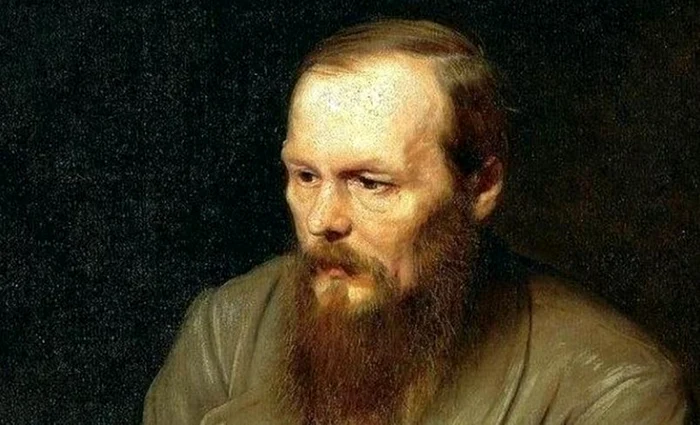
Fyodor Mikhailovich Dostoevsky. PHOTO: Wikipedia
Among his most famous writings are the novels “Crime and Punishment”, “The Idiot”, “Demons” and “The Brothers Karamazov”, considered masterpieces of world literature. In addition to his literary work, Dostoevsky was also an active journalist, involved in political and social debates of the time.
1895: The day volleyball was founded
On February 9, 1895, in the United States, the American educator William G. Morgan officially introduced the game originally called Mintonette, which would later become volleyball. Conceived as a less aggressive alternative to basketball, the new sport was aimed at YMCA members who wanted physical activity without hard contact.
Inspired by tennis, badminton and handball, the game involved sending the ball over a net while keeping it in the air. Thanks to the YMCA network, volleyball quickly spread throughout the world, becoming an Olympic sport in 1964 and one of the most popular sports globally.
1908: Poet and translator Cicerone Theodorescu was born
Cicerone Theodorescu, born in Bucharest, was a poet, translator and journalist, with an intense activity in the press and Romanian cultural life. After 1944, he held important positions in the state's cultural structures, being vice-president of the Writers' Union and editor-in-chief of the “Viata Românească” magazine.
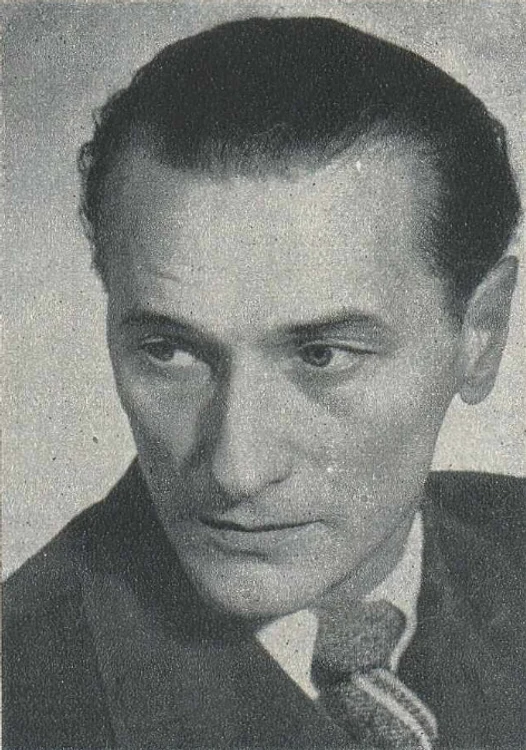
Cicero Theodorescu. PHOTO: Wikipedia
Prolific author, Theodorescu published volumes of poetry, children's literature and folklore works, being awarded the State Prize. He was also an appreciated translator, especially of Russian literature.
1917: Oleg Danovski, founder of modern Romanian ballet, was born
Oleg Danovski, internationally renowned Romanian dancer and choreographer, is considered one of the founders of the Romanian modern ballet school. He performed on prestigious stages such as Balșoi, Scala in Milan or the Metropolitan Opera in New York and contributed decisively to the recognition of Romanian ballet on an international level.
[1945:TheLawforthePurgeofthePressispromulgated
The enactment of the Law for the Purification of the Press, on February 9, 1945, represents one of the most important and controversial moments in the history of the Romanian press. The normative act was adopted in an extremely tense political context, just a few months after August 23, 1944, when Romania broke its alliance with Nazi Germany and sided with the Allies.
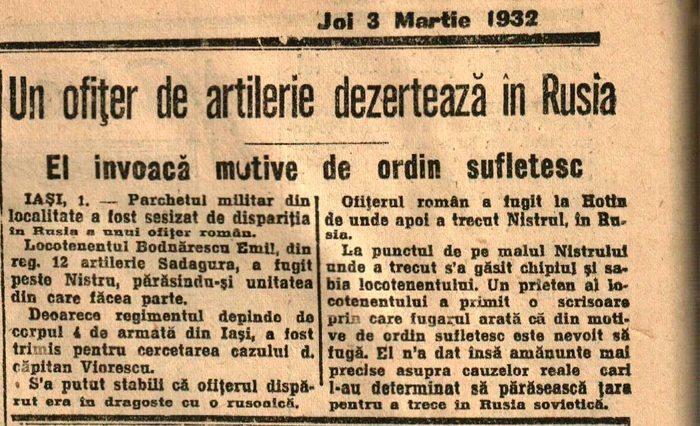
Article from the interwar press. PHOTO: archive
The law was part of an extensive process of “cleansing” state structures, officially justified by the need to eliminate fascist and Hitlerite influences.
In the context in which it was claimed that the press from the period 1940-1944 was a major propaganda tool, supporting the alliance with Hitler, the war against the USSR and anti-Semitic policies, the new regime, installed under strong Soviet influence, considered the press a priority area for purification.
According to the law adopted on February 9, 1945, journalists, publicists and media collaborators were targeted who, before August 23, 1944: supported fascist or Hitler propaganda; they were “stipendized” (paid – n.r.) by the Axis powers or they instigated, through articles or publicity campaigns, violence, terror, extortion and crimes.
The prescribed sanctions included a written reprimand, suspension of activity between 6 months and 5 years and, in cases considered serious, a definitive ban on practicing in the press.
Although the law did not provide for direct criminal penalties, it led to the elimination of numerous journalists from public life and the dissolution or restructuring of important publications, such as the famous “Universul” newspaper.
In practice, the law exceeded the stated purpose of denazification and became a political tool, used to eliminate critical voices and to prepare the transformation of the press into a propaganda mechanism of the future communist regime.
The purge of the press in 1945 was thus one of the first decisive steps towards the loss of freedom of expression in post-war Romania.
[1945:AmericanactressMiaFarrowwasborn

Mia Farrow. PHOTO: Getty Images
Mia Farrow is one of the most famous American actresses, with an impressive career in film and theater. In addition to his artistic activity, he stood out for his involvement in numerous humanitarian actions, being a UNICEF Goodwill Ambassador and one of the most influential public figures of his time.
1957: Miklós Horthy, former regent of Hungary, died
On February 9, 1957, Miklós Horthy, one of the most controversial political figures of Central Europe in the 20th century, died in exile in Estoril, Portugal. Admiral of the Austro-Hungarian fleet and regent of Hungary from 1920 to 1944, Horthy led the country under a right-wing authoritarian regime, established after the collapse of the Austro-Hungarian Empire and the defeat of Béla Kun's Hungarian Soviet Republic.
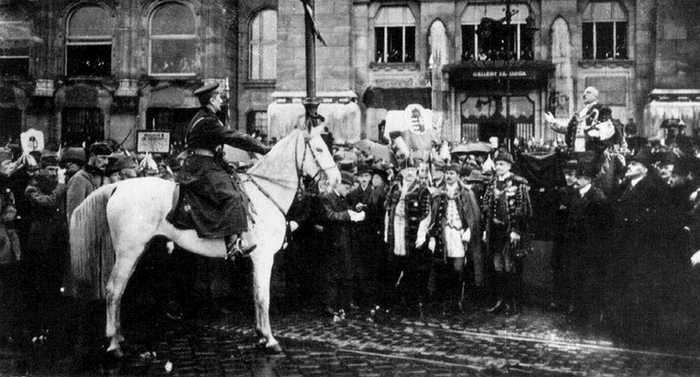
Miklós Horthy's entry into Budapest. PHOTO: Wikimedia
Under his leadership, Hungary pursued the revision of the borders established by the Treaty of Trianon, moving closer to Nazi Germany and Fascist Italy. This policy led to the occupation of some territories, including northern Transylvania, following the Vienna Dictatorship of 1940.
The Horthy regime introduced anti-Semitic legislation and was responsible for the deportation and extermination of hundreds of thousands of Jews, including the Jewish population of the Romanian territories temporarily under Hungarian administration.
After the failed attempt to remove Hungary from the alliance with Germany, Horthy was removed from power in 1944 and placed under German control, and subsequently lived in exile until his death.
1971: The Apollo 14 mission returned to Earth
February 9, 1971 marked the successful completion of the Apollo 14 mission, the eighth mission of the Apollo space program and the third to land humans on the Moon. Launched on January 31, 1971, the mission had as its main objective the exploration of the lunar formation Fra Mauro, an area previously targeted by the Apollo 13 mission, which had failed due to a technical accident.

Alan Shepard, the astronaut who played golf on the moon. PHOTO: archive
The crew consisted of Alan Shepard, mission commander and the first American to fly in space, Edgar Mitchell, lunar module pilot, and Stuart Roosa, command module pilot. During the two extravehicular activities on the lunar surface, the astronauts collected more than 45 kilograms of lunar rocks and samples and conducted important scientific experiments, including seismic studies.
The mission also entered popular culture through the symbolic gesture of Alan Shepard, who hit two golf balls on the surface of the Moon with a makeshift club. The safe return to Earth confirmed the reliability of the Apollo program after the Apollo 13 incident.
1990: The CPUN is established in Romania
On February 9, 1990, the Provisional Council of National Union (CPUN) was established, a temporary body of state power, created in the tense context of Romania's transition from the communist regime to a pluralist political system. The CPUN emerged from negotiations between the National Salvation Front Council (CFSN) and the newly established political parties after the December 1989 Revolution.
Led by Ion Iliescu, the CPUN functioned until June 1990 and had an essential role in the adoption of the electoral law that was the basis for the elections of May 20, 1990, the first free elections after the fall of communism.
2019: The illustrator Tomi Ungerer died
On February 9, 2019, Tomi Ungerer, illustrator, writer and visual artist of French origin, considered one of the most important cartoonists of his generation, died. Born in Strasbourg, in a region marked by conflicts of identity and occupation, Ungerer was deeply influenced by his childhood experience lived in Alsace occupied by Nazi Germany.

Tommy Ungerer. PHOTO: www.tomyungerer.com
Later settled in the United States, Tomi Ungerer distinguished himself with children's books that became classics, but also with satirical illustrations, political posters and cartoons with a strong critical message, especially against the Vietnam War. A contributor to prestigious publications such as The New York Times or The New Yorker, Ungerer was an uncomfortable artist who combined humor, irony and social criticism.
For his lasting contribution to children's literature and illustration, he received the Hans Christian Andersen Medal in 1998, one of the most important international honors in the field.