According to reports by Russian military bloggers who publish on the Telegram platform, the effects on the Russian front are significant. The entire logistics of Putin's army are facing serious problems.
Without a stable satellite connection, transmitting photos from drones in real time to command posts and precise coordination of artillery operations are practically impossible.
Many posts by Russian military bloggers talk about a “huge decline” in command and reconnaissance capabilities. The crisis is hitting Russian troops at a particular time and concerns one key issue.
The Russians are currently preparing for a spring offensive. Particularly affected are units that have significantly changed the way they conduct battles in recent months, switching to commercial drones and flexible data transmission. In this situation, Elon Musk's move is particularly unfavorable for Russians.
According to bloggers' reports, the situation on the front has become much more complicated. Russian engineering corps are now planning to use terrestrial fiber optic lines as an alternative – a throwback to the First World War when communications troops had to lay cables under fire.
The article continues below the video
This situation demonstrates the strategic importance that Starlink has gained in modern conflicts. SpaceX has infrastructure that exceeds government systems in terms of flexibility and reach.
The fact that a single company can decide based on technical parameters which army has stable communications and which does not represents a profound change in the conduct of war.
For Western countries, the Starlink issue is therefore more than just an episode of the war in Ukraine. It shows how much dependence security policy currently has on private, mainly non-European infrastructure.
Europe is working on its own alternative to Starlink, but this is still a distant prospect. The EU IRIS² project is to create a sovereign satellite communications network for civil and military purposes by the end of the decade.
“Russian drones are automatically disabled”
Over the past two months, Putin's army has begun equipping its Geran drones with Starlink antennas. The terminals were allegedly smuggled to Russia through third countries, despite existing export restrictions.
Ukrainian Defense Minister Mikhail Fedorov appealed directly to Elon Musk and demanded SpaceX's intervention. Fedorov has publicly stated that Starlink can no longer be abused by the Russian military.
In response, Musk announced on the social networking site X that he was looking for a technical solution. He then stated that it was not easy because the Ukrainian command also relies heavily on the Starlink system to maintain its digital command structures. So simply turning off the service was not an option.
SpaceX apparently, together with the Ukrainian armed forces, found a way to disable Russian satellite terminals in Ukraine, which Musk later confirmed in a post on X.
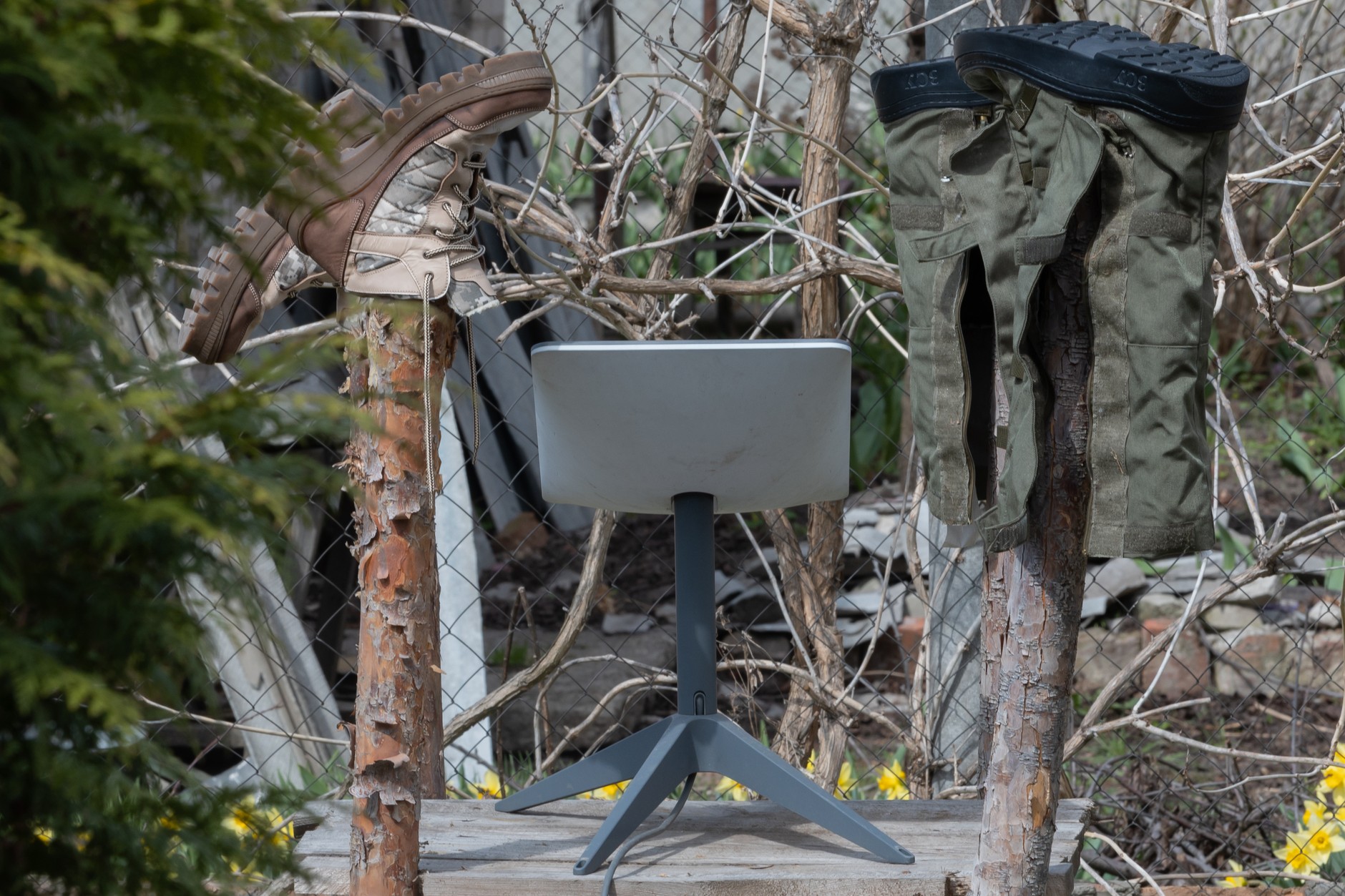
The Starlink system antenna stands in the yard next to wooden poles on which shoes are dried, Kupiansk in Ukraine (illustrative photo)Yan Dobronosov/Global Images Ukraine via Getty Images / Contributor / Getty Images
Firstly, a speed limit for Starlink connections over Ukraine has recently been introduced. Anything traveling faster than 70 km/h loses connection.
As a result, Russian long-range drones, which fly much faster, are automatically disabled. This limit is technically easy to implement because Starlink terminals constantly determine their position and, based on this, speed, in order to optimally position the radio antenna towards the nearest satellite in space despite the movement – which is why this limit has been in force since the end of January.
The second measure, introduced on Wednesday, February 4, has a much broader scope and was more technically complex, which is why it has only now entered into force. From now on, only satellite terminals that have been previously included on the list by the Ukrainian authorities and armed forces can connect to the Internet in the occupied territories and the wide frontal zone.
In recent weeks, Ukrainian troops have already registered the antennas they use, and now all other equipment has been disabled. In this way, Musk excludes all smuggled terminals.
I’m Ashley Davis as an editor, I’m committed to upholding the highest standards of integrity and accuracy in every piece we publish. My work is driven by curiosity, a passion for truth, and a belief that journalism plays a crucial role in shaping public discourse. I strive to tell stories that not only inform but also inspire action and conversation.