The highway that opens the gates of Făgăraş. The amazing places at the foot of Romania's highest mountains

The A13 Sibiu – Făgăraș highway, located in the construction site, promises to boost tourism in one of the most spectacular areas of Romania, Ţara Oltului, the place from where the journeys to the peaks of the Făgăraș Mountains begin.
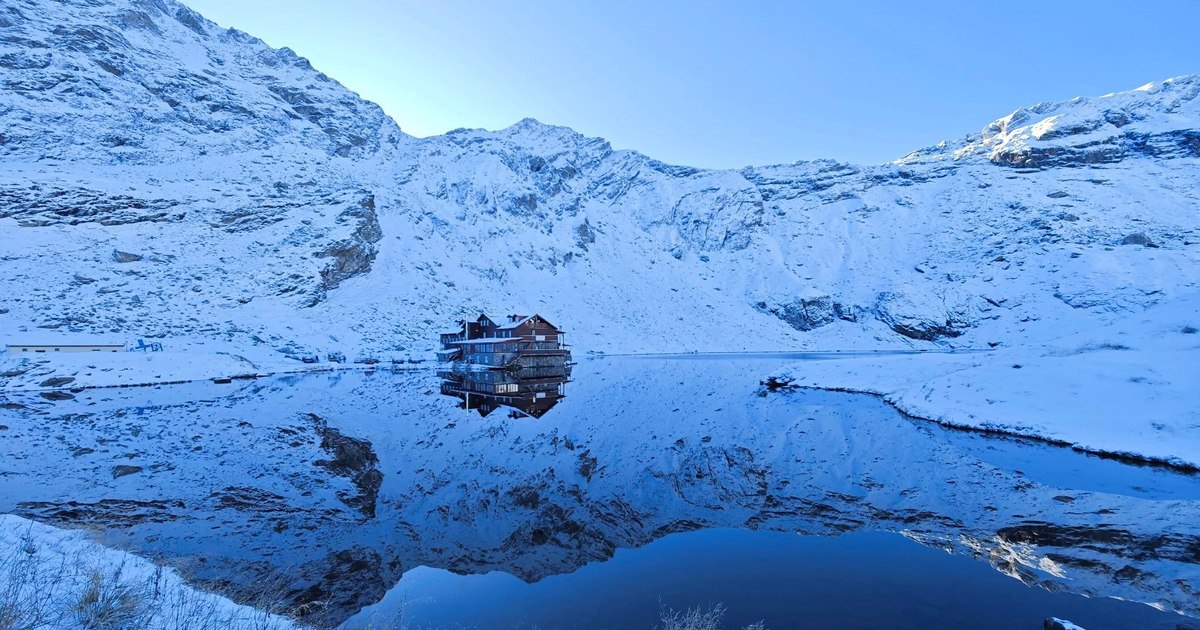
Lake Bâlea from Făgăraş. Photo: Marius Turc.
The Făgăraș Mountains, with the highest alpine ridges in Romania, stretch from west to east, like a “spine” of the Carpathians, over a distance of over 70 kilometers, between the counties of Sibiu, Argeș and Brașov.
Eight of the peaks of Făgăraș rise to over 2,500 meters, the highest of them being Vârful Moldoveanu, with an altitude of 2,544 meters. The peaks, clad in snow for most of the year, appear on the horizon for travelers as they approach Sibiu on the A1 Highway from western Romania.
The junctions of the highway, gates to the Făgăraș Mountains
Beyond Sibiu, the Oltului Gorge, guarded by the town of Turnu Roșu, marks the western edge of Făgăraș.
To the east, the city of Făgăraș, the Piatra Craiului Mountains and the Rucăr–Bran Corridor outline the other end of the massif. In “Tara Oltului”, the name given to the depression in the north of the Făgăraș Mountains, travelers find the main “gates” to the ridges and glacial lakes of the massif: the localities of Avrig, Porumbacu de Sus, Cârtisoara, Arpașu de Sus, Victoria, Sâmbăta de Sus, Lisa and Făgăraș.
The region at the foot of the Făgăraș mountains is crossed by the Olt river and the National Road 1 Sibiu – Brașov, and in the coming years it will also be crossed by the A13 highway. The future Sibiu – Făgăraș highway, with a length of approximately 70 kilometers, starts from Boita and will have six road junctions, at Boita, Avrig, Arpașu, Sâmbăta, Ileni and Făgăraș.
All of them will be able to be used as access points for tourist routes in Făgăraș, one of the least populated mountain areas in Romania.
With the completion of the highway, estimated for 2027 – 2028, road traffic on DN1 Sibiu – Brașov, one of the most congested national roads, will be reduced, local residents' access to Sibiu will be easier, and the Făgăraș Mountains will become closer to tourists, through the settlements at their foothills.
Valea Avrigului, the entrance to Făgăraș
The towns in Ţara Oltului were established in the early Middle Ages, the ones closest to the mountains being, in the past, pastoral settlements of the Romanians, settled at the foot of Făgăraș. In the 12th-13th centuries, Saxon settlers were also settled in the northern part of the region, brought by the kings of Hungary to defend the borders of Transylvania.
In the 20th century, some localities, such as Avrig and Victoria, were industrialized, while others, such as Arpașu, Porumbacu, Sâmbăta de Sus or Cârțișoara, kept their mountain and pastoral characteristics.
The construction of Transfăgărășan, the road that crosses the mountains at over 2,000 meters, connecting the historical regions of Transylvania and Muntenia, boosted tourism in the area, and in the 21st century the communities invested more and more in attracting tourists. The settlements at the foot of Făgăraș have gradually left behind their industrial and pastoral past and are increasingly relying on tourism.
The town of Avrig, in Sibiu County, has less than 12,000 inhabitants and has developed in the last two centuries thanks to its glass factory, attested since the 17th century, according to some historians. Its historic center has preserved buildings with a typical Saxon architecture, and its emblem is the 18th-century Brukenthal Palace, the summer residence of Baron Samuel von Brukenthal.
“It is a wonderful and historic place, which was once considered the Eden of Transylvania, and it has the shape of the Schönbrunn Palace in Vienna, because it was designed by the same architect at the time. The palace is a miniature, seven times smaller than the original.” show the palace administrators.
During the Ceaușescu regime, almost 1,500 people worked at the local factory in Avrig, and several housing blocks and non-familial dormitories were built for the workers.
In the vicinity of the city, another workers' colony had been established in Mârşa, to accommodate the families of the more than 2,000 employees of the Mârşa Mechanical Plant. Dump trucks, trailers, tanks and industrial machinery used on the Danube–Black Sea Canal site were manufactured here.
In recent years, in Valea Avrigului, at the foot of Făgăraş, amusement parks have been established, as well as numerous guesthouses and leisure places. From the Avrig Valley, tourists can climb to the Avrig glacial lake, located at over 2,000 meters above sea level, below some of the highest peaks of the massif.
Transfăgărășanul, the road that crosses Făgărășul
Located near the future highway junction from Arpașu, the town of Cârțișoara is crossed by Transfăgărășan (DN7C), before the mountain road, which connects Argeș and Sibiu counties, enters the alpine area of the Făgăraș Mountains. Cârțișoara, like the neighboring villages of Arpașu de Sus and Porumbacu de Sus, is an area with a tradition of animal breeding, which has become increasingly attractive for tourism investments.
From Cârtisoara, travelers climb to the Bâlea Waterfall and the Bâlea caldera, reaching an altitude of 2,042 meters, near Lake Bâlea. After crossing the Bâlea-Capra mountain tunnel, the route descends towards Argeșului Valley, past Vidraru Lake and Poenari Citadel, to the famous Curtea de Argeș monastery.
Transfăgărășanul was built in the 70s, with immense efforts and the mobilization of numerous Romanian soldiers, and was inaugurated in September 1974 by Nicolae Ceaușescu, before the works were fully completed.
Currently, the mountain road is considered one of the most complex road infrastructure works carried out before 1990, due to the difficult mountain topography. It can only be used for a few months a year because the alpine area is exposed to avalanches, frost and rockfall. However, from Bâlea Waterfall, tourists can go up to Bâlea Lac by cable car, in any season.
Victoria, the industrial city built from scratch
The city of Victoria, in Brașov county, developed around an explosive powder factory, opened in its vicinity, in Ucea, during the Second World War. In the early 1950s, a chemical plant was established here, and a completely new city was built around it, with neighborhoods that copied the model of Soviet mono-industrial cities.
“On November 6, 1949, the first shovel of earth was thrown. The signal was given to start the battle to build the city. The city of Victoria is unique in its way. It is the first time that the design of a completely new city is finalized and its construction begins on several fronts.” informs the publication Apararea Patriai.
In the following decades, the city's population grew to more than 10,000 inhabitants, most of whom were workers employed at the Chemical Plant. Currently, Victoria has less than 6,500 inhabitants, is less industrialized and has remained a tourist landmark, being the starting point for hiking to some of the highest mountain peaks in Romania – Negoiu and Moldoveanu – in the Fagaras Mountains.
The monastery of Arsenie Boca at the foot of Făgăraş
Located in the vicinity of the city of Făgăraș, the commune of Sâmbăta de Sus (Brașov county) is a landmark of tourism in the Făgăraș Mountains, but also a well-known place of pilgrimage, thanks to the Brâncoveanu Monastery.
The monastery in the Făgăraș Mountains was built at the end of the 17th century by the family of ruler Constantin Brâncoveanu. The settlement impresses with its architecture, being the only historical place of its kind built in Transylvania in Brancove style.
The popularity it has gained in recent decades is largely due to Father Arsenie Boca (1910–1989), former abbot of the monastery in the 1940s. After, in 1939, he lived several months of monastic life at the monasteries on Mount Athos, the young deacon Arsenie Boca became a monk and then abbot of Brâncoveanu Monastery. Arsenie Boca quickly won the hearts of the faithful, including the members of the Royal House of Romania, who frequented the settlement, but also other personalities of the era. In the 40s, the monastery in the Făgăraș Mountains had become the site of the “Arsenie Boca phenomenon”, attracting crowds of pilgrims.
Arsenie Boca served at the monastery in the Făgăraș Mountains until 1948, when he was arrested by the communist authorities, imprisoned for several months and “exiled” to the Prislop Monastery in Hunedoara. The fame of the austere monk, linked to these places, continues to attract many believers even today.
The city of Făgăraş, in the heart of Romania
The city of Făgăraș (Brașov county), with about 30,000 inhabitants, is located in the middle of the distance between Sibiu and Brașov, in the center of Romania. The town on the Olt Valley owes its name to Romania's highest mountains and the road that crosses them, but those who visit it discover here one of the best-preserved medieval fortresses in the country.
Five centuries old, the Făgăraș Fortress was in the past a princely residence, but also a prison intended for opponents of the communist regime. Currently, it is a museum and impresses with its massiveness. High and solid walls, surrounded by a moat, now populated by swans and wild ducks, made it extremely difficult to conquer.