
EU agreement with the “hardest negotiator in the world”. It's not Trump at all

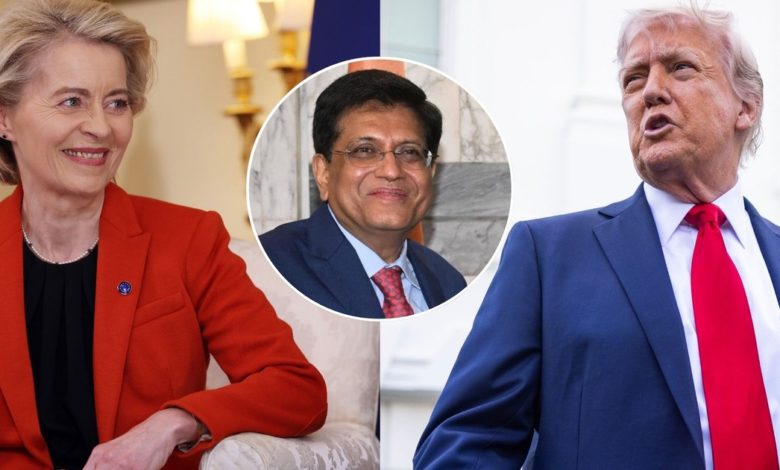
“The countries are queuing up to cooperate with us,” said Politico chairwoman of the European Commission Ursula von der Leyen.
Since the approval of her second term in the EC in December, von der Leyen has completed talks on the long -awaited agreement with the Latin American block Mercosurwhich she has previously opposed, among others Poland, called for the conclusion of the “largest such in the world” of free trade agreements with this year India And she began or resumed talks with Australia, the Philippines, Malaysia, Thailand, the United Arab Emirates and other countries.
Here are some of the most interesting contracts that would amount to trade cooperation (and profits) of the EU with the world to a new level.
Mercosur
Why does it matter? Within a week of swearing in her second committee in December, von der Leyen flew to Montewideo in Uruguay to embrace the hand to the leaders of the Mercosuru countries – Argentina, Brazil, Paraguay and Uruguay – on the agreement that would create a market covering over 700 million consumers on both sides of the Atlantic.
What stands in the way? European farmers, especially in France, are still fiercely opposing the contract, which was worked on for a quarter of a century, fearing competition from cheap imported products from South America. French political leaders took a position against the contract with Mercosur, but Poland, Belgium and Ireland also express opposition.
Farmers cannot be convinced, despite the fact that the contract provides for low importing quotas for products such as beef, poultry and sugar. Added to this is the issue of extinguishing, especially in the case of Brazil, where some are afraid that companies can try to bypass the EU regulation on extinguishing (EUDR).
Is there a chance that this will happen in the near future? Trump's total trade war changed the debate on Mercosuru, leaning some countries that were previously skeptical, such as Austria, to move to the camp's supporters to the camp. Even France seems to hesitate, and the Minister of Trade Laurent Saint-Martin told Politico that Trump's trade war is a “alarm signal for trade contracts”. However, he still maintains that the agreement with Mercosur is unacceptable in its current form.
The opportunity will appear after the presidential election in Poland, which currently exercises the rotational presidency of the EU Council. Voting in the council will take place in September or October, chaired by Denmark, and the final signing of the contract is expected at the end of the year.
Assessment of the chances of concluding a contract: four out of five stars.
India
Why does it matter? In February, von der Leyen flew to India together with the new college of commissioners to present a free trade agreement, which she called “the largest agreement in the world”. It would create a common market covering almost 2 billion people, bringing India to their largest trading partner, which is the EU.
Considering that India is on the right track to become the third largest world economy until the end of the decade, it is not surprising that von der Leyen has set itself the goal of finalizing the contract this year as part of its diversification program.
What inhibits this process? If the past taught us something, then that the EU must approach the free trade agreement with India in a rational way. In 2013, the agreement collapsed after six years and 15 rounds of talks, in an atmosphere of European frustration related to the market access in sectors from automotive to alcoholic. In 2021, conversations that got stuck in a point were taken again, and Their effect is a three -sided trade agreement, which is to terminate issues such as the high duties of India for imported cars.
The main negotiator of Prime Minister Narendra Modi, Minister of Trade Piusz Gojal, gained a reputation of the hardest trading negotiator in the world. Another delicate issue for New Delhi is a carbon dioxide emission tax planned by the EU, in a connection with which Gojal is threatened with the introduction of a retaliation fee, which, he claims, will be a “funeral march for the production industry in Europe.”
Chances for a quick agreement? Both von der Leyen and Modi made it clear that they want to finalize the contract this year – which is an ambitious goal if experience taught us something. However, in the face of Trump's pressure on India, to open their market, New Delhi strives for less forced and more consensus trade relations. Modi will also want to play Washington and Brussels against himself to get the best conditions. Gojal is to come to Brussels on May 1-2 on the second visit to 2025, before the next round of formal conversations that will take place on May 12-16 in New Delhi.
Assessment of the chances of agreement: Three out of five stars.
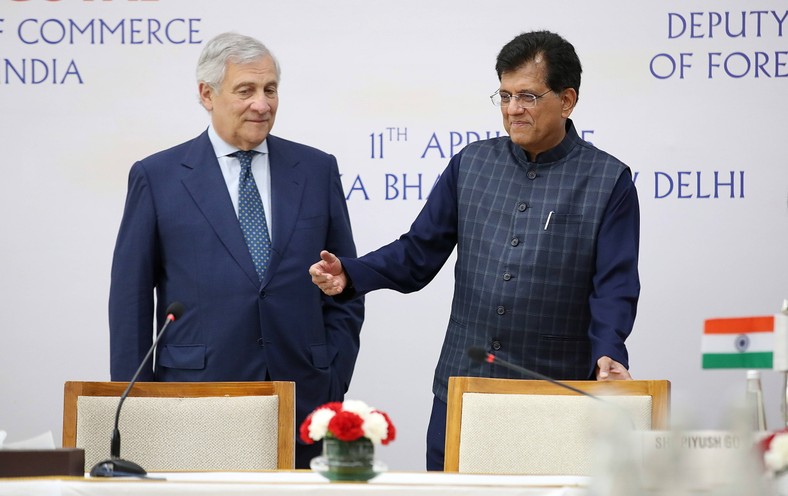
Foreign Minister of Italy Antonio Tajani (L) and Minister of Trade and Industry India Piusz Gojal during a press conference after a meeting in New Delhi, India, April 11, 2025.
Australia
Why does it matter? Negotiations between Australia and the EU began in 2018 and so far 15 rounds have been held. The conclusion of the contract would increase the Union GDP by around EUR 4 billion [17 mld zł]. The EU is the third largest trade partner of Australia in the field of goods, ahead of the United States and the second in the field of services. Brussels, however, remains in an adverse situation when it comes to trade with Australiabecause competitors such as Japan and Great Britain use preferential access under a comprehensive and progressive transpection partnership agreement (CPTPP).
What inhibits progress? Beef and lamb. The talks broke down just before the finish in October 2023, when the Australian Trade Minister Don Farrell left the negotiating table, complaining about the lack of access to the EU market. The European Commission replied at the time that the Australian side again presented demands on agriculture, which in its opinion “did not reflect recent negotiations and progress achieved by high -ranking officials.”
Australian farmers still want more access to the EU market, but commission trade negotiators have a small room for maneuver due to the European agricultural lobby, which is against trade liberalization. Geographical markings are another disputed issue, as a result of which Australian producers would lose the right to naming products such as Prosecco, Feta and Parmigiano Reggiano.
Chances for a quick agreement? Parliamentary elections in Australia, which will take place on May 3 and will probably end with the victory of the current Prime Minister Anthony Albanese, can give a signal to start new negotiations. Farrell, a man who ruined the EU agreement in 2023, now claims that “the world changed” after Trump's customs offensive.
Even Australian farmers say that if the EU wants to meet his role in trade, he must go from words to deeds and lead to the conclusion of a contract. At the beginning of this month, Farrell talked with Maros Sefcovic, the main commercial negotiator of the EU, and claims that they both agreed to the meeting shortly after the election.
Assessment of the chances of agreement: four out of five stars.
Indonesia
Why does it matter? Indonesia is the largest economy of the Association of Southeast Asia Nations (ASEAN)-a regional trade community-and the fourth in terms of population country in the world. However, her EU trade relations are incomparably weaker. The EU is the fifth largest trade partner of Indonesia, but despite its size, Indonesia is not even in the first thirty EU trade partners. This means unused potential.
What inhibits progress? Talks over the past decade have been at least turbulent, and large many times went to the World Trade Organization (WTO). Jakarta hoped to end the conversations before taking power by the new government in October, but it turned out to be too ambitious.
The Union wants Indonesian nickel ore for its steel and automotive industry, but Indonesia banned its export, which the EU effectively questioned in the WTO. Jakarta also demands greater freedom within Eudr, which aims to prevent it from preventing the cultivation and would affect its palm oil industry. The EU will not go away.
Is there a chance that this will happen in the near future? After the 19th round in July last year, the 20th round is not planned. The very number of rounds shows how much this process is prolonged, and the negotiators have not been able to reach agreement for almost ten years.
Assessment of the chances of agreement: two out of five stars.
Southeast Asia (Philippines, Malaysia, Thailand)
Why does it matter? The EU also intensifies the efforts to strengthen ties with other ASEAN countries – resumes suspended commercial talks with Malaysia, Thailand and the Philippines. All these countries include the EU as their main trading partners. These actions are taken when the alliance tries to catch up with its rivals in the region, such as China and the United States.
With a market covering over 660 million consumers, 10 ASEAN countries are the third largest EU trade partner outside Europe, after the United States and China. Malaysia is also a member of CPTPP, which can strengthen the EU's aspirations to join this agreement, given that Great Britain is already a member of this trade alliance.
What inhibits this process? Misunderstandings regarding the Palm oil industry in Malaysia, the second largest in the world, led to the suspension of the contract in 2013 – as in the case of Indonesia, Eudr and concerns about sustainable practices became the dispute point.
In the case of the Philippines, concerns about human rights violation by the previous prime minister Rodrigo Duterte and his hostility towards the West led to the breaks of conversations, which were resumed in 2023 after Duterte's resignation. Similarly, the military coup in Thailand in 2014 caused the EU to suspend conversations.
Chances for a quick conclusion of the contract? The Prime Minister of Malaysia Anwar Ibrahim visited Brussels in January to press the conclusion of the contract. Brussels expects the first round of negotiations before the summer or in the second half of 2025. The Minister of Malaysia Tengku Zafrul expects the end of the talks next year.
Negotiations on the free trade agreement with the Philippines and Thailand are progressing, and the next rounds are scheduled for June – Brussels will host conversations with the Philippines, and the EU delegation will go to Bangkok to negotiations with Thailand. Several chapters in each negotiations have already been pre -agreed.
Assessment of the probability of the conclusion of the contract: three out of five stars.


