2026-01-20 22:18
publication
2026-01-20 22:18
After an extended weekend, the New York stock exchanges were only able to react on Tuesday to Saturday's threats from President Trump, who announced the introduction of tariffs on European countries opposing the takeover of Greenland. The reaction was not limited to the stock market. The dollar and Uncle Sam's treasury bonds also suffered.
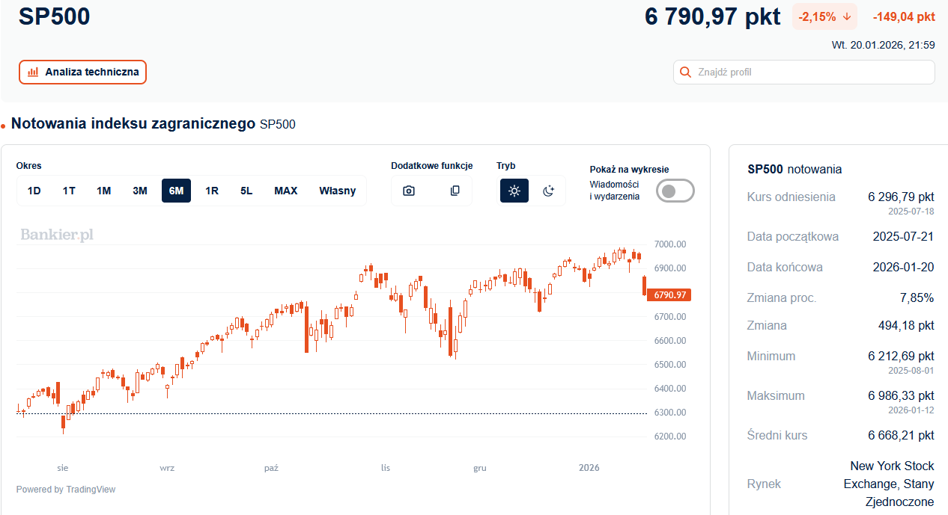
Such steep declines have not been seen on Wall Street since October. The S&P500 index fell by 2.06% and ended Tuesday's session at 6,796.86 points. The Nasdaq fell by 2.39% and finished with a score of 22,954.32 points. Dow Jones gave up 1.76% and stopped at 48,488.77 points.
What was significant was the nearly 30% jump in the VIX volatility index, commonly known as the “fear index.” It measures the increase in the implied volatility of an option and indirectly reflects changes in demand for instruments hedging against declines in stock prices. But at the same time, the nominal value of the VIX itself (20.32 points) still remains very low.
It is worth noting that the valuations of virtually all American assets went down. The dollar lost significantly against the euro for the second day in a row. However, the yields on US government bonds increased, which signals a decline in their market prices. This is starting to resemble the investment scheme known a year ago called “sell America”.
A year ago, it was a reaction to the massive import tariffs introduced by President Trump's administration. Then, investors massively got rid of American stocks, the dollar and bonds, moving their capital to Europe. Virtually everything is falling now, but simultaneous declines on Wall Street and the decline in Treasuries accompanied by a weakening dollar are a rare combination.
This is because financial markets are afraid of further unpredictable moves by the American leader. And their economic consequences. Over the weekend, the dispute over control over Greenland, which has only been rhetorically clarifying, dangerously touched upon customs issues. Donald Trump announced that additional tariffs would be imposed on products from eight European countries that openly supported Denmark in the dispute over the world's largest island. Unlike a year ago, Europeans are not in debt and are already threatening to retaliate against the US. This means a risk of resuming the trade war between formal NATO allies.
– On the other side of trade deficits and trade wars, there are capital wars Ray Dalio, founder of Bridgewater Associates, said on CNBC's “Squawk Box” during the World Economic Forum in Davos, Switzerland. – If we take conflicts into account, the possibility of capital wars cannot be ignored. In other words, maybe there's not the same propensity to buy U.S. Treasuries and so on, Dalio added.
Investors fear that we may be facing a repeat of the entertainment that Trump's team provided the markets almost exactly a year ago. Then the declines on Wall Street began in mid-February, escalated in March and exploded in early April after the so-called Liberation Day. Now, in addition to strictly economic issues, there are new territorial aspirations of the White House in the form of the desire to annex Greenland and perhaps even Canada (which the US president seems to suggest).
Let's also not forget that the season for publishing reports for the fourth quarter is just getting started on Wall Street. So far, 33 companies from the S&P500 index have reported results and 85% of them exceeded the market consensus of earnings per share. But on Tuesday, the industrial conglomerate 3M, which, due to the scale and industry scope of its operations, is sometimes called the “economy in a nutshell”, was a major disappointment. 3M shares fell by nearly 7% after the company disappointed with its full-year earnings forecast.
K.K