At 50, Kristin McGee looks and feels better than ever. It's not about lucky genes or some extreme diet. Her secret? A combination of Pilates and weight training – two different methods that complement each other wonderfully.
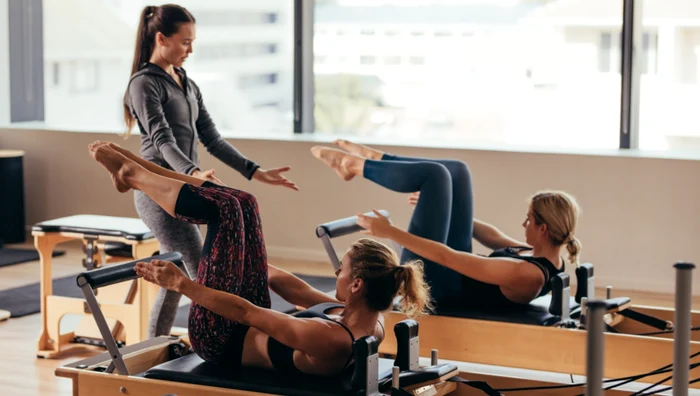
Photo credit: Shutterstock
McGee isn't just into fitness. Mother of three, entrepreneur and certified Pilates and yoga instructor with over twenty years of experience, she has seen fitness trends come and go. Some disappeared as quickly as they appeared. Her approach has remained consistent, and more importantly, it works.
“Pilates helps you control your movements, and weight training gives you strength. Combined, it gives you long-term mobility, strength, balance and endurance” she explained. “Basically, you build your strength from within,” she explains to MindBodyGreen.
If you've ever thought you had to choose between Pilates and weight training, Kristin has good news: you don't have to. In fact, the two work much better together than apart.
Think of it this way: Weight training builds strength and muscle mass, strengthens bones, and speeds up your metabolism. Pilates, on the other hand, refines the way you move, giving you control, stability and a deep awareness of your body in space.
“Pilates will always be the foundation for me,” says McGee. “It aligns my body, helps me breathe properly and have stability in my movements, feel strong and balanced. At the same time, weight training brings strength, intensity and metabolic benefits that we, especially women, need as we age.”
At 50, McGee talks freely about age. Well, he really considers it an advantage. “When I was in my 20s and 30s – I trained for looks and creativity. Now I do it for longevity, energy and hormonal balance. Everything has completely changed,” she says.
According to its statements, Pilates gives you stability, corrects your posture and helps you move more efficiently in your daily life, while weight training develops muscles, strengthens bones and speeds up your metabolism. “Together, they help you have a body that not only looks good, but functions flawlessly for years on end.”
How Pilates helps you lift more pounds
Have you ever felt like you lose your balance when doing squats or can't maintain proper form when lifting weights with a straight back? Pilates may be just what you're missing.
Everything starts from the center of the body – the abdominal area and the lower back. We're not talking about “magazine abs,” but the muscles that support your spine and protect you while lifting weights. When these muscles are strong, you can lift heavier weights with less risk of injury.
Pilates also helps you in a more subtle but equally important way: it increases your awareness of your body in space, what specialists call proprioception. Here, McGee says, the effects are felt immediately: you maintain your posture, execute each movement with more control, and feel secure throughout your workout.
“The exercises I suggest help the body stay flexible and strong without excessive strain,” says McGee. “I include them in all of my workouts: dynamic warm-ups, spinal exercises, joint movements, and stretches. When people do them consistently, the results appear quickly: muscle soreness decreases, strength increases, posture improves, and the body is in balance.”
Studies back it up: Research recently published in the Journal of Sports Science & Medicine shows that participants who started practicing Pilates reported significant improvements in balance, coordination and movement precision.
Why weight training makes you better at Pilates
Just as Pilates refines your technique and posture, weight training empowers you to do more complex and demanding movements. So, according to the specialist, more muscle mass means you can hold positions for longer and move with more power, which makes Pilates practice more dynamic and satisfying.
In the long run, adds MindBodyGReen's Kristin McGee, the benefits go much further: preserving muscle mass is one of the surest indicators of healthy aging.
In addition, lifting weights also offers a mental advantage: the visible progress and the way the body adapts gives you a feeling of strength and self-confidence that is felt not only physically, but also mentally.
How to combine Pilates and weight training. Practical guide
“Start with two to three Pilates sessions and two to three weight lifting sessions per week. You don't have to do them on the same day, and it's not recommended.” McGee explained. “Adjust the number and intensity of these depending on your schedule and how quickly you recover from your workouts.”
McGee stresses that recovery is key when combining Pilates with weight training. Both types of exercise are demanding, so it's important to pay attention to nutrition, hydration and rest. For those who exercise frequently, amino acid supplements can support muscle recovery.
Pilates can also be used as a form of active recovery. “After an intense workout, a gentler Pilates session helps stimulate circulation and maintain mobility without overtaxing the body.”
Another thing McGee highlights is the importance of doing the exercises correctly. Whether you're using the Pilates machine (reformer) or lifting weights, it's more about how you do the movements than how many repetitions you do. In the beginning, the specialist recommends, a certified instructor can guide you to do the exercises correctly and avoid injuries, so that you can progress safely.
When you don't have time (or think you don't)
“I make time for exercise throughout the day, I don't wait for a perfect hour,” McGee confesses. “Ten minutes of Pilates early in the morning before the whole family wakes up. A short circuit of weightlifting between meetings. Yoga, a longer stretch in the evening, after the kids are asleep. Movement is my daily anchor, not an item on a to-do list.”
As a mother and entrepreneur, McGee is aware that real life is not like the one on the pages of magazines. That's why her advice is simple and practical: “Don't put pressure on yourself and focus on consistency. You don't need long or spectacular workouts to get stronger. Five minutes makes a difference. And ten minutes makes a difference. The body responds to frequency.”
It's a change of perspective. Instead of feeling guilty about missing “that perfect 60-minute workout,” it's important to appreciate yourself for at least doing something for your body. “Any type of movement is better than none. In the long run, consistency outweighs intensity.”
For McGee, the motivation to exercise is no longer about what she sees in the mirror, but how she wants to feel in her 60s, 70s, or 80s. “I'm totally OK talking about age, and I'm actually proud of it. At 50, my perspective on strength has completely changed. Muscle isn't just for looks, it helps you have an active and healthy future. It protects your bones, supports your joints, keeps your metabolism working, and helps you stay independent and active for as long as possible.”