“It's not a pleasant place.” Astronomers have obtained the clearest image yet of an exoplanet. What we know about Kua'kua

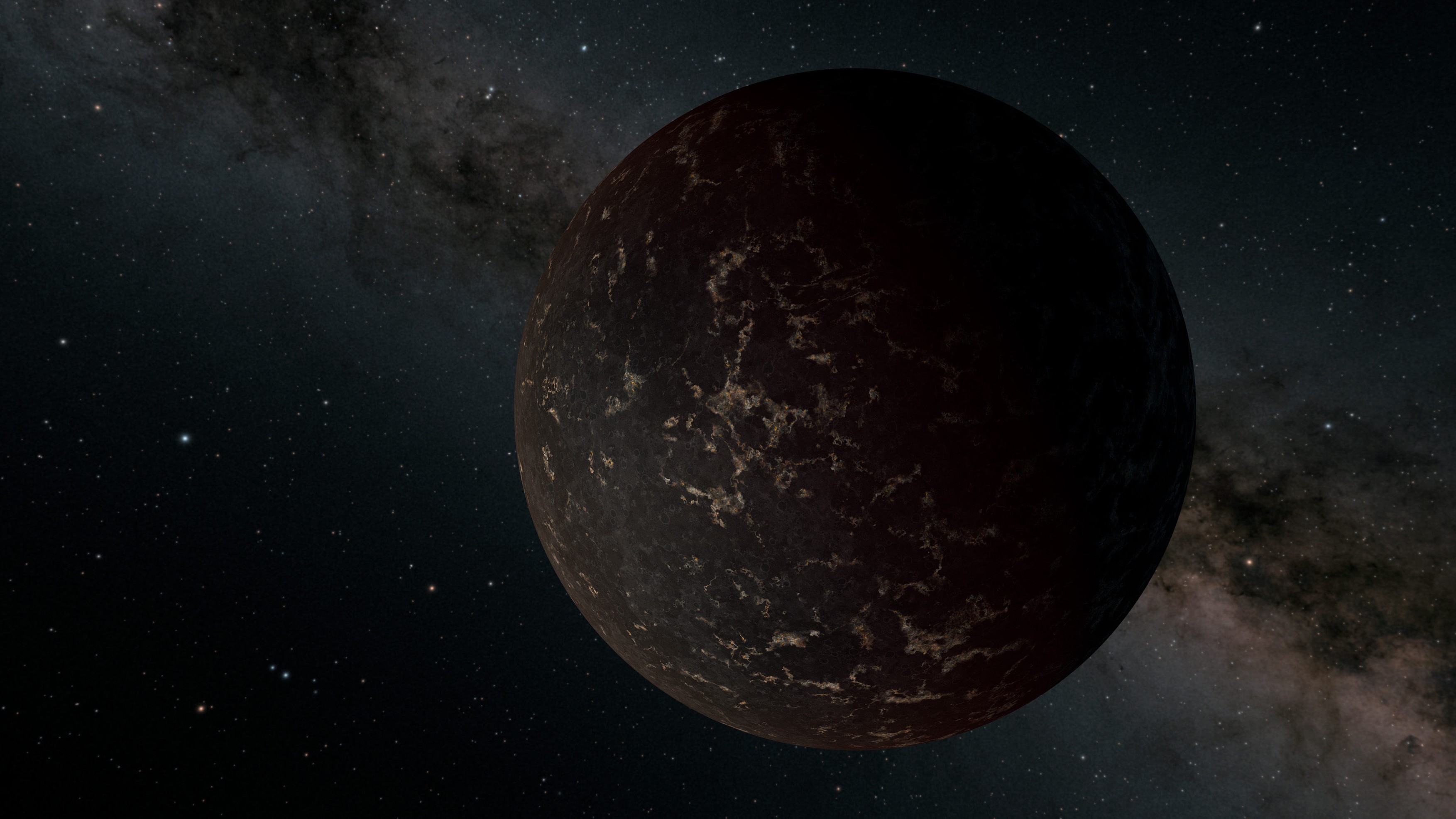
Astronomers have obtained the clearest view yet of the surface of an exoplanet — a planet beyond our solar system — thanks to NASA's James Webb Space Telescope, Reuters reports.
Webb collected data on a rocky exoplanet about 30% larger in diameter than Earth, data that indicates it is a barren, atmosphereless world whose surface may resemble that of Mercury, the closest planet to the Sun in our solar system.
The lack of a visible atmosphere and its extreme temperatures – extremely hot on one side and freezing on the other – appear to make it uninhabitable.
“It is a hellish and barren rock”
The planet is called LHS 3844 b, or Kua'kua, the word for butterfly in an indigenous language spoken in Costa Rica. It orbits a star smaller and less luminous than the Sun, located about 49 light-years from Earth.
“This planet is not a pleasant place,” said astronomer Laura Kreidberg, director general of the Max Planck Institute for Astronomy in Germany and lead author of the study published this week in the journal Nature Astronomy.
“It's a hellish, barren rock—much more like Mercury than Earth. There's no trace of an atmosphere. Instead, we see a dark, probably ancient surface. Imagine a bare rock hurtling through space for billions of years. You wouldn't want to go there,” Kreidberg said.
The observations suggest an ancient planetary surface covered in dark regolith—fragmented and loose rocky material covering solid bedrock, the result of eons of continuous bombardment with stellar radiation and micrometeorite impacts.
Everything is due James Webb Space Telescope
Webb, which was launched in 2021 and became operational in 2022, enabled revolutionary advances in understanding exoplanets. Its robust infrared observing capabilities have helped discern the chemical composition and internal dynamics of exoplanet atmospheres, even showing what kind of clouds are present.
Webb now allows astronomers to directly study the geology and surface composition of exoplanets, said astronomer and lead study author Sebastian Zieba of the Harvard & Smithsonian Center for Astrophysics in Massachusetts.
“This was very difficult before the James Webb Space Telescope. So this puts the Earth and the solar system as a whole into a larger context, allowing us to check whether the processes or surface compositions known in the solar system are also common around other stars,” said Zieba.
“It's like we've suddenly cleaned our glasses and can see the planets clearly for the first time,” Kreidberg added.
What we know about Kua'kua and its solar system
The star around which Kua'kua orbits is a common type called a red dwarf. Its mass is about 15% of that of the Sun, and its luminosity about 0.3%. Kua'kua is extremely close to the star, orbiting it once every 11 hours.
It is also “locked”, meaning that one side is always facing the star and the other side is always facing the opposite direction, as is the case with the Moon relative to the Earth.
The surface of the illuminated face of the planet – permanently heated by the star – has a temperature of about 725 degrees Celsius. No heat was detected on the “dark side” of the planet.
Webb allowed the researchers to detect light – specifically the infrared region of the electromagnetic spectrum – coming directly from the planet's surface.
“Different rocks have different spectral signatures, as do atmospheres. Dark volcanic rocks like basalt matched our observations much better than brighter, silicon-rich rocks like granite,” Zieba said.
The surfaces of Mercury and the Moon are dominated by basalt.
Another possibility that matched the observations was a solid surface of relatively recent volcanic rock, but the researchers looked for gases related to volcanic activity, such as sulfur dioxide, and found none.
Without an atmosphere, protection against stellar radiation or charged particles from the star is reduced, and liquid water, considered fundamental to life, has no chance of existing.
“So overall, it's almost certainly not a habitable world,” Zieba said.