The current public discussions about the deployment of Western troops in Ukraine are counterproductive to the negotiations between Moscow and Kiev on a truce, writes German political scientist Andreas Umland in an opinion piece hosted by HotNews. He believes that the debates about the deployment of a “European reassurance force” in Ukraine distract from much more important issues.
- Andreas Umland studied political science and history in Berlin, Oxford, Stanford and Cambridge, is an associate professor at the Department of Political Science of the Kyiv-Mohyla Academy (NaUKMA) and an analyst at the Stockholm Center for East European Studies (SCEEUS) of the Swedish Institute of International Relations (UI).
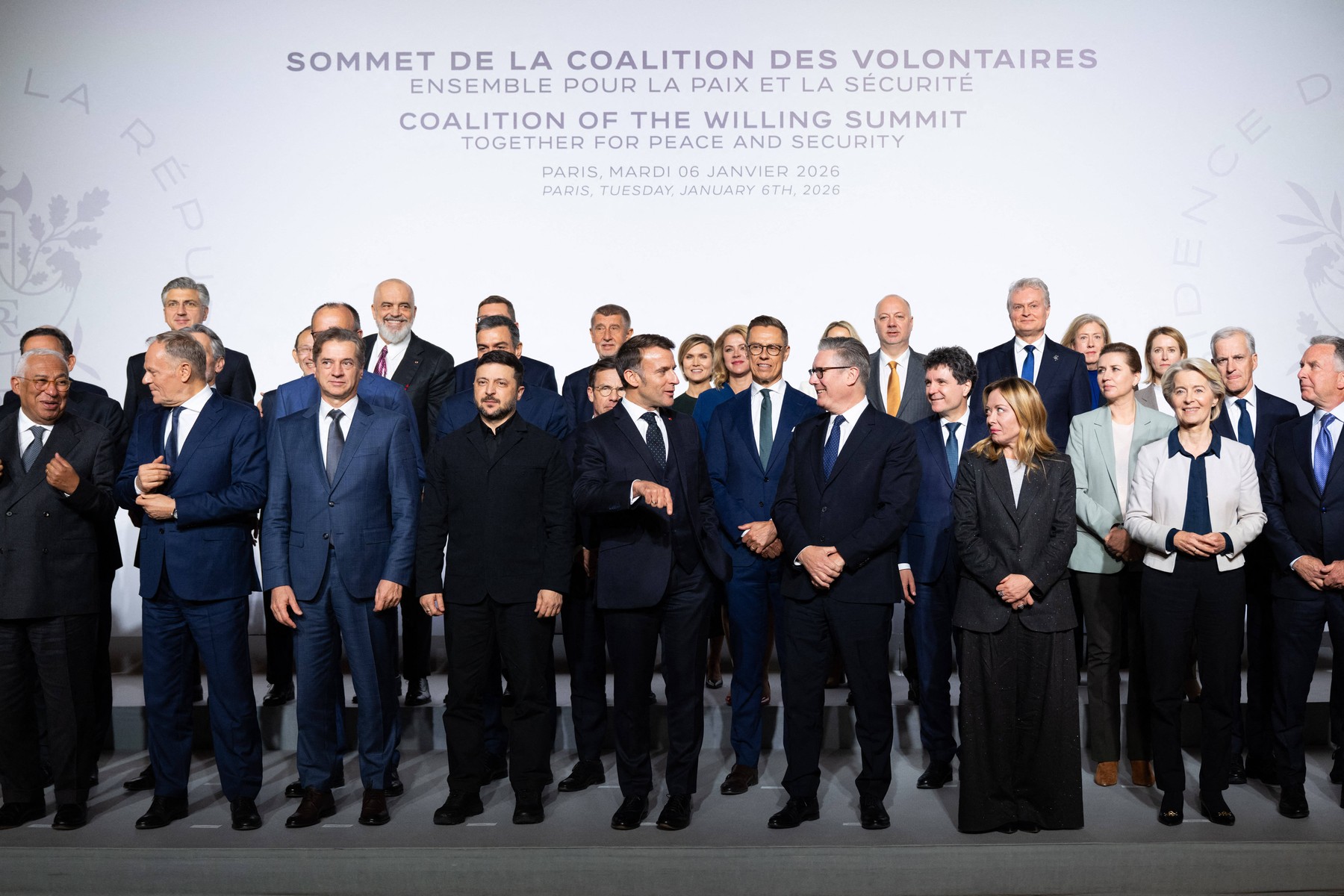
When President Volodymyr Zelenskiy landed in Paris for the Coalition of the Will talks, a key topic on the agenda was “European-led multinational force for Ukraine.”
A draft coalition statement – which was approved by leaders on January 6 – includes “binding commitments” from members to support Ukraine in the event of a future Russian attack.
The document also states that the United States would lead a “ceasefire monitoring and verification mechanism” with international involvement and would “commit to support” a European-led multinational force deployed in Ukraine to bolster the country's military.
The statement details earlier ideas on security guarantees to ensure the stability of a future ceasefire, which called for a “reassurance force” for Ukraine.
The plan was originally conceived in the spring of 2025 and provided for the deployment of up to several tens of thousands of ground troops on the territory of Ukraine, as well as the dispatch of warships to the Black Sea, from some of the 33 member states of the so-called Coalition of the Will (CoW).
The most difficult question related to the deployment of Western troops in Ukraine
The laudable European plan to create a Western “reassurance force” in Ukraine, however, faces two strategic paradoxes.
First, the current public discussions about the deployment of Western troops in Ukraine are counterproductive to the negotiations between Russia and Ukraine on a ceasefire. As welcome as the idea of a Western “reassurance force” is in Ukraine, it is firmly rejected in Russia.
If Europe promises to bring in troops only after the war is over, this is likely to reduce Moscow's willingness to accept an armistice, thereby increasing the economic and military pressure needed to persuade the Kremlin to agree to a ceasefire.
The plan's second strategic paradox derives from the uncertainty surrounding a “worst-case” scenario in which the “reassurance force” would be engaged in active combat with the Russian military.
The most difficult question related to the deployment of Western troops in Ukraine would be how they would react if they were attacked, for example, by Russian missiles and drones, causing significant loss of life and material.
The response to such an incident would not only pose a military dilemma, but would also have far-reaching political implications.
If the “reassurance force” were to respond proportionately to a Russian provocation and retaliate accordingly, troop-contributing countries, as well as NATO and/or the EU, could be drawn directly into the Russian-Ukrainian war.
If, on the other hand, the “reassurance force” did not respond adequately to a Russian attack, the mission would lose its meaning and the troops would be demoralized. The West's security guarantees to Ukraine and its general willingness to engage in collective defense would be called into question. NATO and EU member states' mutual assistance commitments would be weakened.
“SkyShield”
However, is there some form of direct military support that the Coalition of the Will (CoW) can provide beyond material, financial and cognitive assistance to the Armed Forces of Ukraine?
A limited commitment of Western air forces over western and central Ukraine seems less problematic than deploying ground troops and warships. Such support, using Western interceptors to protect western and central Ukraine – also known as “SkyShield” – would already be possible and reasonable right now, that is, before a ceasefire is concluded.
The creation of joint air defense zones over entire regions of Ukraine, or at least over major cities such as Uzhhorod, Lviv and Kiev, or critical infrastructure, carries a lower risk of escalation, as the deployment of Western interceptors can be limited in two ways.
First, Western involvement in Ukraine's air defense could be agreed to take place exclusively over Ukrainian territories far from current combat zones and the Russian-Ukrainian border.
Second, this geographical restriction of combat aircraft operations to the interior of Ukraine, in the central and western regions, means that they would not encounter Russian manned aircraft or helicopters. Western interceptors or drones and anti-aircraft missiles would only shoot down Russian unmanned aerial vehicles and would not endanger Russian soldiers or violate Russian airspace.
Such an activity carried out by a limited contingent of European military personnel (pilots, communications officers, technicians) near the border, over and partly on the territory of Ukraine could be justified both in front of public opinion in the countries of origin, and in relation to Moscow and the wider international community, as protecting the legitimate security interest of the participating states.
First, the embassies of the states of the Coalition of the Willing (CoW) in Kiev are, under the 1961 Vienna Convention on Diplomatic Relations, their inviolable territories and house diplomats as well as other government employees who need physical and psychological protection.
Second, the recent incursions of Russian drones into NATO territory, coming from Ukraine, illustrated the need for a shield against such intrusions.
“In today's conditions, the debates regarding the deployment of a “reassurance force” in Ukraine distract attention from much more important issues”
Third, politicians, diplomats, journalists, development cooperation specialists and other citizens of the CoW states regularly travel to Ukraine by rail and road, routes that must be protected by Russian unmanned aerial vehicles during these trips.
Fourth, through its Black Sea ports, Ukraine exports, among other things, grain and other agricultural products important for the stability of global food prices, which is a vital collective interest of mankind — including the CoW states.
Last but not least, protecting Ukraine's energy network and its nuclear power plants against missile, projectile and drone strikes would be in the interest not only of the eastern EU member states, but also of Russia, Belarus and the Republic of Moldova.
In a few years, circumstances may change, and the presence of foreign ground troops in Ukraine and maritime employment in the Black Sea may become less problematic.
In today's conditions, however, the debates regarding the deployment of a “reassurance force” in Ukraine distract from much more important issues.
Ultimately, the decisive guarantor of Ukraine's security is and will remain its own army. Moscow's aggression can only be kept in check by a heavily armed Ukraine with well-trained soldiers – a condition valid both in wartime and peacetime.
The opinion article was originally published in Contributors.ro