Europe is now dependent on US gas and Trump could soon use this leverage against us, warns a major European newspaper


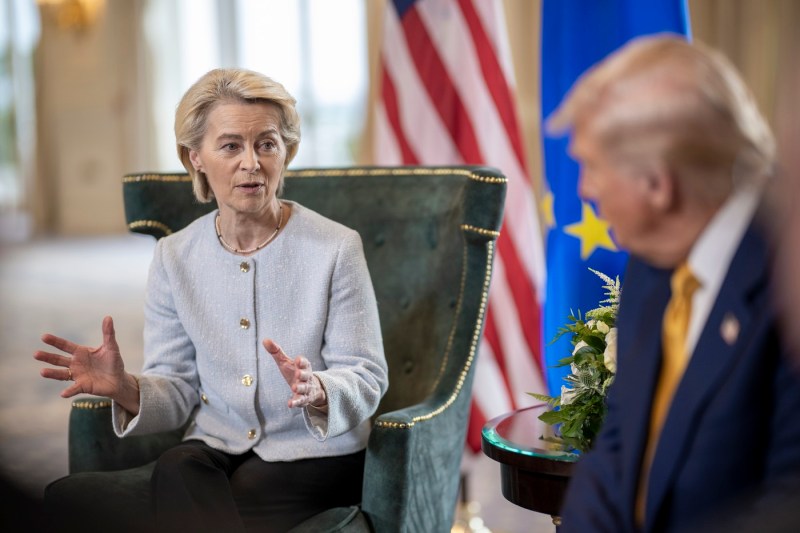
Ursula von der Leyen and Donald Trump. Photo credit: White House / Zuma Press / Profimedia
On Saturday, when Nicolas Maduro was captured, Kirill Dmitriev, Vladimir Putin's negotiator at the White House, underlined his concerns: with the addition of Venezuela, the United States now controls 20% of global oil production, writes the Italian newspaper Corriere Della Sera, picked up by Rador Radio Romania.
“An enormous power,” noted Dmitriev. The Russians are not unhappy about this, as they have their own idea of where the United States could direct this influence: not to Moscow, which controls its own energy resources, but to European capitals.
And while this may be partly true for oil, it is certainly more true for natural gas.
The EU has traded one dependency for another
The European Union has struggled to free itself from dependence on Russia for natural gas in recent years; but few of its leaders would have imagined that the new strategic supplier, the United States, would prove so inconvenient so soon, notes the well-known Italian newspaper
Trump's attempt to annex Greenland, perhaps with an action similar to Putin's in Crimea in 2014, is no longer just a possibility. He himself announced his intentions. For the first time, such an act would be committed against a region of the European Union, by the hand of an ally.
In the case of Crimea, Europe responded with an initial wave of sanctions against Putin. But what could he do in the face of Trump? Of course, Europe's dependencies on the United States are multiple: security, market access, and technology.
However, energy dependence, although so far secondary, becomes the most pressing and dangerous. Today, the European Union needs American natural gas more or less as much as it needed Moscow's four or five years ago.
Americans have someone else to sell to
Amounts of US liquefied gas in Europe are smaller than those delivered by pipelines from Russia in 2021; but the power of the White House to increase heating and electricity bills on the Old Continent by reducing supply is similar to that of the Kremlin since then.
In 2022, Europe faced an energy crisis as Putin began using natural gas as a weapon, trying to force Europe to end its aid to Ukraine.
The blackmail failed, partly because other suppliers, mainly Americans, intervened.
As of January 2022, Russia was Europe's main supplier, with about 2.6 billion cubic meters of natural gas per week, according to think tank Bruegel. Today, Moscow has practically disappeared from European markets.
Meanwhile, sales of liquefied natural gas (LNG) to the European Union rose from 1 to 2.9 billion cubic meters per month, with America accounting for 60% of the total. Between 2021 and 2025, shipments to the US exploded from 1 to nearly 8 billion cubic meters per month.
But American suppliers can sell all their output to power plants in the United States or to Asian customers: they are not as dependent on Europe as Europe is on them. And it's a detail that might even go unnoticed, if Trump didn't seem determined to impose new humiliations on Europe itself.