A score of 50 points is an important barrier that separates expansion (readings above this limit) from recession (below) in the sector. Not only is it important whether it is below this cut-off level, but an important indication is whether a change is taking place: a rising PMI, even if it is below 50 points, suggests improvement in the sector.
The last month of 2025 was not good for the European economy
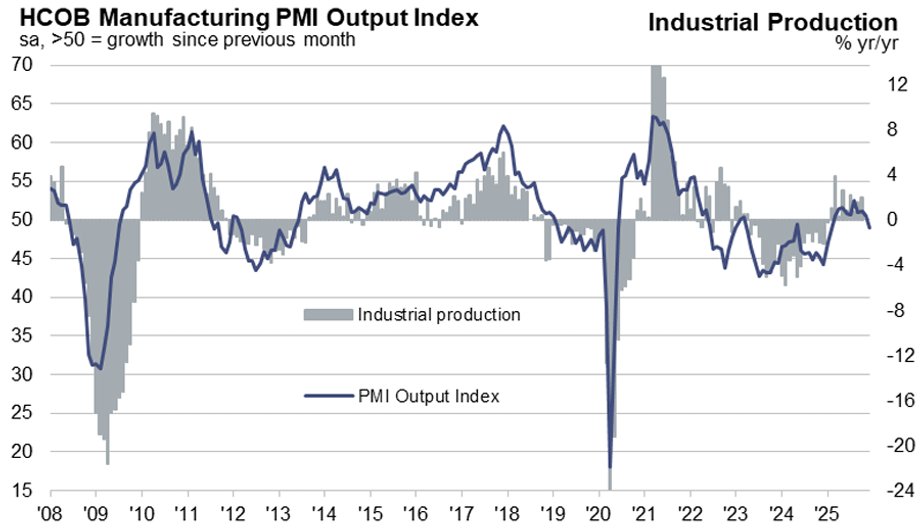
Industrial production in the euro zone fell for the first time since February last year, although it was a mild deterioration. Demand for goods from the region also saw new signs of weakness as new orders declined at the fastest pace in almost a year. In addition, sales results deteriorated. Nevertheless, surveyed entrepreneurs were the most optimistic about the outlook for next year since immediately preceding Russia's full-scale invasion of Ukraine in February 2022, according to an S&P Global summary.
Eurozone producers reduced production in the last month of the year. Purchasing activity was reduced to the greatest extent since March last year, and inventories of raw materials and intermediate goods fell significantly. Post-production stocks also fell, although at the slowest pace since September 2024. There was growing evidence of pressure in supply chains for euro area manufacturers. Average lead times for goods purchased from suppliers have extended to the greatest extent since October 2022.
|
S&P Global
In December, production results deteriorated in several key euro area economies. The most noticeable was Germany, which saw the biggest deterioration in the sector since February 2025 and recorded the weakest performance of the eight monitored eurozone countries. New PMI readings below 50 in Italy and Spain also signaled renewed declines from southern parts of the monetary union, but conditions at Greek factories improved at a slightly faster pace than in November. France also bucked the downward trend in domestic manufacturing PMI readings, signaling the strongest expansion since June 2022.
A difficult start to 2026, but there is hope for the European economy
“Demand for industrial products from the euro area is slowing down again. Significantly fewer orders, decreasing order backlogs and ongoing inventory reduction are the most obvious indicators of this phenomenon. It's no surprise that companies continue to downsize in this situation. They appear neither able nor willing to build momentum for the coming year, but instead remain cautious, which is detrimental to the economy,” wrote Cyrus de la Rubia, chief economist at Hamburg Commercial Bank.
He pointed out that the manufacturing sector has been in recession almost continuously since mid-2022., and 2025 seemed to be the year in which the economy in this sector could turn around. “In fact, the recession has moderated significantly, but has not managed to shift to a sustainable growth path. For 2026, however, there is hope that Germany's economic stimulus program and rising defense spending across Europe will breathe new life into the industry. Many companies seem to see this similarly, as the belief that production will be higher next year than it is now has risen again from already high levels,” de la Rubia added.
He pointed out that some production costs of companies have increased, especially industrial metals (copper and tin), but in his opinion it is still surprising that despite the weak economic situation, companies are apparently unable to force lower prices for goods whose prices are less dependent on the global market. One explanation, he said, may be problems with the supply chain, as indicated by longer delivery times.
“The Spanish manufacturing sector, which has grown almost continuously since 2024, is currently in a slight crisis. On the other hand, French manufacturers, who have been in crisis for almost three years, have again shown signs of recovery. The sharp decline in German and Italian industries is another disappointment. The relatively good results in Greece and Ireland cannot compensate for this. Overall, the euro area's manufacturing sector will not have an easy foothold in 2026. However, expansionary fiscal policy can help with this” concluded de la Rubia.
How did the PMI indices perform in individual countries
Industrial PMI w Germany it dropped significantly to 47 points from 48.2 points a month earlier compared to the expected 47.7 points. This is one of the weakest PMI readings for the industry of Europe's largest economy: the last time it was worse was in February 2025.
However, good results were recorded in Francewhere the industrial PMI jumped to 50.7 points from 47.8 points. There is no surprise, however, because the forecasts assumed an increase (50.6 points were expected). This is the highest result on the Seine in over three years.
IN Spain the index for industry decreased to 49.6 points from 51.5 points (i.e. it was worse than the forecast 51.1 points), this is the first result below 50 points in this country since April 2025. In Italy the industrial PMI dropped significantly to 47.9 points from 50.6 points in the previous month, which is also a negative surprise, and a clear one at that, because it was assumed to be 50 points. For this in Czech Republic PMI for industry unexpectedly jumped to 50.4 points from 48 points in November (stabilization was assumed).
We also learned the PMI data for the Polish industry: in December 2025, the index amounted to 48.5 points, i.e. dropped from 49.1 points a month earlier. This result is slightly worse than forecast, as the result was expected to be around 49 points. The December result was close to the average for the entire 2025 of 48.3 (the highest since 2021), but it was also the eighth month in a row below 50 points. However, there were many optimistic forecasts.