Putin still has an 18-month window. Why is the Kremlin dragging its feet and continuing the war in Ukraine


Vladimir Putin's latest statements unequivocally indicate the Kremlin's intention to continue the war in Ukraine. For political analyst Vadim Denisenko, Moscow's strategy is clear: delay peace at all costs, amid the belief that Russia still has a window of about 18 months before major structural economic problems emerge. In the meantime, the Kremlin is counting on weakening Ukraine and achieving its political and military goals.
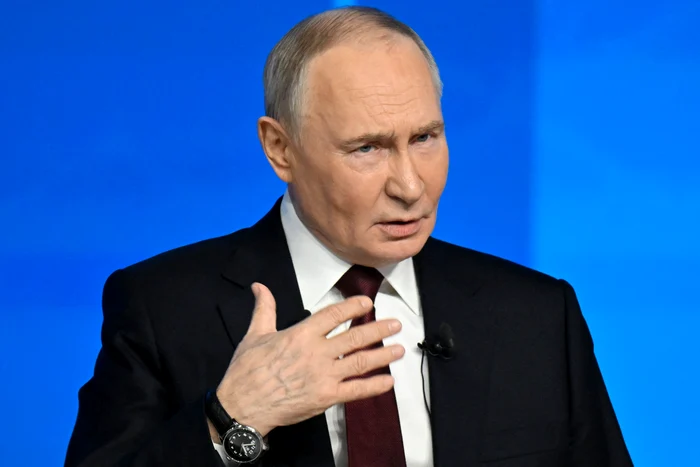
Russian President Vladimir Putin/PHOTO: AFP
Negotiations, a game of pulling time
In recent public appearances, Vladimir Putin again spoke about the alleged collapse of the front and the advance of Russian troops, a sign that Moscow did not expect real progress in the Ukrainian-American dialogue. The Kremlin leader's behavior can be interpreted as an attempt to distance himself from possible deals with Donald Trump or, rather, as a new attempt to raise the stakes to delay negotiations.
In this logic, Putin is not looking for a quick agreement, but is trying to buy time, counting on the attrition of his opponents and changes in the international context.
What were the real stakes of the war
The invasion launched on February 24, 2022 was not aimed exclusively at occupying Ukraine. From the Kremlin's perspective, Ukraine was just one element in a much larger geopolitical game. At that time, the main objectives were:
-the transformation of Russia into a third pole of global power;
– the establishment of total political and security control over the post-Soviet space;
– stopping the process of “de-Slavization” of Russia through the integration of about 30 million Ukrainians.
Today, none of these goals are realistic, regardless of how the war ends. This is understood even in the Kremlin, which is why the “deep causes” of the conflict have changed.
The Kremlin's new goals
At the end of 2025, Moscow's stakes seem to be different:
-returning to the international agenda through the partial lifting of sanctions and access to certain markets;
– avoiding a total political and economic dependence on China in the next decade;
– the attempt to take advantage of a possible weakening of the European Union, in a context of US-China rivalry;
– changing the political leadership of Ukraine with one more favorable to Russian interests.
This is where Putin's central dilemma arises: the first two goals point to the need for a quick end to the war, while weakening the EU and influencing Ukraine push him to continue the conflict.
The Ukrainian dilemma
Regarding Ukraine, the Kremlin is oscillating between two options: destroying the Ukrainian state, with huge economic and demographic costs for Russia, or trying to shift power from Kiev through one or two election cycles.
There are several calculations on Putin's table:
– lack of desire to wait any longer;
– the fear of an internal opposition, if the “Ukrainian problem” is not resolved;
-the belief that the Russian economy can last at least until the middle of 2027;
– the uncertainty regarding the consequences of an open break with Donald Trump.
At the same time, Russia's attempts to avoid sanctions – including by using the “shadow fleet” – risk deepening the budget losses. However, the Kremlin estimates that it still has about 18 months before serious economic problems erupt.
Hence the current strategy: delaying, feigning willingness to negotiate and refusing a quick deal in the absence of serious US pressure.
“Novorusia”, the real stake
According to the analyst Maxim Iali, from Focus.ua, Putin did not hide his real objective: control over eight regions in the east and south of Ukraine, united under the concept of “Novorusia”. That is why Moscow continues to delay and puts forward conditions that are impossible for Kiev to accept.
The Constitution of Ukraine does not allow the abandonment of the Euro-Atlantic path, nor the recognition of the occupied territories as Russian. Moreover, during the war, amending the Constitution is impossible, a fact well known in the Kremlin.
A possible referendum would require a lasting truce – a scenario that Putin deliberately avoids, convinced that he can achieve more on the battlefield.
The role of the US and the limits of the EU
In the relationship with Washington, the main objective of the Kremlin is to avoid new sanctions, not to sign a real peace. Instead, for Ukraine, the stake in the negotiations with the US is to obtain solid security guarantees, ratified by Congress, not a new “Budapest Memorandum 2.0”.
Previous experiences – the withdrawal of the US from the nuclear deal with Iran or the lack of firm reactions in 2014 – compel Kiev to be cautious. The European Union, although important for Ukraine's financial stability, cannot offer security guarantees comparable to those of the US.
Why peace is not near
President Volodymyr Zelensky cannot accept territorial concessions, neither for domestic political reasons, nor for legal and statehood considerations. Such a decision could trigger internal protests – a scenario the Kremlin wants.
Under these conditions, a quick peace is unlikely. Neither by the end of the year, nor in the short term, are there any prerequisites for an agreement to end the war.
For now, Putin continues to play the time card, betting on the 18 months he considers decisive.