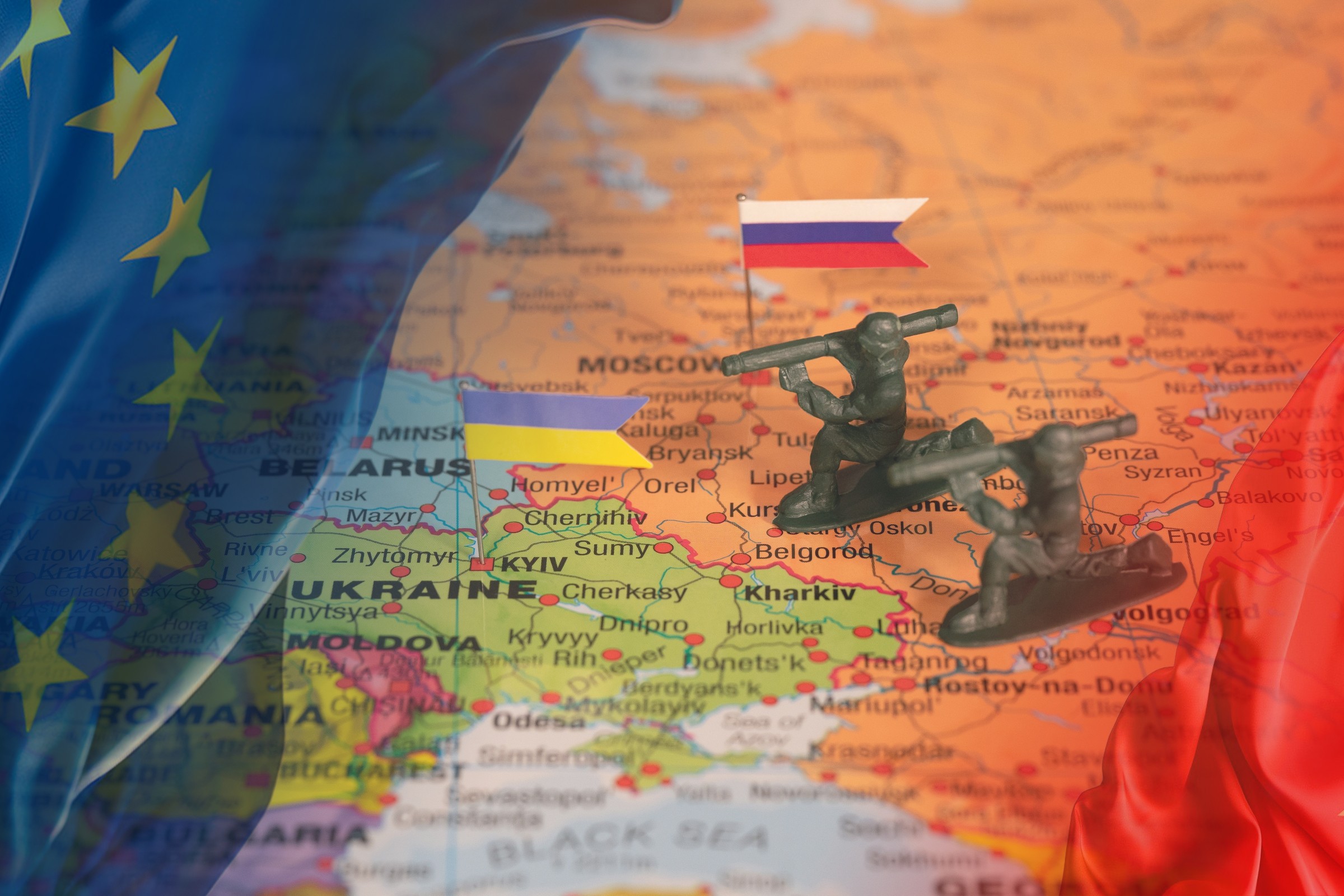
Recently, we have been paying most attention to the European Union. Ukraine's integration with this bloc has significantly accelerated after 2022. Despite this rapprochement and ongoing reforms, there are many skeptical voices throughout Europe questioning the possibility of Ukraine's admission to the EU. This issue also appears in the context of peace plans that regularly appear in the media. However, the situation is complex – to become a full member of the EU, you must not only meet a whole list of difficult economic, legal, environmental and other criteria, but also acquire the appropriate political will.
Taking into account the latest statements of European politicians, Ukraine's accession may seem unrealistic in the short term. It is difficult to expect all Member States – with their own interests – to speak with one voice. An example is Belgium's resistance to using frozen Russian assets for Ukraine. It is not difficult to imagine that currently countries such as Hungary will say a firm “no”, while others may make their consent conditional on the pursuit of their own interests.
Politicians in Kiev often assume that the most important EU decisions are made mainly in Berlin and Paris – a wrong starting point that alienates other partners. This was seen during the grain crisis with Poland, when Ukrainian representatives tried to negotiate the export and transit of grain to the EU bypassing Polish officials.
Ukraine must seek support and maintain good relations with literally every EU member state. Not only arguments and narrative will be important – these should not be based solely on the belief that one is right or true, but on the skillful formulation of a message that reaches partners. Politics is not always facts – it is often simplifications, clashing interests, narratives and power asymmetries. Moral victories only soften the bitterness of defeat.
The article continues below the video
Even if membership seems out of reach today, the political situation can change quickly. A “window of opportunity” may open – then Ukraine should be prepared by meeting the required standards and criteria. Neither social nor political will will be an obstacle. Ukrainians have repeatedly demonstrated their desire to enter the structures of the West, especially during Euromaidan. The entire political class of Ukraine now shares these aspirations. However, the key word is “currently”.
We cannot rule out a scenario in which Ukraine will emerge unscathed after the war, but will remain outside the structures of the West. Such a situation could create a feeling of betrayal by allies. Politicians could take advantage of these moods and – following the logic of “if it worked before, it will work now” – push the idea of an isolationist Ukraine: anti-Russian, linked to the West, but politically closed to itself.
Similar emotions may arise if EU membership turns out to be too burdensome and requires sacrifices at the national, economic or private interest level. This could leave Ukraine caught between East and West – internally divided and politically unstable. Such a scenario would be very unfavorable and, unfortunately, more likely than the so-called “Georgian scenario”, in which a nominally pro-Western political force takes power but actually makes anti-Western decisions.
Politics is often based on simplifications, clashing interests, narratives and asymmetry of power. Moral victories only mitigate defeat.
Fortunately, three entities play a stabilizing role in this puzzle:
1
The European Union, which – as recent events have shown – can effectively influence Kiev, as when trying to weaken NABU's independence [Narodowe Biuro Antykorupcyjne Ukrainy] and SAPO [Specjalistyczne Biuro Antykorupcyjne Prokuratury] in August 2025
2
Ukrainian society, strongly Western-oriented
3
Ukrainian deep state structures
The latter is often underestimated or criticized for corruption and connections with oligarchs, but this is not entirely true. The deep state has kept the country functioning since 2014 and prevented it from collapsing.
Paradoxically, the oligarchic system also contributed to this: the oligarchs largely sided with Ukraine, providing significant funds for the state's survival – despite knowing that they would lose their influence and wealth. And this, paradoxically, strengthened Ukraine's pro-Western stance.
Another example of the constructive action of the deep state is the effective work of institutions such as NABU and SAPO, which enjoy public support.
Poland's example: from “forget it” to full membership
Poland's path to NATO shows how political declarations and circumstances can change. Poland joined the Alliance in 1999, ten years after the political transformation. Although the country was not at war and Russia was weakened after the collapse of the USSR, the accession process in the mid-1990s was quick, but not at all obvious. Just five or six years before accession, Polish diplomats in Washington heard “forget about it.”
In the early 1990s, Poland also underwent painful economic reforms, partly overseen by the International Monetary Fund. The example of Poland shows that in the long run, much is possible — provided consistent actions based on broad political and social consensus.
It is also worth remembering that the European treaties themselves or the need to change them may be an obstacle to Ukraine's membership. Many unpredictable events can also create new windows of opportunity. The accession process itself may take unexpected forms: partial, hybrid or without participation in some structures, such as the Schengen Area.
Some countries, such as Bulgaria, only joined Schengen in 2025. Bulgaria is also a country struggling with political instability and corruption, and yet EU membership has had a stabilizing effect. Once again, political will is key and opens space for Ukrainian diplomacy.
Ukraine has a long way to go – a difficult but real goal lies ahead
Ukraine has already come a long way, and its goal – although difficult – is not impossible to achieve. What seems unreal today may look completely different in two years, because reality is becoming less and less predictable. The key remains to continue reforms, stay on the strategic course and wait for the window of opportunity to open. It is worth remembering that in the interests of both the EU and its members, it is much better for Ukraine to be integrated with the EU – subject to supervision mechanisms in Brussels – than to be an unstable entity on its own.
I’m Ashley Davis as an editor, I’m committed to upholding the highest standards of integrity and accuracy in every piece we publish. My work is driven by curiosity, a passion for truth, and a belief that journalism plays a crucial role in shaping public discourse. I strive to tell stories that not only inform but also inspire action and conversation.