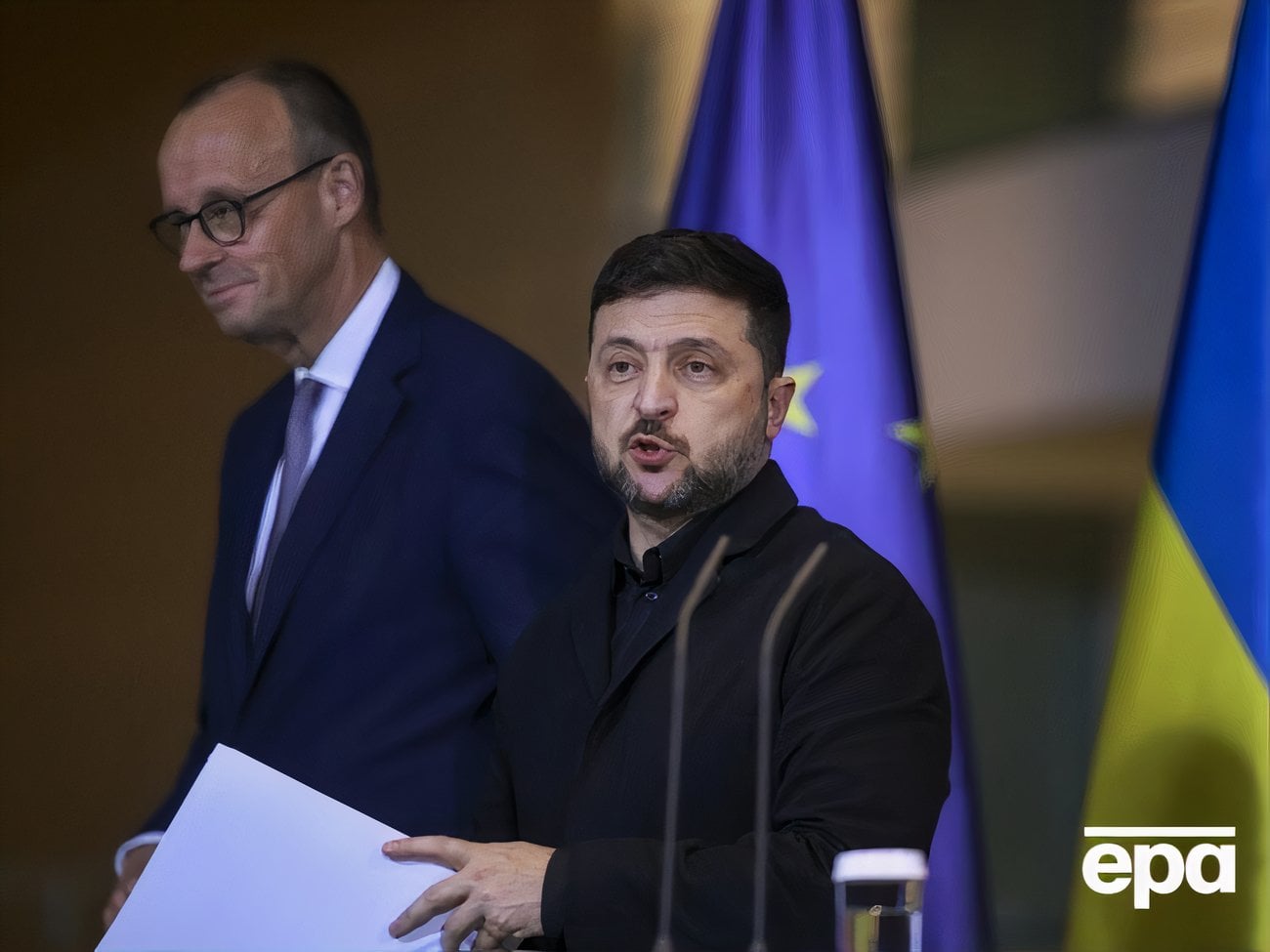
“You know that they want our Donbass. And our position is practically real, fair, we stand on it. But we don’t want to give up our Donbass. The Americans want to find a compromise. They offer a free economic zone,” Zelensky said after two days of negotiations in Berlin with the US delegation.
At the same time, he clarified that “this does not mean” that the free economic zone in Donbass will be “under the leadership of the Russian Federation.”
“Neither de jure nor de facto will we recognize the Donbass as Russian. That part that is temporarily occupied, of course. But, nevertheless, we are discussing issues regarding the territories. It is one of the key ones. We do not yet have a consensus on this issue, I will be frank,” the president said.
But there is progress on other issues, he added. In particular, on security guarantees, which, according to Zelensky, must be voted on in the US Congress.
“I see that the president's team [США Дональда] Trump is ready for this. We know exactly what Congress will support. Well, accurate or not, we know that the majority of Congress is positive about this. And it is important that this is a legally binding responsibility of our partners in the event of a violation of the peace agreement or ceasefire by the aggressor – the Russian Federation. That is, there will be a reaction to something similar to what is in Art. 5 NATO,” the president said.
According to Zelensky, at the negotiations on the “peace plan” he said what kind of weapons, strength, training, number of soldiers and funding for the Ukrainian army Ukraine would need so that “there would be stability in the Ukrainian warrior.”
Zelensky considers it a positive sign that the United States and Europe worked together on the issue of peace in Ukraine.
He stated that Ukraine needs security guarantees both from European countries and those in the coalition of the willing, and from the United States.
Context
Before the meeting in Berlin, the Ukrainian and US delegations had already held seven rounds of negotiations on a “peace plan” for resolving the Russian-Ukrainian war. In parallel, the American side is discussing this issue with the Russian Federation.
December 10 Trump had a “tense” telephone conversation with the leaders of France, Germany and Great Britain, calling on them to put pressure on Zelensky to agree to the terms of the “peace plan,” WSJ reported. Same day Ukraine handed over to the American side a framework document for a “peace plan” consisting of 20 main points, the president said. According to the NYT, Ukraine is in the US response to the “peace plan” rejected the refusal of the territories of Donbass and entry into NATO.
Negotiations between the delegations of Ukraine and the United States took place in Berlin December 14th and 15th. After the first meeting, Trump's special envoy Steve Witkoff reported that the negotiations “Significant progress has been made.” December 15 Secretary of the National Security and Defense Council, member of the Ukrainian negotiating group Rustem Umerov expressed hope that by the evening it will be possible to “reach an agreement that will bring us closer to peace.”
AFP reported that Ukraine at this meeting sought a ceasefire without territorial concessions, and, according to Reuters, Zelensky offered to abandon Ukraine's accession to NATO in exchange for security guarantees.
On the evening of December 15 in Berlin, the leaders of several European countries held a meeting on Ukraine, they were joined by Vitkoff and Trump's son-in-law Jared Kushner. The American President had a conversation with them.