The US's harsh criticism of Europe has shaken the continent. In an interview for POLITICO and in the recently published US national security strategy, Donald Trump hits hard at partners on the other side of the Atlantic.
“The most likely threat is a serious attack on EU critical infrastructure. Hybrid warfare is assessed as the greatest challenge for the EU in the coming year and the risk with the greatest impact,” says Veronica Anghel, who coordinated risk analysis at the international organization European University Institute. These are the results of assessments conducted by over 500 policy and security experts.
A year ago, experts correctly predicted that the greatest threat to Europe in 2025 would be the US withdrawal from security policy.
The United States' turning away from the Old Continent goes beyond security issues. It is accompanied by direct interference in the policies of European governments. In the new national security strategy, Washington demands an end to mass migration, criticizes the alleged restriction of freedom of speech and suggests negative consequences for cooperation if European countries “do not change their course.” The end of the year brings a historic rupture in transatlantic relations.
Criticism from the Trump administration, also present in the US security strategy, is now commonplace. It attacks both the main parties in Europe and the unity of the European Union, and at the same time strengthens European extremists and Russia. It can be predicted that Washington's anti-EU position may translate, for example, into a reduction of American forces in Europe.
However, as experts from the European University Institute state, other threats to Europe are emerging at the same time. Russia's almost four-year-long full-scale invasion of Ukraine goes beyond the country's borders – European countries must repel Moscow's hybrid attacks every day.
From cyberattacks on the Bundestag's infrastructure, through the activities of Russian submarines and ships near energy and internet connections, to arson and airspace violations by Russian military aircraft: the situation is becoming increasingly tense.
“US foreign policy is no longer based on credible security guarantees”
Experts warn that current EU funds are insufficient. Since Putin's invasion of Ukraine, Europe has focused primarily on conventional defense. But attacks on energy, digital and transport systems must be equally strongly integrated into Europe's population protection strategies – from defense against attacks to rapid repairs.
“In the future, Europe's deterrence and defense will not depend solely on investments in classic military instruments. They will also depend on the protection of Europe's critical infrastructure and rapid recovery protocols,” Anghel concludes.
The authors of the study consider the “favorable ceasefire in Ukraine for Russia” to be another major risk.
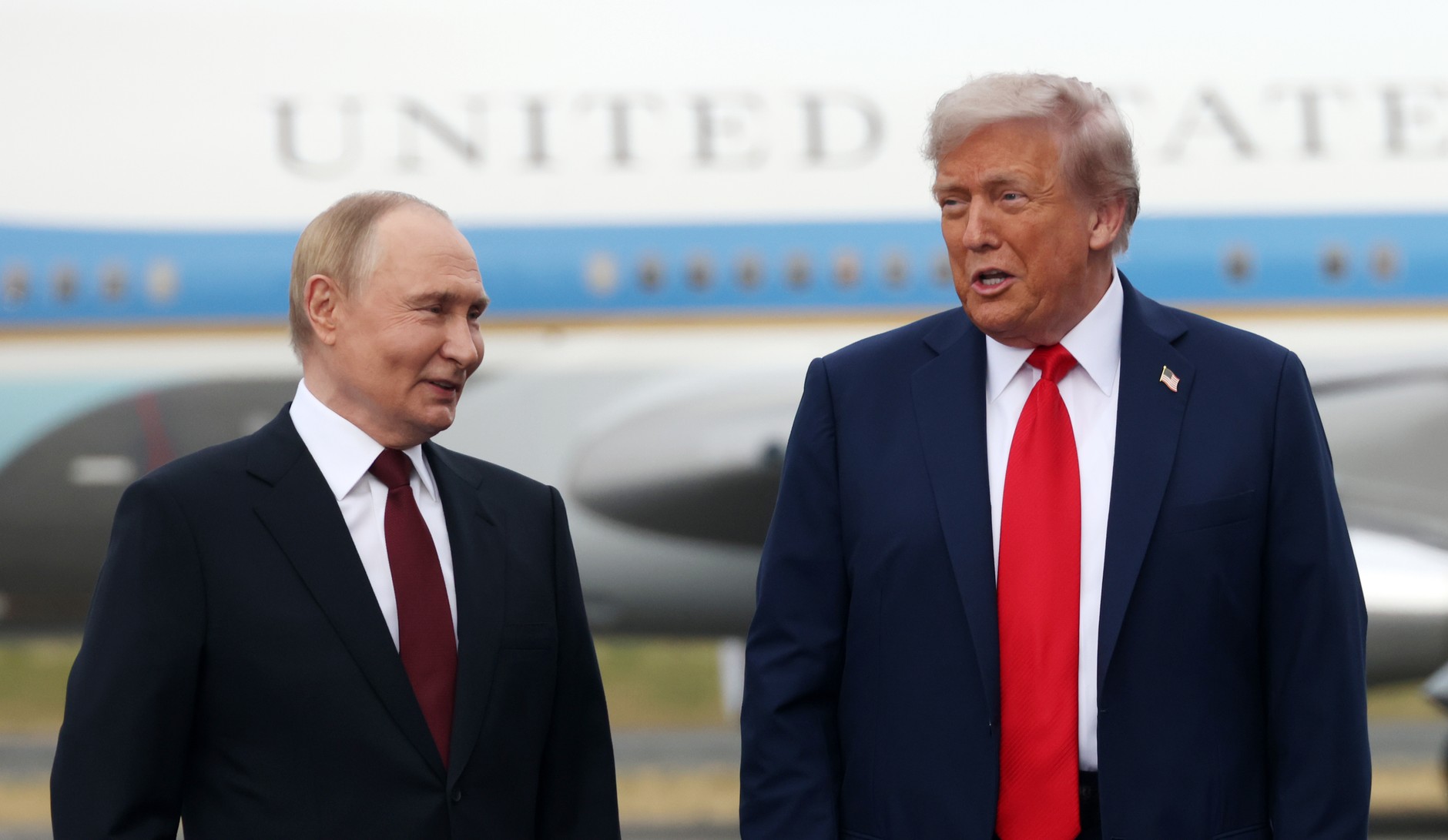
Vladimir Putin and Donald Trump in Alaska, August 15, 2025 (illustrative photo)Contributor/Getty Images/Getty Images
The analysis says that EU security would be directly threatened by a pro-Russian peace agreement that would consolidate Moscow's territorial gains, reward aggression and undermine Ukraine's long-term ability to function as a sovereign, democratic state. Peace on Russian terms would also send a signal that the EU is unable to shape its own security environment or fend off future threats from Russia.
The prospect of Russia starting new military operations in non-NATO countries is also considered a high risk. Moscow's focus is on the Black Sea region, in particular Moldova and Georgia.
Far from Europe, but also high risk, is the conflict between China and Taiwan. The Trump administration recently changed its position that China was considered the main adversary of the US and therefore there was an obligation to help Taiwan in the event of an attack. In Trump's second term, this is no longer discussed so categorically. The voices coming from Washington say that Taipei must take care of its own defense in the event of a threat.
“It is now clear that U.S. foreign policy is no longer based on the credible security guarantees that were once expected for Taiwan,” Anghel says. “At the same time, the United States is increasingly withdrawing from security guarantees for Europeans.”
A direct conflict between Taiwan and China and a lack of U.S. military involvement would have a dangerous impact on transatlantic security commitments — and thus on Russia's aggressive ambitions.
The Onet editorial team presents various points of view regarding the possible development of the situation in Ukraine and Russia's aggressive actions towards NATO countries. The above material is one of them.
We would like to point out that it cannot be predicted that there will be a military attack by Russia on Poland or another NATO country. The war in Ukraine is a challenge for the Russian army and economy. It is unlikely that while fighting the Ukrainians, Vladimir Putin would also decide to confront NATO, which would be incomparably more costly for Moscow – militarily, financially and politically. It should also be remembered that neither Russia nor the Soviet Union ever directly attacked a NATO country.
Below are some analytical texts by our expert Witold Jurasz, devoted to Poland's security: