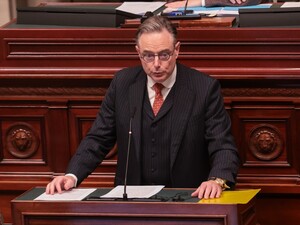
According to de Wever, the use of frozen assets held in the Belgian depository Euroclear “could have potentially negative consequences both for Belgium and for Europe as a whole.”
He further presented the very conditions for supporting the reparation loan.
In particular, according to the politician, it is necessary to ensure “full mutual responsibility for risks.”
“Under current bilateral investment protection agreements, compensation for illegal expropriation can significantly exceed the value of the assets themselves and include compound interest as well as unrealized profits. Therefore, in our view, guarantees should cover all potential financial liabilities from day one,” de Wever told parliament.
In addition, Belgium wants to “ensure liquidity and protection against risks,” the prime minister added. As de Wever pointed out, Euroclear must have the necessary resources in place in case they are needed, for example if the company becomes the target of Russian sanctions.
They will also be needed if the Central Bank of the Russian Federation demands compensation. This could be the result of a legal process, arbitration or a peace agreement, the Belgian prime minister said.
Third, Belgium expects a fair distribution of costs, de Wever said.
“It is absolutely logical that all member states that own Russian assets should participate in this operation. And we should demand these funds proportionally and equally from all institutions located in Europe, and, ideally, even wider than the territory of Europe – including countries that are part of the “coalition of the willing,” said the head of the Belgian government.
He said that the European Commission's proposal “moves towards these three conditions” but is not sufficient to meet the minimum requirements.
After his words, said in an interview published on December 2, that “Russia is not losing the war” in Ukraine and that this is “not even desirable,” de Wever assured parliament that Belgium “fully supports Ukraine” and wants to do everything necessary to strengthen support.
“We are loyal to Ukraine. We will always choose peace, freedom and democracy. We are ready to make sacrifices, but we cannot demand the impossible from our country. This is the government’s position, and I hope to receive the support of parliament,” the politician concluded.
In Parliament, I responded to questions about our country's position regarding Euroclear. Many false insinuations are being spread to put pressure on us, but our conditions are reasonable and constructive. We are not going to burden ourselves with irresponsible risks. pic.twitter.com/W39Koiy9Kf
— Bart De Wever (@Bart_DeWever) December 4, 2025
Context
On September 10, European Commission President Ursula von der Leyen announced a new strategy to support Ukraine using frozen Russian assets. As Reuters columnist Hugo Dixon explained, the proposal for a so-called reparations loan suggests that the country could be provided with financing from frozen Russian assets without outright confiscation.
On October 23, the head of the European Council, Antonio Costa, assured Ukrainian President Vladimir Zelensky that the leaders of EU member states would confirm their support for Kyiv and would be able to decide on a reparation loan from frozen Russian assets for the period 2026–2027. De Wever immediately named three conditions under which he would agree to support the idea of a “reparation loan.”
On November 7, the European Commission warned EU countries of the risk of annual costs of up to €5.6 billion if they do not agree on the creation of a reparation loan for Ukraine worth €140 billion using frozen Russian assets.
On November 13, Zelensky called on European allies to overcome differences over the use of frozen Russian assets, as new funding is critical for the country's war-ravaged economy to continue its fight against Moscow.
On November 15, Valérie Urbain, director of the Belgian depositary Euroclear, which manages frozen Russian assets, said she “does not rule out” legal action against the European Union if a decision is made to confiscate them.
There is growing dissatisfaction with Belgium's position in the European Union. EU countries accuse the government of insufficient disclosure of information about the use of taxes on these frozen assets. The European Union also suspects that Belgium may appropriate income from Russian assets frozen in Euroclear, Politico wrote.
On December 2, the same media reported that the EU had found an opportunity to use Russian billions for the needs of Ukraine without risk to Belgium.