“Visionary, surreal, bizarre, but still anchored in the memories of Bucharest”. Financial Times, praise for a novel written by Mircea Cărtărescu


“A dream trip through communist Romania”, headlines the reputable British newspaper Financial Times in a review of the volume “Orbitor. Left Wing”, written by Mircea Cărtărescu in 1996.
The review was of the English translation by Sean Cotter, published in the United States in 2013, which has just been released in the UK as part of Penguin's International Writers series – which includes translated works by renowned authors from around the world.
“Visionary, surrealist, bizarre, but still firmly anchored in the memories of the working-class Bucharest that raised him, Orbitor does not lead readers into an easily decipherable landscape of childhood events and emotions. Rather, we enter what Cărtărescu calls the “inextricable triple empire” of “reality-hallucination-dream”. Vividly realistic episodes suddenly give way to phantasmagoric sequences of fantasy, nightmare and prophecy,” notes the British financial newspaper.
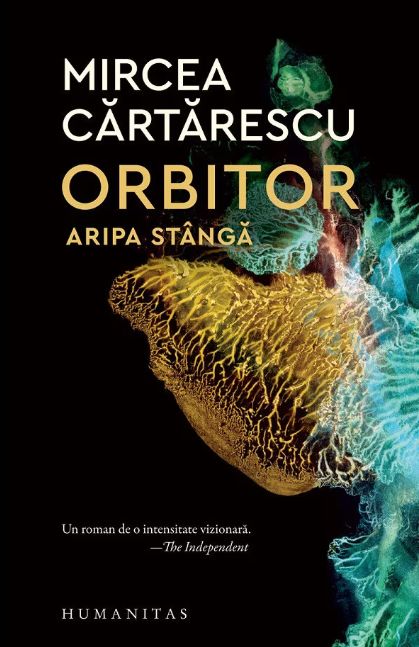
“Orbitor” is a Romanian trilogy written by Mircea Cărtărescu. The three volumes were written over the course of 17 years, “The Left Wing” (1996), “The Body” (2002) and “The Right Wing” (2007). In Romania, the trilogy is published by the Humanitas publishing house.
“Memoir, saga, fantasy, satire, mysticism, even horror”
The novel is considered both visionary and autobiographical.
“This multi-layered strangeness makes Orbitor, in Cotter's virtuoso translation, an exhilarating yet disorienting journey. With admirable agility, Cotter's language jumps between all the genres—memoir, saga, fantasy, satire, mysticism, even horror—that this kaleidoscopic novel covers. Its richness and density, as well as its periodic leaps from one mode to another, make Orbitor an intoxicating literary drink, which should be savored in small sips, not swallowed all at once,” explains the Financial Times.
“It merges the inner and the outer in an esoteric vision of an all-encompassing kinship”
Dazzling “is a passionate journey through childhood spent in Bucharest during the communist period” by Mircea Cărtărescu. “The narrator is extremely attentive to every state and facet of the city and its inhabitants, whether they are “enveloped in the warmth of a fragrant spring” or covered in gray snow. Little Mircea becomes the city, and the city becomes him: “my own artificial body”, reports the Financial Times.
In Orbitor, Cărtărescu “combines the inside and the outside in an esoteric vision of an all-encompassing kinship,” reports the British newspaper that goes into its review and narrative.
“In sinister and squalid apartment blocks or dilapidated houses, we meet three generations of Mircea's family: above all, his mother Maria, a peasant who became a factory worker. Her imaginary past and the search for a story that would give her “coherence and dignity” in a time of war, poverty and tyranny, give rise to passages in which the author's torrential eloquence serves the tenderness and Elsewhere, relatives join the Securitate – dictator Nicolae Ceaușescu's secret police – and hunt down conspiracies among the circus people in their own paranoid search for connection,” according to the Financial Times.
As adults, we are “like someone who lost his sight in childhood and who sometimes dreams of things he cannot conceive”. We follow the clouds of a half-forgotten glory from a better place. Memory, “the essence of the essence of the sacred,” helps to open the inner eye that sees this vanished realm. Orbitor evokes scenes of violence, hardship and disease with an irresistible power. However, it somehow conveys a radiant faith in the “certainty of our angelic nature”~.
Mircea Cărtărescu's awards
Mircea Cărtărescu is the most awarded Romanian writer. Among the prizes won are the Dublin Literary Award, the Thomas Mann Prize, the “Giuseppe Acerbi” Literary Prize, the FIL Prize for Literature in Romance Languages, the Pluma de Plata, but also the Romanian Writers' Union Prize and the Romanian Academy Prize.
He published more than 20 books of poetry, prose and journalism, among Mircea Cărtărescu's best-known volumes are “Solenoid”, the trilogy “Orbitor”, “Theodoros”, “Landscape after hysteria” and “Melancolia”. They have been translated into over 23 languages, including English, French, Spanish, German, Serbian, Turkish, Norwegian, Dutch, Russian.