Russia is “hunting” foreigners more and more intensively. He promises them a job and sends them to the front line. The growing scale of recruitment reveals the Kremlin's problems
According to data from the OpenMinds organization, which studies information wars, since this summer the number of advertisements regarding contract service in the Russian army addressed to foreigners increased more than sevenfold. This information is provided by CNN, to which the research group shared the results of their analysis.
The Russian campaign is gaining momentum: content analysis of the VKontakte social networking site showed that by mid-2025, every third post advertising military contracts was addressed to foreigners, while a year ago they constituted only 7%. general.
While some advertisements and accompanying photos clearly suggest that contractors will be fighting on the frontlines, others often include assurances that new recruits they will not be sent to shock troopsbut they will be assigned to less risky positions. However, this turns out to be just a clever trick by the Kremlin.
They promise work and send them to the front
Captured mercenaries from poor countries such as Sri Lanka, Cuba, Nepal and African countries said they were promised jobs in warehouses, as construction workers, security guards or drivers, Ukrainian military intelligence told CNN. However, after signing contracts in Russian, which they do not know, they were sent to shock troops after one or two weeks of military training.
According to the estimates of the Ukrainian military, over 18,000 have fought or are fighting in the Russian army. foreigners from 128 countries. This figure does not include the thousands of North Korean soldiers sent to fight for Russia as part of a military cooperation agreement between the two countries. As Brigadier General Dmitry Usov, chief of the coordinating staff for the treatment of prisoners of war, told CNN, out of over 18,000 foreigners whom Ukraine was able to identify, at least 3,000. 388 were killed. Nearly 200 foreigners from 37 countries were captured by the Ukrainian Armed Forces.
The article continues below the video
According to OpenMinds data, about half of the ads for foreigners are addressed to Russian-speaking citizens of post-Soviet countries, and the rest – to African countries, India, Bangladesh, Iraq, Yemen and others. Only about one sixth of the ads do not mention a specific country.
Problems in the Russian army
Despite enormous efforts, the Russian army is advancing through Ukraine at a snail's pace, suffering enormous losses. The authorities are trying to attract people to serve not only with generous salaries resulting from contracts. The chairman of the Investigative Committee of the Russian Federation, Alexander Bastrykin, announced in May that the authorities had “captured” 80,000 people. recently naturalized citizens who evaded military registration. According to him, 20 thousand new Russian citizens from Uzbekistan, Tajikistan and Kyrgyzstan are already at the front. In November, an act on the mobilization of reservists was adopted, which will allow approximately 2 million people to be called up for active service.
Meanwhile, Russian military recruitment continues at a steady pace, notes in a November report Janis Kluge, a researcher at the German Institute for International Security Studies (DIS), who analyzes the budgets of Russia's regions in terms of payments to new contract soldiers and the families of the fallen.
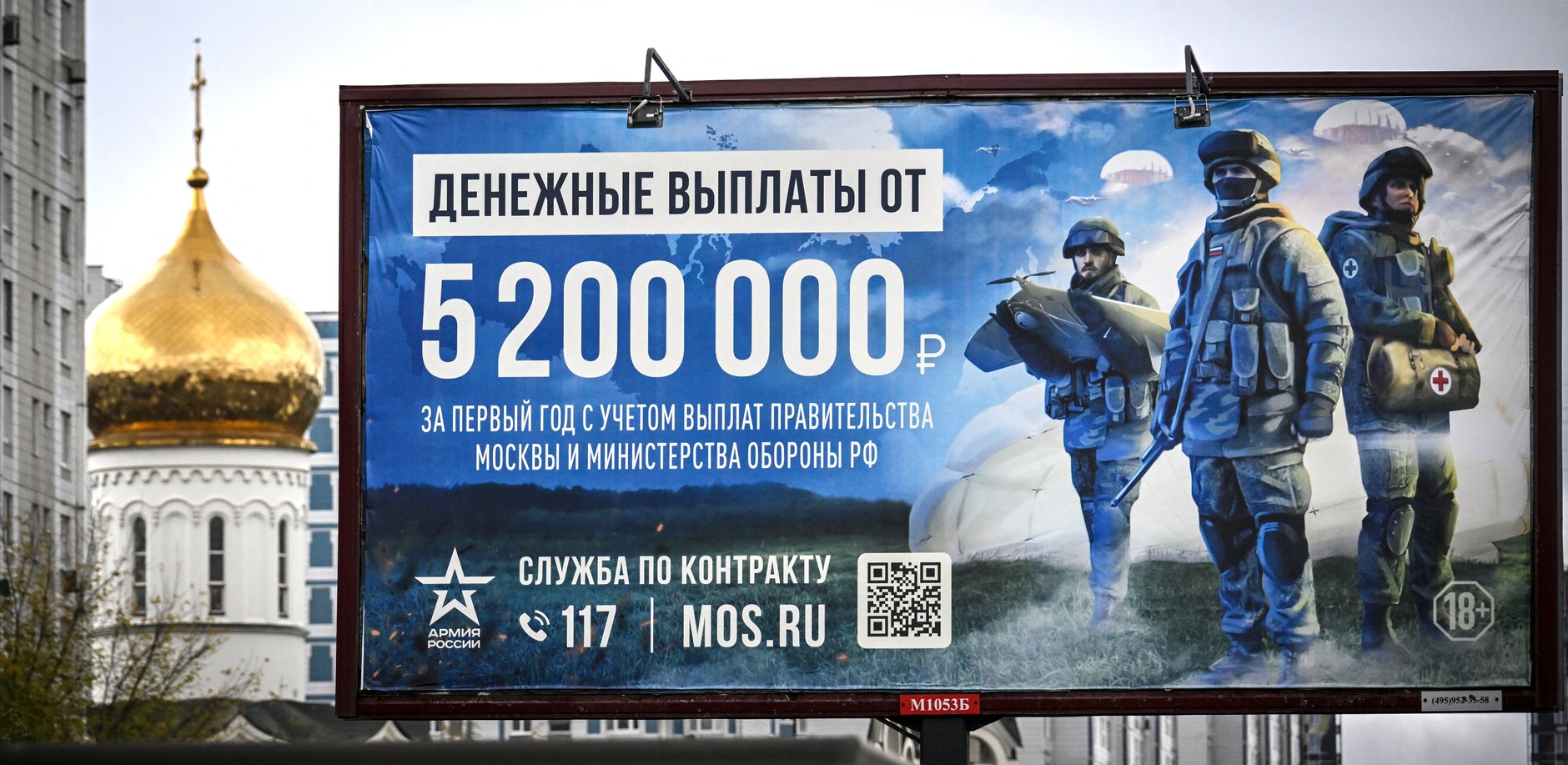
Billboard promoting service in the contract army with the inscription “5 million 200 thousand rubles for the first year of the contract”, Moscow, October 14, 2025.ALEXANDER NEMENOV / AFP POOL / AFP / AFP
More than 30,000 contracts are signed monthly. people. In October, their number increased to 37,000. 938, although it is less than in October 2024 (41,292). In September, the number of “signatories” was also lower than in the previous year, but increased in August, the data shows.
At the same time – as the analyst notes – these data may indicate an increase in losses on the front. It is true that only 13 regions include information on payments for the fallen in their budgets, but “it is easy to confirm that currently [na froncie ukraińskim] 5-10 thousand die. Russians a month,” that is, over 200 people a day, Kluge says.
He notes that the payments represent the minimum number of actual casualties, not the maximum, because not every soldier has relatives eligible to receive the payment, and not all eligible relatives receive it.
I’m Ashley Davis as an editor, I’m committed to upholding the highest standards of integrity and accuracy in every piece we publish. My work is driven by curiosity, a passion for truth, and a belief that journalism plays a crucial role in shaping public discourse. I strive to tell stories that not only inform but also inspire action and conversation.