Ceaușescu's Romania amazed Westerners: “They stand in queues for claws and wings. No one seems to know where the rest of the birds are”


Remembered with nostalgia by some Romanians, Nicolae Ceaușescu had become, in the 1980s, an almost anecdotal figure for the Western press, stunned by the cult of personality he imposed on a people tormented by shortages and fears in the face of an oppressive regime.
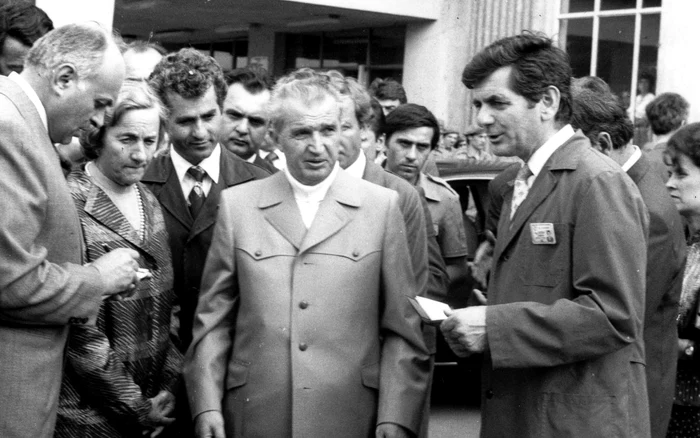
Ceausescu in 1986. Source: Fortepan Sütő András, Új Élet editoség.
At the beginning of 1988, the cities of communist Romania presented a dystopian image to Western journalists, dominated by the presence of the communist president Nicolae Ceaușescu, whose 70th birthday had been turned into an international topic by the communist regime's press.
For days after January 26, 1988, the date on which the communist president had been celebrated, newspapers published congratulatory messages sent by politicians and representatives of the leadership of many states. Some were later proven to be false. Numerous exhibitions were organized in his honor, and the tributes seemed to be endless. Everyone seemed to have reasons to publicly thank the “great hero of the nation”, as he was called by the Scînteia newspaper.
Ordinary Romanians tried, instead, to forget the sufferings and deprivations they faced during the winter, which most of them faced in silence, for fear of the oppressive regime led by the man illustrated in most of the portraits that adorned the streets, shop windows and walls of the cities.
The series of tributes in the cruelest years of the Ceaușescu regime
Charles T. Powers, the Warsaw correspondent of the Los Angeles Times publication and one of the most acclaimed American journalists of the time, traveled to Romania during the last years of the Ceaușescu regime and revealed what the Romanians actually thought about the poets nicknamed the “Golden Man of the Carpathians”.
“Ceaușescu is 70 years old, and his birthday in January was celebrated with solemn party meetings, full pages of gray newspaper accounts, three national museums that organized official “tributes” to his achievements, and documentaries broadcast repeatedly in the two hours of daily television programming, in which choirs of workers and schoolchildren, in brightly colored costumes and in the sunlight, sang hymns of gratitude for his very existence.”he recalled in the LA Times.
He added that a cult of personality had arisen around the party leader and his wife Elena, a cult surpassed only by that of North Korean dictator Kim Il Sung. With the help of hired writers and the state treasury, he published 145 books abroad, all aimed at promoting his image as a fighter for international peace and disarmament.
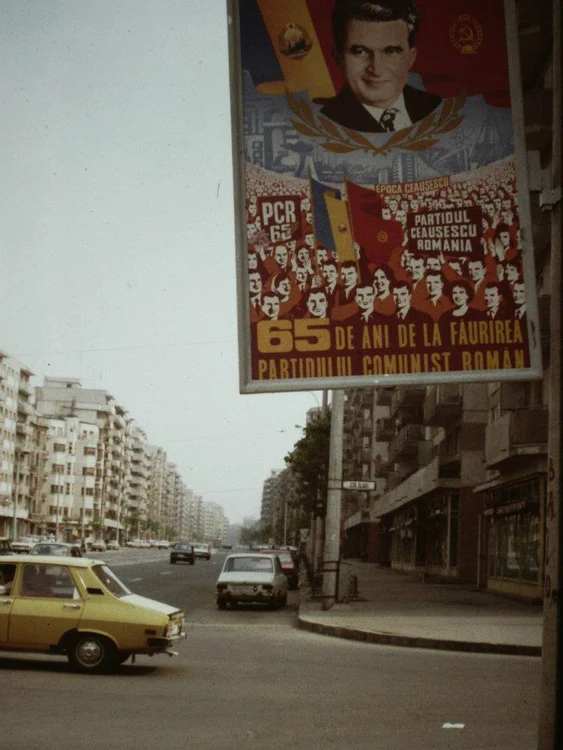
Romania in the 80s. Source: Wikipedia.
“The photo of Ceaușescu, taken at least 20 years ago and colored pink, with full cheeks, brown hair, thick and wavy, smiles from public buildings, state offices, shops, hotels, an unwitting parody of the gray and sharp figure he has become. Roadside billboards, near rural football fields and local markets, praise the Ceaușescu Era. Official scribes often write the pronouns “He” and “She” with capital letters, as if the Ceauști had acquired a divine aura”observes the Western journalist.
According to him, the national mechanism for glorifying Ceaușescu was tireless and shameless.
“On the occasion of his recent anniversary tribute, state media published congratulatory messages from foreign leaders, including Queen Elizabeth II of Great Britain, King Baudouin I of Belgium, King Juan Carlos I of Spain and King Carl XVI Gustav of Sweden. This sparked protests from those governments: the messages, it turned out, were fake, made up of fragments of old protocol texts.”added Charles T. Powers.
All this was not a joke for the 23 million Romanians forced to live not only with the egos of the Ceaușescu family, but also with the growing insecurity of the regime and its dependence on police control.
Ceaușescu honored, Romanians at the height of poverty
The scenes in the streets suggested something that could be described, he claimed, as an exercise in a prison yard.
“People are standing in line on sidewalks sticky with mud from the president's massive demolition and construction projects to buy plastic bags of chicken scraps: claws and wings. No one seems to know what happened to the rest of the birds. That's on a good day. In fact, many butchers have simply closed down. The ones that are left are selling pieces of pork bacon and some kind of sausage gray. No one has seen a potato in the markets for months. There are carrots, beets, and small apples. For the seventh winter in a row, meat, butter, and oil have been rationed.” the journalist reported.
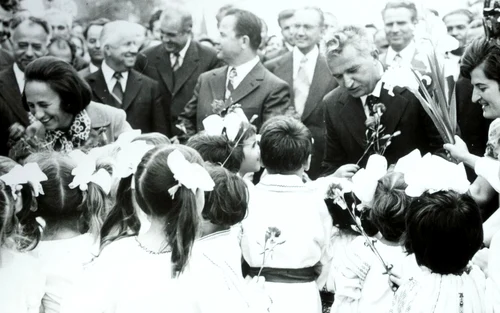
Image 1/6:
Nicolae Ceausescu Photo Album Vaslui City Hall, National Museum of Romanian History 001 jpg
In January 1988, a family of four was allotted 35 kilowatt-hours of electricity, which meant rooms dimly lit by 40-watt bulbs, and violators found themselves with bills equal to a month's salary.
Romania's blessing that year had been a mild winter, even though theatergoers wore their coats throughout the performance, and hundreds of thousands of residents of the blocks around the old city began cooking the stews of pork fat and carrots at 10 p.m., when the gas was turned on.
“The city sinks at night into a gloom that seems unreal for a capital of two million people. Shop windows are boarded up, the few restaurants close at 8 or 9 p.m. Half the streetlights are turned off. Winter fog rises from the wet streets, forming halos around what little light there is and amplifying the echo of footsteps in the darkness. Late at night, policemen, uniformed, in teams in groups of three, they stop the few citizens who dare to drive at such a challenging hour, check their documents, ask them where they've been and where they're going. It's like a place at war.” Charles T. Powers recalled.
Casa Poporului, the palace dreamed by Ceaușescu
In those years, the Casa Poporului (House of the Republic, the current Palace of the Parliament), the great dream of Nicolae Ceaușescu, had taken shape over the ruins of the old neighborhoods of the Capital. The works were started, symbolically, on June 25, 1984 by the communist leader, and in the following years, over 100,000 people arrived at the construction sites of the People's House and the current Union Boulevard. Almost 20,000 workers worked in three shifts, 24 hours a day, during the peak periods, and between 1984–1990, 12,000 soldiers participated in the construction.
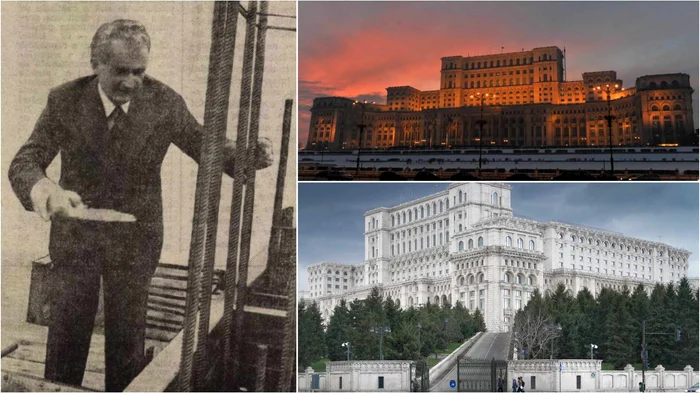
Ceaușescu and the House of the People. Source: Wikipedia. The Palace of the Parliament
“20 churches were destroyed, eight were moved, 10,000 homes were demolished, and over 57,000 families were evacuated. The following were demolished: Văcăreşti Monastery, the sacred hill for the history of Bucharest from Mihai Vodă, Brâncovenesc Hospital, the first medico-legal institute in the world, the Union Hall, the Operetta in Senate Square, the Army Arsenal and the Central Military Museum”. informs the International Conference Center – Palace of the Parliament.
Ceaușescu was directly involved in the project of the People's House and its boulevard, which, at his request, kept growing in volume and surface area, gradually engulfing other neighborhoods of Bucharest. The House of the Republic was erected with the structure and the walls “in red” in the first year after the start of construction, when, climbing on the terrace of the building, at a height of over 100 meters, Ceaușescu thought that the Boulevard of Victoriei Socialismului, which was taking shape in front of it, was too short, and he then decided to have it extended.
“According to Ceaușescu's instructions, no old building, no monument, no church was worthy to be part of the Civic Center of the Victory of Socialism. Absolutely all the historical monuments on the route were either demolished, or were translated and moved to suitable places”, showed the architect Gheorghe Leahu, in Annales Sighet (2003).
In the darkened Capital of 1988, only the construction site of the People's House remained visible from a great distance during the night.
“Up on the hill, the work continues all night. When almost all other lights go out, one can still see, up in the iron scaffolding of what is called the Government Palace, the blue flash of welding lamps, a building with the height and approximate contours of a post-modern pyramid, which many believe is, in fact: Ceaușescu's monument to himself.” he says.
Around 20 percent of the old city of Bucharest was destroyed to make way for the House of the Republic and the future boulevard of Victoriei Socialismului, outlined by huge blocks also under construction in the 1980s.
“The alleyways leading up to the huge building are as deserted as the new apartments. The street lamps, each with six globes and spaced 40 paces apart, are still off. The only light comes from the halogen floodlights that illuminate the construction. Up close, the building is purposefully impressive and yet strangely obscure, smoldering with dust, welding fumes, and night fog. From somewhere above, the cries of workers can be heard unseen, distant but insistent, echoing back and forth, descending to the dark street below' the journalist reported.
The survival of the Romanians depended on Kent cartridges
The journalist noted that in 1988, Nicolae Ceaușescu had been in charge of Romania for 23 years. At first he was admired in the West, and the 70s were a relatively prosperous period for Romania. The country then borrowed heavily and invested in heavy, energy-intensive industries, accumulating about $10 billion in debt.
In 1980, Ceaușescu decided on the quick repayment of the loans. The national economy was export-oriented, in order to obtain hard currency needed to pay debts, while severe austerity measures were imposed on Romanians.
The meat reserves were exported, and the Romanians had to make do with the leftovers. Living conditions steadily worsened, and fear of the regime had become a national disease due to wiretapping and legions of informants in the Security Service.
“The blatant lie becomes the national truth. Thus, on a city tour, the hotel guide, when he sees the queues of people in front of the shops, has an explanation: In fact there are no shortages of anything, Sometimes there are only supply problems”, the journalist notes.
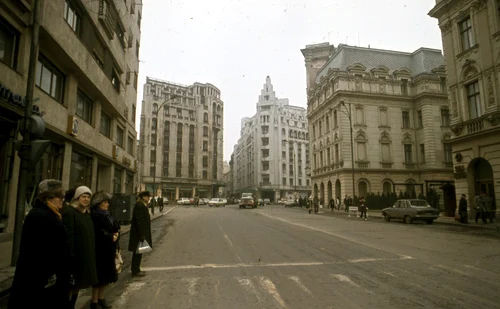
Image 1/7:
Bucharest Source Urbán Tamás Fortepan (1) jpg
The Romanians were trying to survive from scratch, and along with currency, coffee and cigarettes were the most trafficked products.
“The fixation on Kent cigarettes remains one of Romania's bizarre economic mysteries. Neither the Romanians nor a spokeswoman for the company that once produced Kent could explain how or when the whole story began. But since Romanians are forbidden to own currency, Kent cigarettes have become a substitute for money. Some people actually smoke them, although this is a sign of ostentatious advantage, kind of like lighting cigarettes with bills.” added the journalist.
In practical terms, a Kent cartridge could buy a set of dentures, secure an appointment with an important doctor or a hotel prostitute. Twenty cartridges could get a person on the waiting list to buy a color TV, and two or three packages offered at the back door of a restaurant could provide a month's worth of meat.
“A single packet, waved at the curb, will cause fights between taxi drivers. A single cigarette is a reasonable tip for a quick waiter”added Charles T. Powers.
Behind a hotel bar, Kent cartridges were stacked in pyramids, he observed, like stacks of money in Las Vegas casinos, suggesting wealth, prosperity, and good luck.
“But their presence is an unspoken acknowledgment of Romania's desperate situation: these cigarettes are bought by foreigners and distributed to people, a kind of necessary grease for the creaking mechanism”. concluded the journalist.