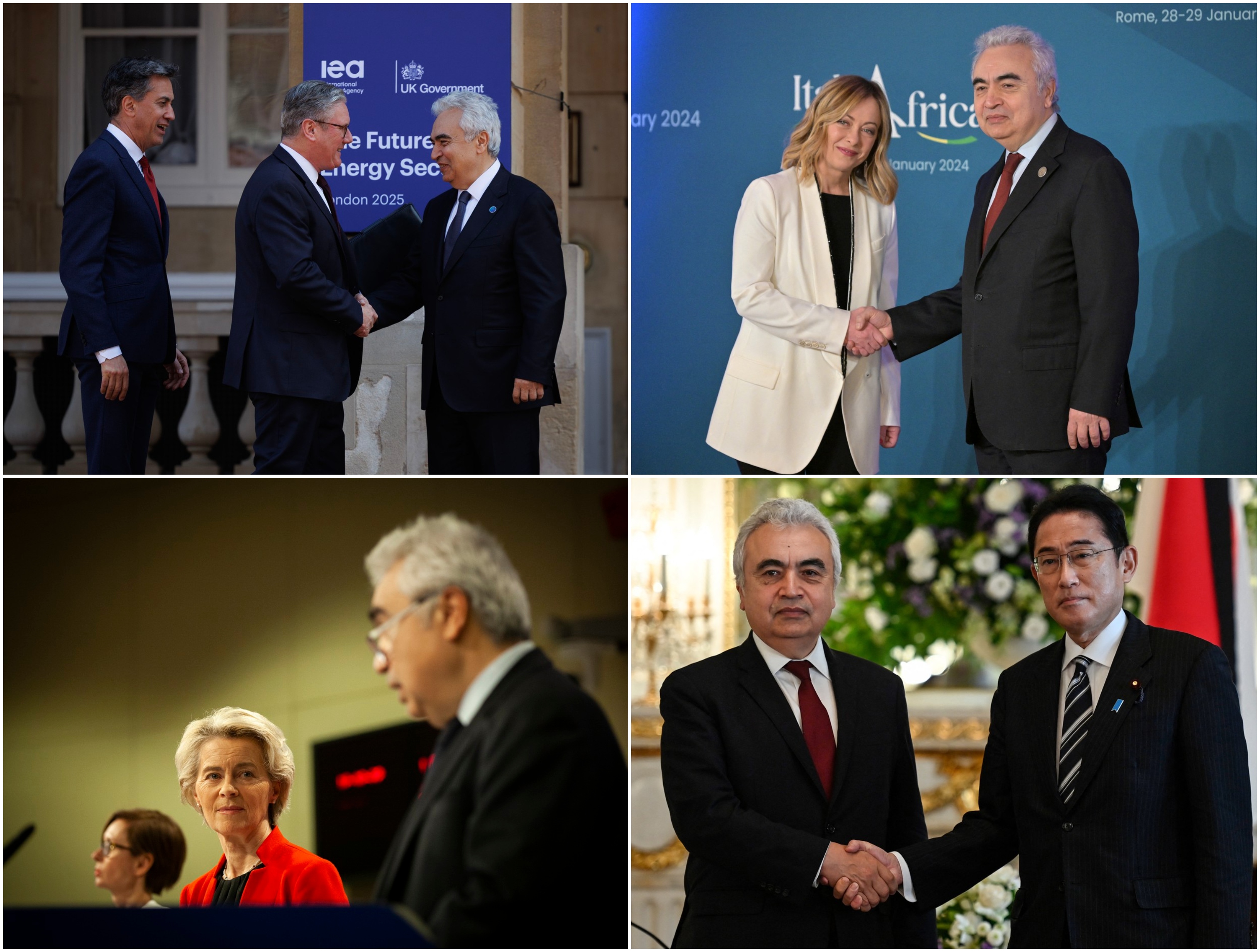
Politicians, oil giants and climate activists are hanging on his every word. The Trump administration has criticized him harshly. How did an economist come to be known all over the world?
The New York Times tells the story of Fatih Birol, a Turkish energy economist who ten years ago became director of the International Energy Agency (IEA), the autonomous intergovernmental organization that provides policy recommendations, analysis and data on the global energy sector.
An important meeting of Birol with the US Secretary of Energy, Chris Wright, who had just publicly criticized the IEA, calling it “absurd” because it had predicted that demand for fossil fuels would soon begin to decline globally, would have been impossible ten years ago, the American publication notes. But the fact that it took place shows how much influence the IEA has gained under the Turkish economist's tenure.
Birol likes to joke that he is “the most boring man in the world”. But he led the IEA during a decade in which energy re-emerged as a geopolitical weapon.
The debate over how to tackle climate change is upending economic and diplomatic relations around the world — even as the Trump administration works to reverse the global trend toward renewable energy by producing, consuming and exporting as much fossil fuel as possible.
Fatih Birol has repeatedly warned the fossil fuel industry that it must adapt or fail, especially as solar power grows at a rate that even the IEA has underestimated.
Whether we agree with the IEA or not, its relentless stream of data-driven reports regularly roils markets, influences billions of dollars in investment, and draws the admiration and scorn of politicians, energy executives and climate activists, who are hanging on Birol's every word, the NYT notes.
IEA, tensions with the US and accused of “unrealistic” plans
More than a dozen countries have awarded Birol with state awards. He holds the Order of the Rising Sun First Class of Japan, the highest state honor awarded to lay persons, as well as the Order of Zayed, awarded by the United Arab Emirates in honor of its founder.
“The more important we become, the more people want us to sing their song,” Birol said of the attention he's getting from people across the political and economic spectrum. “But our song is data. Data always wins.”
However, compiling raw data from its dozens of member states is only part of the IEA's work. Under the leadership of the Turkish economist, the IEA has become an organization that outlines different paths the world could take in terms of energy consumption and provides roadmaps to get there.
The organization's members, mostly Western countries, increasingly look to it for guidance, even though the IEA has occasionally been wrong about important issues, such as the rate of growth of solar power or the speed of coal's decline. Perhaps the most important question of all – whether or not the world is approaching peak demand for fossil fuels – is one that the IEA has revised its answer to several times.
The fact that the IEA is making such a prediction has created tensions between the agency and the Trump administration, which has dismantled nearly all US climate policies. The United States contributes about 14% to the IEA's budget. Republicans accused the agency of publishing “politicized information to support the promotion of climate policies.”
Many representatives of the fossil fuel industry share a negative view of the IEA. The head of OPEC, the oil-producing bloc, said this year that the IEA had an “anti-oil narrative” and that its action plans were “unrealistic”.
But Birol says he's not telling anyone what to do, just what is most likely to happen. And, for now, he has convinced Washington not to impose sanctions. Meanwhile, the organization is set to welcome two new members who are major energy players: India and Brazil.
India's ambassador to France from 2020 to 2024, Jawed Ashraf, who knows Birol well, said the IEA's forecasts are particularly important for countries trying to balance economic growth with their commitments to reduce greenhouse gas emissions.
“What Fatih did was to apply the full power of data collection and modeling at a granular level, which actually gives a clear idea of the effort required to achieve the climate goals,” Ashraf said. “In some ways this is more relevant than the United Nations climate negotiations. The IEA informs them, not the other way around.”
The major change from the IEA
The International Energy Agency was created by then-Secretary of State Henry Kissinger in the 1970s, at a time when climate change was not part of the political vocabulary. The agency's original mandate was to monitor global oil supplies and help countries coordinate to prevent energy price shocks.
In 1973, a group of Arab oil producers blocked oil exports to the United States and other countries to protest support for Israel. This led to skyrocketing prices, fuel shortages and a period of economic crisis known as “stagflation”.
Birol was a young film student in Vienna when the agency was in its infancy. But his passion didn't make a living, so he switched to energy economics and took a side job at an agricultural produce market. After graduation, he became an analyst at OPEC.
He moved to the IEA and advanced in his career for two decades, until he was elected executive director in 2015. Alternative energy sources, such as solar, wind and natural gas obtained from hydraulic fracturing, were on the verge of significant growth.
The agency expanded its focus from oil to analyzing how these sources could power vehicles, data centers and heavy industry. Climate change began to become a hot political issue as the science linking its causes to greenhouse gas emissions became clearer.
Shortly after taking office, Birol initiated a major shift in how the organization envisioned the future. Previously, the agency had only predicted what would happen to global demand for fossil fuels if countries continued on the same path. These reports generally suggested a long-term increase in fossil fuel consumption.
But in 2020, the agency replaced that scenario with one that took into account the policies countries were most likely to adopt, based largely on their pledges to cut emissions in global climate negotiations. At the time, Birol said this scenario offered a more realistic picture of the world's energy future. But it also marked the beginning of a rift between the IEA and many fossil fuel advocates.
The IEA also published a so-called “net zero” scenario, which, rather than just a projection of the future, set out 400 milestones the world could reach in its effort to completely stop greenhouse gas emissions in the atmosphere by 2050.
One of these goals was to eliminate all investment in new coal, oil and gas fields. This became a mantra for climate activists, although Birol later clarified that the IEA was not prescribing an action plan, but merely stating that it would eventually happen as the world worked towards net zero greenhouse gas emissions.
Even as the IEA's work attracted more attention and criticism, Birol remained popular. He was unanimously elected by the organization's member states for a third four-year term, which will end in 2027.
“I'm here to make people think about the future – to really imagine it, which is very difficult,” he said. “Climate change is a good example of this. People only pay attention when a catastrophe happens. But we need a plan for that,” said Fatih Birol.