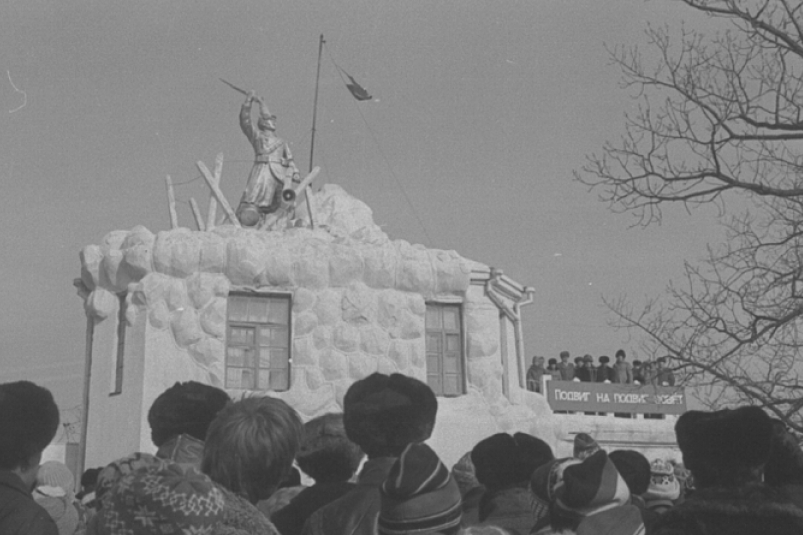
Memorial on Volochaevskaya Sopka. 1985
Photo: State Archive of the Jewish Autonomous Region
November 11, 1928
A monument-museum was erected near the village of Volochaevka-1 on the June-Koran hill.
After the Volochaevsky battle, Vasily Konstantinovich Blucher, commander-in-chief and chairman of the Military Council of the People's Revolutionary Army, issued the order:
“In the battle of Volochaevka, boundless in valor, many of the best sons of the working people died the death of the brave. The names of these comrades should be written on the brightest page of the history of our struggle for the revolution and our native land. The memory of the fallen should be given the honor that they deserved with their heroic death for the common workers’ and peasants’ cause.
I order: Immediately collect the bodies of all those who died with selfless valor in a fierce battle near Volochaevka and bury them in a common mass grave at the top of the June-Korani hill, and erect a worthy monument over this grave. Let the last resting place of the red eagles constantly remind all citizens of our republic of the glorious page of the struggle of the people's revolutionary army and inspire the fighters to new feats to achieve our historical, revolutionary goal in the Far East.”
All the bodies of the fallen soldiers were buried in a mass grave. A year after the capture of Volochaevskaya Hill, a temporary monument was erected – a wooden obelisk, painted with oil paint with a tin star on top. A memorial plaque was placed with the inscription on it: “Here lie 118 soldiers who fought for the victory of the Soviets in the Far East, who died a brave death in the fight against the interventionists during the storming of the Volochaev fortifications on February 12, 1922.”


Subsequently, a decision was made to build a permanent monument. On November 11, 1928, a monument-museum to the heroes of the Civil War was opened on the June-Koran hill. The author of the sculpture of the People's Army soldier was the Hungarian internationalist, an Austrian prisoner of war who remained in Russia after the imperialist war, A. A. Badonyi. He also took part in the Civil War on the side of the Red Army and stormed Volochaevka.
By 1945, a memorial museum was already located in the school building.

Day in the history of the Jewish Autonomous Region. Photo: Photo: Regional Library
November 11, 1970
On November 11, 1970, the newspaper “Birobidzhanskaya Zvezda” (12+) published Decrees of the Presidium of the Supreme Soviet of the RSFSR on awarding the regional newspapers “Birobidzhanskaya Zvezda” and “Birobidzhaner Stern” (12+) with the Certificate of Honor of the Presidium of the Supreme Council of the RSFSR.
The same newspaper contains congratulations to the newspaper editors from the Khabarovsk Regional Committee of the CPSU, the Executive Committee of the Regional Council of Workers' Deputies and other congratulations. Also published were decrees conferring the title of Honored Worker of Culture of the RSFSR on the editorial staff of regional newspapers: Alla Grigorievna Avdoshina, Yakov Efimovich Gurevich, Meyler Beru Srulevich; on awarding the Certificate of Honor of the Presidium of the Supreme Council of the RSFSR to Naum Abramovich Korchminsky, Ilya Vasilyevich Evgrafov, Grigory Shmulevich Mitsel, Roman Abrosimovich Skurlatov.
November 11, 1982
The plenum of the regional committee of the CPSU discussed the tasks of the regional party organization to increase the production of grain and feed, and their effective use.
Determining the main directions of development of the country's national economy for the current five-year period and for the future, at the plenum it was said that it is necessary in the near future to carry out an inventory of adopted crop rotations on state and collective farms. Make changes, where necessary, to the structure of sown areas.
The report from the plenum was published in the Birobidzhan Star newspaper.
“Autumn tillage of fields is of great importance for obtaining high and sustainable yields. In order to minimize the impact of drought, waterlogging and associated water and wind erosion of soils, it is necessary to introduce, first of all, a soil protection farming system in the farms of the Leninsky and Oktyabrsky districts. The level of soil fertility largely depends on the correct use of organic, mineral and lime fertilizers.
It is necessary to expand the planting of such high-yielding fodder crops as paisa and Sudan grass, and to decisively improve the production of fodder root crops and melons.
There are still many unresolved problems and untapped opportunities in all areas of the regional economy. The task is to activate all available reserves and ensure highly efficient and coordinated work in all areas of production.”
November 11, 1993
In accordance with the resolution of the head of the administration of the Jewish Autonomous Region dated November 11, 1993 No. 2623, the regional hunting and fishing management department was transformed into the hunting management department of the Jewish Autonomous Okrug administration.
Main functions of management: control and regulation of the use of wildlife objects classified as hunting objects, their habitat in the region.