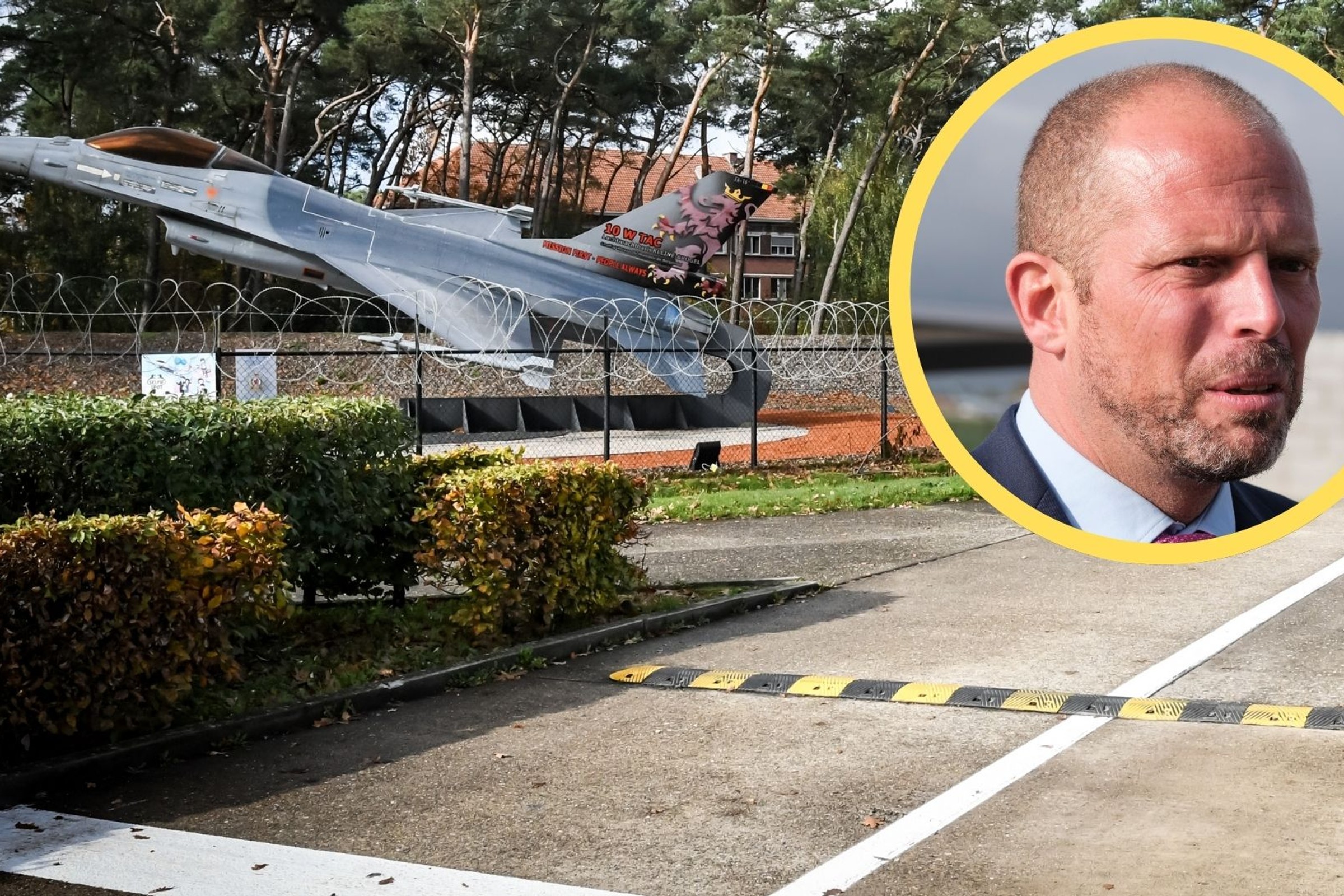
Drones over Belgian airports and bases are not everything. The repeated incidents fell squarely on Belgium's fragile five-party coalition government. The authorities are currently engaged in tense negotiations over the 2026 federal budget and key defense spending commitments. And this doesn't make the task easier.
Violations may prove beneficial for the alliance in the long run, says retired US Army Colonel Richard Williams, former deputy director of NATO's Defense Investment Division. In his opinion, recent events force us to adapt more quickly to new conditions. He talks directly about the “drone wall”.
The most disturbing incident occurred on Saturday evening and continued until Sunday. Francken confirmed in a social media post that three separate reports were received overnight.
The presence of suspicious drones – which resulted in a 20-minute suspension of flights – sparked an immediate but ineffective response.
In order to neutralize the threat, a military device that disrupts the operation of drones was used, but it did not bring the expected results. There may be two reasons – either the high altitude of the targets or a specific radio frequency.
The situation was made worse by the common a pursuit by police vehicles and a military helicopter, which lost sight of the drone after a few kilometersas it reportedly flew north towards the Dutch border.
“A drone jammer was used, but to no avail,” Francken said. — A helicopter and police vehicles chased the drone but lost sight of it after several kilometers.
“Clear order” regarding espionage
Kleine-Brogel is one of the most sensitive military installations in Europe. Currently, American F-16 aircraft capable of carrying nuclear weapons are stationed there, and advanced F-35 aircraft are to be deployed there from 2027, making this base a key element of NATO's nuclear deterrence strategy.
Francken clearly characterized these observations as an espionage operation intended to probe the base's defense systems and resources.
“They come to spy, to check where the F-16 planes are, where the ammunition is and other information of strategic importance,” Francken told local media, confirming what the military has long feared: NATO's critical infrastructure in Belgium is actively monitored.
He noted that the “long duration” that one of the drones observed the base suggested deliberate intelligence gathering. The investigation is currently ongoing. Francken is scheduled to meet with police next week to “assess the threat and take the necessary steps to find and arrest the drone pilots.”
The article continues below the video
There have been a lot of violations recently – observations over military installations in nearby Leopoldsburg Camp, the largest military facility in Belgium, above Elsenborn Camp [w pobliżu granicy z Niemcami]as well as civilian airports. The drones over Kleine-Brogel are the latest in a series of incidents.
Francken is scheduled to unveil a new $58 million plan next week [214,5 mln zł]aimed at rapidly implementing a national counter-unmanned aircraft system (CUAS), financing detection systems, jamming devices and “anti-drone weapons.”
The failure of existing countermeasures at Kleine-Brogel provides direct, indisputable evidence of why funding must be found in a limited budget where defense spending is often the subject of political disputes.
New NATO front: debate on the “drone wall”
Although Francken did not go so far as to blame Moscow directly, the implications were obvious.
“The Russians are trying to do this in all European countries,” he noted, linking violations of Belgian airspace to a broader pattern that includes the interception of Russian drones over Poland and Romania and the disruption of flights at airports in Denmark, Norway and Germany.
The airspace violations highlight a growing debate among EU leaders about feasibility continental “drone wall” to strengthen Europe's eastern flank.
This idea, which has gained popularity following the recent aggressive incursions of Russian aircraft into NATO airspace, is to create a continent-wide defense network combining radars, jammers and interception devices.
Retired US Army Colonel Richard Williams, former deputy director of NATO's Defense Investment Division, claims that the violations may prove beneficial in the long run, forcing faster adaptation to the prevailing conditions.
The strengthening and long-term improvement of counter-unmanned aircraft systems (CUAS) will have a positive impact on the Belgian and NATO counter-drone network and potentially accelerate the planned deployment of F-35 aircraft to Belgium
Williams says in an interview with Kyiv Post.
The increased ability to shoot down drones will, in his opinion, “benefit the alliance.”
For now, the identity of the pilots controlling the drones remains a secret. But for Brussels, the message conveyed over three nights is clear. “The war is really a drone war, and the Department of Defense really needs to prepare for it,” Francken concluded.
I’m Ashley Davis as an editor, I’m committed to upholding the highest standards of integrity and accuracy in every piece we publish. My work is driven by curiosity, a passion for truth, and a belief that journalism plays a crucial role in shaping public discourse. I strive to tell stories that not only inform but also inspire action and conversation.