An alleged computer attack on Saturday caused major dysfunctions in several international airports, including Heathrow (London) and Brussels, where check-in and boarding systems have suddenly yielded, generating chaos among passengers and personal. Officially, the explanation was a “technical problem”, but the cyber security specialists look beyond the dry formula of official communications and wonder if we are witnessing a “costume test” for a much larger attack.
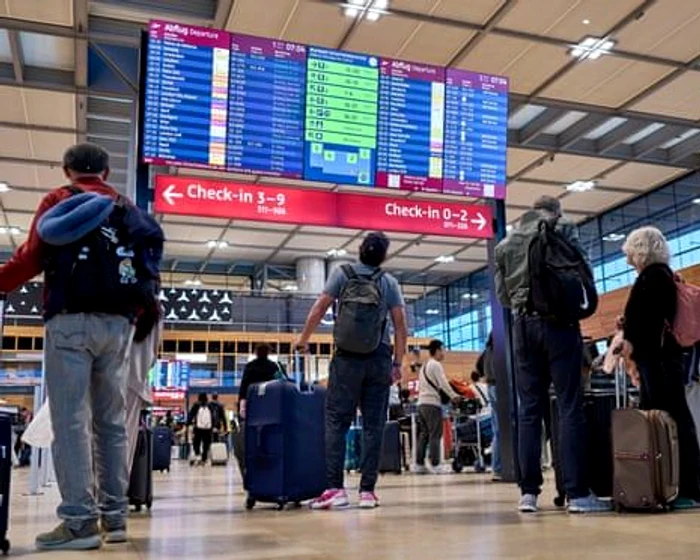
Great airports affected by a cyber attack/photo: x
At the origin of the blockage is Muse – a computer platform developed by Collins Aerospace, a technology provider for about 150 airports worldwide. The system is used in common check-in, boarding gates and luggage teaching kiosks. In the absence of normal museum operation, airlines were forced to return to manual procedures.
Professor Alan Woodward, a cyber security expert and associate professor at the University of Sussex, points out that the lack of transparency around this incident suggests a deliberate action than an isolated technical accident. “Cyber criminals operate for money. Network infiltration is usually followed by blackmail. I say,” We can stop everything, if you don't pay. “This seems to have been a test,” says Woodward, quoted by the British publication.
Its concern is doubled by a difficult to ignore: if Muse is a standard system used in hundreds of airports, why have only been affected? Was it an update with an inserted malware? Why did some air traffic nodes be hit, and others right? “More questions are raised than answers. And there is total silence from those involved,” says the teacher.
In fact, recent cases like the Jaguar Land Rover – where an initially minimized computer science has proven to be much more serious – offers an uneasy precedent. In such situations, underestimating the extent of the problems can lead to financial and reliable losses to recover. “Cleaning a compromised system implies, most of the times, its complete stop. And in a system as interconnected as aviation, that means hundreds of thousands, maybe millions of affected passengers,” Woodward warns.
Who is Collins Aerospace?
Few passengers have ever heard of this name, but Collins Aerospace is the key supplier of digital infrastructure for many of the soil operations of airlines. From luggage handling software to aircraft technology, the company-owned by the American giant RTX-is a true pillar of the industry. Including the British government is among Collins customers.
The fact that an entity of this magnitude has been vulnerable generates concern among specialists and authorities. “It is an alarm signal. If the systems of such a big player can be altered, what guarantees do we have that the entire global network cannot be paralyzed in one move?” Asks Paul Charles, transport expert.
On this tense background, the former military information officer, Colonel Philip Ingram, states that the attack bears the “classic imprint” of a Russian influence operation. “It is very possible to be the Kremlin's hand,” he told the Daily Mail. Moreover, the concept of “attack by the supply chain”-by which it does not directly attack a target, but its key suppliers-has become an increasingly common tactic.
Cyber security in aviation: from rhetoric to reality
In the face of this context, Woodward warns that the only viable strategy is to adopt a “deep” computer security model: the assumption that any system can be broken and the creation of multiple barriers, on the concentric model of a medieval fortress. “It is not a matter if, but since. Companies must know immediately when they have been compromised and limit the effects. Not to wait for confirmations, but to act,” stresses the teacher.
On Saturday, the same day with the problems in the big European airports, the Terminal 2 of the Dublin airport was evacuated due to a security alert. Coincidence or indication that the attack has larger ramifications?
Officially, the investigation is ongoing. Unofficially, the silence after the Saturday incident seems rather a sign that something bigger is coming, says the Brianic publication.