Mariia Tsiptsiura: What is the current situation around Pokrovsk? How serious is she?
Roman Switan: She is very serious. During the summer campaign, the Russians took advantageous positions to surround the Pokrov-Myrnograd agglomeration. They approached from the southwest, through Udachne and Dymitrowe, along the railway line from Mezhova to Pokrovsk and practically reached the southern suburbs of the city. Their sabotage and reconnaissance groups operate there.
From the north they are trying to surround Myrnohrad and advance between Myrnohrad and Rodynsky. They have already occupied the southern part of Rodynskie. In this way, they are trying to cut off our main logistic lines.
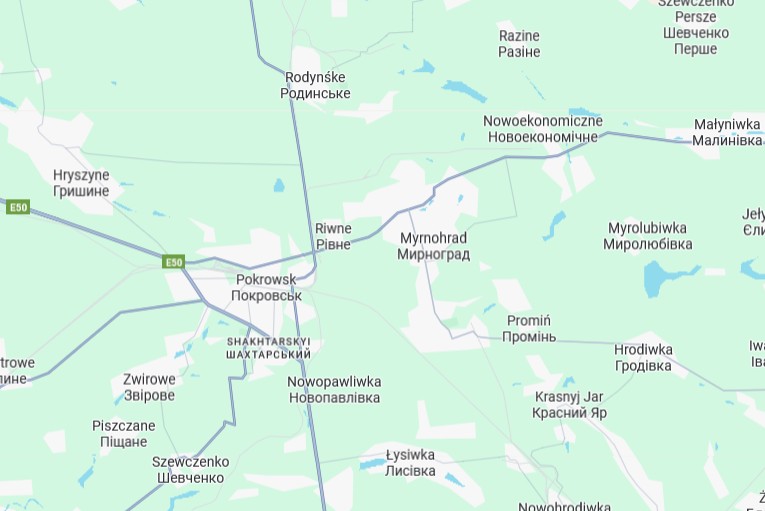
Pokrovsk and Myrnohrad areaGoogle Maps
“Grey zone” in Pokrovsk. The Russians are besieging the city. “We still have a chance”
So, if I understand correctly, they have already taken part of the city?
They partially occupied the southern part of Pokrovsk. But you have to understand it well: war does not look the same today as it did a hundred years ago, so the Russians did not occupy this part of the city in the classic sense of the word. There are individual small groups operating there and it cannot be said that they completely control the territory. That is why we are currently conducting an operation to destroy them. Our assault units are operating there. This is the so-called “gray zone”.
The article continues below the video
Have the Russians already occupied the entire southern part of Pokrovsk?
What are the possible scenarios for the development of the situation in Pokrovsk?
What would the loss of Pokrovsk mean for Ukraine?
How long can the intensity of Russian attacks last?
And as for the north of the city?
From the north, they are trying to get between Rodynsko and Myrnohrad – this practically means half-surrounding our agglomeration. They also entered the southern part of Rodynskie.
Currently, there are constant attacks by the Russians. They carry out over 200 attacks a day along the entire eastern front line. That's twice as much as before. Therefore, the situation is difficult, but not critical for now.
The Pokrovsk exit still exists, allowing ammunition to be delivered and soldiers to be evacuated. Therefore, we cannot talk about complete encirclement yet.
How can the situation continue to develop?
The situation is not critical yet. We still have the option of unblocking one of the directions: either to push the Russians out of the Rodynsky area to prevent them from advancing from the north, or to stop them in the western direction, along the railway line.
If we manage to push them away from Myrnohrad, the situation will become difficult for them, because mini “cauldrons” are forming in the Dobropol area, north of Pokrovsk and Myrnohrad. However, if we do not do this, we will have to decide to withdraw from Pokrovsk.
The Russians storm Pokrovsk. “Losing the city would be dangerous for two reasons.”
What would the loss of Pokrovsk mean for Ukraine?
The Pokrovsko-Myrnograd agglomeration is the third line of defense, in fact the last line before the Dnipropetrovsk Oblast. The loss of Pokrovsk would open the way for the Russians to the Dnieper, to the so-called operational space. Then only Pavlohrad and the Dnieper River will be able to stop them. It's about 200 km, so such a loss would be extremely serious for us. Therefore, maintaining Pokrovsk is crucial.
After Pokrovsk, the next goal of the Russians would be to capture Slavyansk and Kramatorsk. Sloviansk is particularly important for them, because this is where the Seversky Donets-Donbas canal begins. Currently, Donbas is practically without water. That's why the Russians are trying to reach Slavyansk from the direction of Dobropol and Pokrovsk. As long as Pokrovsk holds on, this is a very risky maneuver for them because we can attack on the left wing.
Losing Pokrovsk would be dangerous for us for two reasons: it will open the road to the Dnieper and create conditions for occupying the Kramatorsk-Sloviansk agglomeration. Therefore, Pokrovsk must be maintained at all costs. Perhaps a counter-offensive should be launched to push the Russians past the Pokrovsk-Kostantynivka route. This would stabilize the situation.
What about other sections of the front?
There is almost no positive dynamic. There are tactical successes, but not operational or strategic ones. The Russians are advancing between Hulyapol and Pokrovsk, trying to widen the land corridor. They're having some success there – they've advanced about 20km in a year. They are also trying to bypass Hulaypole from the north, towards the Pokrovsky region.
However, the Kostantynówka area is problematic: the Russians are also trying to put pressure there, although the situation here is not yet as difficult as around Pokrovsk or Kupiańsk. Because the defense of Kupiańska is one of the biggest challenges. The Russians already control about half of the city, we hold the southern part, trying to maintain logistics on the left bank. If we lose the logistic routes, the group on the left bank will be left without supplies.
And if the decision is made to withdraw from the left bank, it will mean the loss of the Kupański knot. Then it would become an important logistics center for the Russians.
How long will the Russians be able to maintain this intensity?
We are at the peak of the second wave of the Russian offensive in the 2025 campaign. They are now carrying out over 200 attacks a day, twice the usual number.
This pace will likely continue for another month, maybe a month and a half, until the rains and frosts begin. Then the number of attacks will decrease: either because the ground is soggy or because the ground is frozen.
Russian losses are currently huge. That's over a thousand people a day. At this rate, they will be able to maintain this offensive for about another month and a half.
Does this mean there will be a break after that?
Yes. There will be an operational break, during which we may observe a reduction in the intensity of hostilities. The Russians will have to gather forces, equipment and ammunition for a new campaign, which will begin in the summer of 2026.
Such a break may last from 3-4 to 5-7 months, depending on the resources of the Russian economy. This year, they launched a large-scale offensive only after six months of gathering forces.