The Romanian delicacies that give class to the omelette. Traditional Moldavian and Transylvanian dishes that turn breakfast into a treat


The omelette was imported by Romanian gastronomy precisely from France. Fewer and fewer Romanians, however, know that Romanians also have traditional recipes similar to omelettes, even more delicious and less messy. They have different names and recipes depending on the ethnographic region.
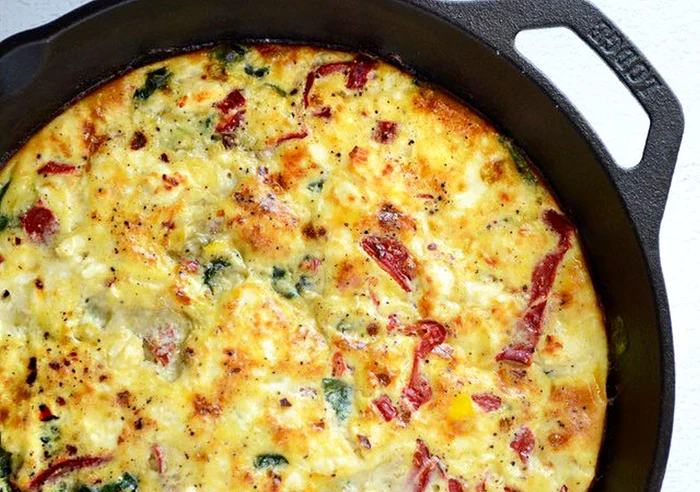
variant of omelette PHOTO the truth
One of the most popular breakfast dishes in Romania is undoubtedly the omelette. And that's because it meets several qualities. It's easy to make, it's cheap and on top of that it's delicious. Not to mention versatility. That is, we can put a lot of other ingredients in it, according to taste. The omelet, however, is a valuable French import in Romanian cuisine, since the 19th century. For the Romanian from the countryside, especially, but also for the cooks of the noble houses or the slums, the omelette was not something unheard of. On the contrary, in traditional Romanian cuisine there are quite a few recipes with beaten eggs with different ingredients.
And some of them can be much more delicious than the usual omelette. Some recipes also appear in the literary works of Romanian writers. One of them, a real peasant delicacy, is mentioned, for example, in the story “Nepoata lui Moș Mitruț” by Ion Agârbiceanu, included in the volume “Files from the book of nature”. Her name was papara and she was a sister of the omelette from Transylvanian lands. The Moldovans don't let themselves down either and add a type of omelette from the east of the Carpathians, also called scrob, a real morning culinary indulgence that you can't help but fall in love with. Not to mention all the variants of Romanian scrambled eggs, based on the principle “how many people eat so many habits”.
“Romanians ate scrambled eggs long before they borrowed the French word”
When did the Romanians start preparing dishes from eggs beaten and fried in vegetable or animal fat? It's hard to say. There are no clear references on this. However, it is clear that Romanians ate scrambled eggs before the omelet made its way into Romanian kitchens. This is what Oana Topală, graduate in modern philology and philosophy, author of the intercultural project, awarded in 2021 in Brussels, and called “Les mots voyageurs – une histoire des mots venus d'ailleurs” says.
“The Romanians ate beaten eggs, fried in oil, long before they borrowed the French word, evidence is the existence of numerous synonyms, some of which are very old. “Eating a papara” The oldest is “papara”. The old meaning of the word was “food prepared from slices of toast sprinkled with breadcrumbs and scalded with soup, water or milk”. It is supposed to come from Neo-Greek and/or Bulgarian (“popara”). The word also appears in numerous familiar expressions, which proves not only its antiquity, but also its frequency: to eat a tick, to shoot someone's tick, etc.confesses Oana Topală on her personal blog oanatopala.eu. And the variety of scrambled egg dishes is quite large. A few of them have gained a special reputation.
Papara, the Transylvanian delicacy that can be eaten at any time of the day
One of the most famous traditional Romanian dishes made from beaten eggs is papara. It is a dish mainly found among Romanians from Transylvania. Obviously, especially in rural households. Papara has a lot of variations. Some peasant, simple, direct, others more bourgeois, more sophisticated. Either way the papara is delicious. Here is one of the most popular variants of Transylvanian papara. It can be served in the morning and at lunch, but also in the evening. A universal food of the peasant from Nassau, Brașov, Transylvania in general.
“Translated by some as omelette, which is true, but with nuances, papara is not only a dialectal-universal word but also an appetizing collection of variants. In the present case, even a much enriched variant of a primitive model. Papara is usually the dinner of the people of Nassau and Brasov, but also of Banat, married with some green onions and a good brandy”said the well-known gastronomy enthusiast Radu Anton Roman.
It is generally made with lots of eggs, cheese, butter and pieces of bread. Use six to eight well-beaten eggs. While beating them, with a whisk or a fork, add milk. White bread cubes are also soaked in milk. The cheese, usually a telemea but it also works salty sheep, mix well with two eggs.
After completing these tasks, we begin the thermal preparation of the papara. A large pan or a cast iron or tuci saucepan is used, which is greased with butter or, more rustically, with lard. In the hot lard or butter, put the bread soaked in milk, sprinkle the cheese, as a base. Later we add another layer, bread with cheese. Pour in the beaten eggs, mixed with milk and roll in the oven, on moderate, even low heat. Total madness comes out. There are even more “primitive” variants, mentioned by the late Radu Anton Roman. I mean, that peasant papara. Simply break eggs, beat well with salty cheese. Add finely chopped onions and peppers.
First, a finely chopped onion is sauteed in a saucepan well greased with lard. Pour the mixture of beaten eggs with cheese and pepper over the tempered onion. Mix well until the aroma spreads throughout the house. In some parts, there is no lack of jumars, which are well browned before pouring the eggs. When corn and sorghum appeared among the Romanians, a variant of papara also appeared. Either the one in layers with polenta instead of bread, or in a polenta nest. The latter involves placing the papara from eggs with jam and cheese, directly in a nest dug in the pole.
The omelette of the fierce Moldovans
If the Romanian relative of the omelette from Transylvania is called papara, in Moldova it is simply called scrob. It is a very old preparation, at least three centuries old, attested around 1700.In an old Romanian-Latin dictionary, from around 1700 (“Anonymus Caransebensiensis”), the word “scrob”, of ancient Slavic origin, is recordedsays Oana Topală on oanatopala.eu.
The Moldavian scrob also knows several variants, depending on the area, the influences. The simplest version of scrob is the one where the peasant throws a few eggs into a bowl, beats them well and mixes them with salty sheep's cheese. Then he roasts them in a pot, in lard or oil, as the case may be. However, there are also more economical scrobs. For example, in the Moldovan with animals and many birds in the yard, scrofula becomes a delicacy that can “make you sick”, as they say east of the Carpathians.
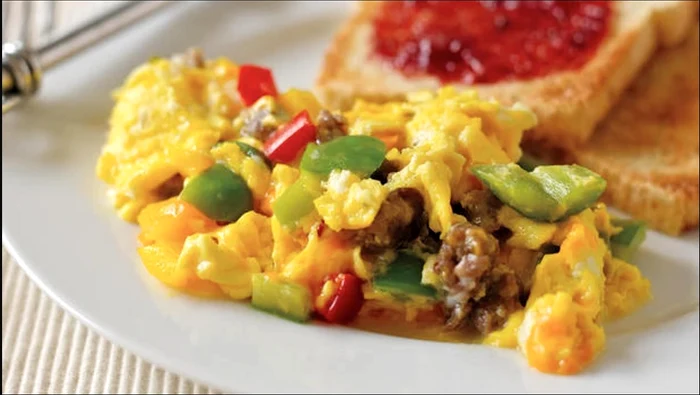
Scrob PHOTO Click Good appetite
Let's elaborate. More eggs are used, even eight. Beat well, season with salt, although the Moldovan likes it better with kneaded salty sheep's cheese. Set aside the bowl of scrambled eggs and cheese. Place a saucepan with lard in which to sizzle fresh home-made bacon or sausage, cut into slices. In some areas, meat is added to the side dish for a demented taste. Eggs with cheese are thrown over jumeri, sausages, meat as a side dish, or over all together if we have the hand. There are also variants in which the beaten eggs are not filled with salty cheese but with cream and green onion tails. Mix the eggs well with the cream, add salt and then put in the pan. Obviously, it is also possible without sausage and meat as a garnish, just with eggs, cream, green onions and salt.