Shock after Trump's triumphalistic announcement. Hamas and Israel accuse each other of violating the armistice while the US leader asks the second phase of the plan


The tensions are still high in the Gaza strip, Israel accusing the Palestinian militant group of Hamas of violating the ceasefire agreement initiated by world leaders, the day before in Egypt, by restraining 24 hostages.
The fragile armistice in Gaza was subjected to its first attempt on Tuesday, when Israel announced that the flow of humanitarian aid to the Palestinian territory devastated by the war will be halved and that the important point of crossing Rafah, on the border with Egypt, will not open according to the plan, accusing Hamas. The bodies of Israeli hostages, writes The Guardian.
On Monday, the Israelis celebrated the return from Gaza of the last 20 hostages in life, and the Palestinians enjoyed the liberation by Israel of almost 2,000 prisoners and prisoners, as part of the first phase of the armistice.
Hamas returned, during Monday, the remains of four deceased hostages, but previously warned that the recovery of the other 24 bodies still in Gaza could take longer, because not all the places where they were buried.
But Israeli military officials believe that Hamas knows where the remains of the other hostages are and that the militant organization has deliberately delayed their transfer, the newspaper Haaretz wrote.
Trump: “The second phase” of the Peace Agreement “Start right now”
US President Donald Trump urged Hamas to release the bodies of deceased hostages still in the enclave, showing that the step is necessary to allow the next phase of the Peace Plan for the Gaza Strip.
“All 20 hostages returned and feel as good as possible. A great burden was raised, but the job is not completed. The dead were not returned, as promised!”, Post, in a message on Social Truth. “The second phase begins right now !!!”, added the leader from the White House, writing, in his characteristic style.
The initial tensions during the cessation of fire were expected, as Hamas and Israel are trying to achieve advantages during the implementation of the 20 -point plan proposed by Trump, a plan that has not been clearly defined so far.
However, the measure of restricting humanitarian aid and postponing the opening of the Rafah point – a major crossing point that would allow the gaza to enter the supplies outside Israel – came as a shock, notes the British publication.
The crossing point was to be opened on Wednesday, in accordance with the agreement in 20 points agreed last week, which provided an increase in the flow of humanitarian aid at the levels last time during the short -term armistice of March.
The plan to cease the fire also provided that “all the hostages, lives or deceased” should be returned within 72 hours of accepting the agreement, but provided a mechanism if this did not happen, stipulating that Hamas should share information about deceased hostages. possible ”.
The International Committee of the Red Cross (CICR) acknowledged on Tuesday that delays are expected, describing the teaching of all the hostages as a “huge challenge”, given the difficulties of finding the bodies among the ruins of the enclave transformed into rubble.
“The search for human remains is obviously an even greater challenge than the release of people in life,” said Christian Cardon, a CICR official, in a press conference in Geneva.
Ela Haimi, whose husband, Tal Haimi, 41, was killed when Hamas attacked Kibbutz Nir Yitzhak on October 7, 2023, supported the restriction of humanitarian aid to Gaza. She said: “I have information that (Hamas) does not do everything he can. The Israeli army provided them with information, and they did not use them … We can control the number of trucks entering the strip. We have means available and we must use them.”
She added that she did not believe that the Israeli government should go to the “second phase” of the peace plan until all the bodies of the hostages are recovered.
Civil defense in Gaza announces 6 dead, Israel claims to have fired on suspects
After the joy of Monday, displayed in both camps, tensions increased during a day marked by sporadic violence in the Gaza strip.
The Israeli forces, which withdrew on Saturday from the city of Gaza and other parts of the enclave, opened fire on civilians who approached their positions in two separate incidents, killing six people. According to the agreement to cease the fire, the Israeli forces withdrew to the so-called “yellow line”, but still occupy a little more than half of Gaza.
Mahmud Bassal, the spokesman of the Civil Defense Agency in Gaza, said that five people were killed by drones while inspecting their homes in the Shujaiya district of Gaza, and another person died in a drone attack southeast of Khan Younis.
The Israeli army transmitted that its forces opened fire after repeated warnings to “suspects” who had been identified as threats, after they approached their positions, in the first incident and invoked a former Hamas weapon warehouse in the second.
Hazem Qassem, a Hamas spokesman, said that the attacks have violated the understanding of ceasing fire and that Israel is trying to “evade from his commitments to mediators.”
Hamas, execution in the public market
There were other stories about shooting, beats and shifts largely from Gaza, while Hamas continued to reprim their authority in the territory, sending armed fighters on the streets and targeting those who opposed his domination or were considered to be collaborators.
In a video broadcast on Monday night, Hamas fighters dragged seven or eight men with their hands tied behind in a market in the city of Gaza, forced them to kneel and shot them from behind, while dozens of spectators looked from behind the shops nearby.
France Presse agency noted that he was not able to quickly check the authenticity and date of filming. The material appeared on Monday night on the Telegram channel of the Al-Aqsa television, accompanied by an explanation: “The resistance executes the death penalty of several collaborators and criminals in the city of Gaza”.
Trump seems to have given Hamas permission to reaffirm a certain control over the Gaza strip, at least temporarily. Israeli officials, who say that any final agreement must foresee the permanent disarmament of the militant group, have not commented so far the reappearance of Hamas fighters on the streets of Gaza, in the case of public execution.
“We cannot say that there is an influx of aid”
Delaying the opening of the crossing point from Rafah dismayed on the fields of humanitarian aid in Gaza, who said that only limited supplies entered the territory after the conclusion of the cessation of fire.
The UN announced that Tuesday entered the Gaza tents for displaced families, frozen meat, fresh fruits, flour and drugs, but on Monday no truck from Israel due to the passing of the hostages released from Gaza. Tuesday was a Jewish religious holiday, so the passage points were closed.
“We have not noticed any significant change on the ground. Especially in the North, we need services, tents, water, heavy equipment … practically, we cannot say that there is a help-out,” said AMJAD AL-HAWA, director of the Palestinian NGO network.
On Tuesday, a hospital in Gaza announced that it had received the bodies of 45 Palestinians who were returned by Israel, as part of Trump's plan to end the two -year -old conflict, which was triggered by the Assault Surprise on Israel, in which 1,200 people died. The Israeli offensive that followed killed 67,000 people and hurt over 170,000.
The agreement signed last week also provided that Israel will provide information on the remains of the Palestinians who died in Israeli prisons.
Transition authority
The attention is now focused on the efforts to set up the transition authority in Gaza and the multinational stabilization force, as specified in the agreement. Both would ultimately supervised by a “Peace Council” chaired by Trump and probably led by Tony Blair, former British prime minister.
Badr Abdelatty, the Egyptian Foreign Minister, said 15 Palestinian technocrats were selected to administer Gaza, approved by all Palestinian factions – including Hamas – and check by Israel.
“We have to send them there to deal with the daily life of the people in Gaza, and the Peace Council should support and supervise the flow of finance and money, who will come for the reconstruction of the Gaza strip,” he said.
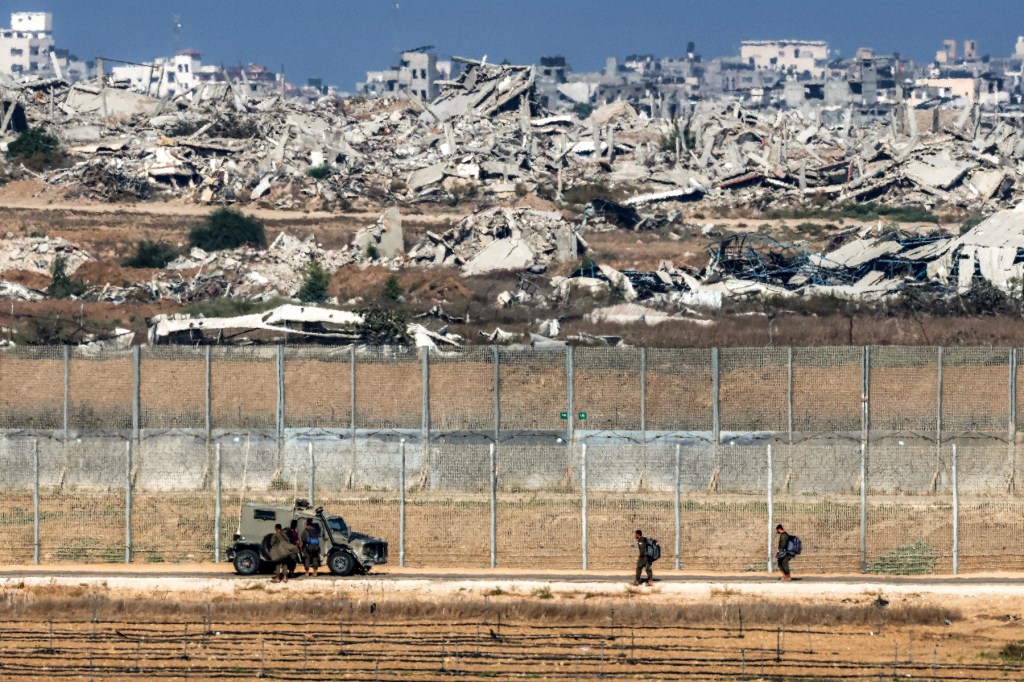
Gaza, covered by 55 million tons of rubble, the 13 -fold equivalent of Gizeh pyramids
As tens of thousands of people return to their destroyed homes, the extent of the damage in Gaza becomes clearer, notes the British publication.
Jaco Cilliers, PNUD (United Nations Development Program), which supervises a Palestinian aid program, said on Tuesday that the UN, the EU and the World Bank have estimated that the reconstruction of the strip will cost $ 70 billion.
“The estimated damage and rubble, throughout Gaza, amount to about 55 million tonnes … The 13-fold equivalent of Gizeh pyramids,” he said, referring to the Pyramids in Egypt.
Cilliers said that $ 20 billion will be needed in the next three years, and the rest will be needed for a longer period – possibly decades.
According to him, the Gaza strip might need decades to completely restore.
“We have heard very positive news from a number of our partners, including European partners … (and) Canada” regarding their willingness to help, he said in a press conference, mentioning that there are also discussions with the United States, according to Reuters.
The situation of destruction is particularly serious in the city of Gaza, the scene of some of the most powerful bombings, where 83% of the buildings suffered, according to the United Nations Satellite Center (UNOSAT).
PNUD has announced that it has already cleaned about 81,000 tons of rubble in the Gaza strip and continues the operations.
 Interview A former Israeli soldier says that real peace can be obtained after the cessation of occupation in the West Bank and the Gaza / Update strip: How IDF responds