Merkel's defeat towards Russia. He's just making fun of himself [OPINIA]


— It didn't happen. Then I left office and that's when Putin's aggression began, Merkel said.
Since the beginning of the war, Merkel has repeatedly made controversial statements. However, all the elements that characterized her stand out from her last interview for a Hungarian magazine a disastrous failure of German policy towards Russia over the last two decades – German conceit, arrogance towards Eastern partners and a downright pathological tendency to create illusions about Russia's true intentions. It's high time to come to terms with the failed eastern policy of the Merkel era.
Angela Merkel's pro-Russian course
There is a fairy-tale story about the Merkel era among German conservatives that goes something like this – the chancellor was the first to notice the authoritarian nature of Russian President Vladimir Putin, and the mistakes of German policy towards Russia were primarily the fault of social democrats, whom Merkel did not want to alienate in the coalition governments of the CDU and SPD. Therefore, it could not refuse to implement projects such as the Nord Stream gas pipeline, which dangerously increased Germany's dependence on Russian gas.
However, such an interpretation does not take into account either the chancellor's foreign policy competences, which she often used, or the fact that Merkel herself was often the driving force behind this spectacularly unsuccessful policy of rapprochement with Russia.
It started during the NATO summit in Bucharest in April 2008. Merkel was then the decisive force behind the veto of some EU countries, such as Germany and France, on the admission of Georgia and Ukraine to the NATO accession process. This left both countries unprotected in a geostrategic no man's land between Russia and NATO and made them easy targets for Russian aggression. That this policy of concessions did not pay off became clear already in August of the same year, when Moscow responded to Western concessions with a war against Georgia. However, this did not stop Merkel from strengthening her pro-Russian stance in the following years.
The article continues below the video
A course that cannot be understood without considering Germany's decision to phase out nuclear energy, taken in 2011. After the Fukushima reactor accident, Merkel sought to phase out nuclear energy for purely opportunistic, domestic political reasons. In this way, in the following years, it led Germany to dangerous dependence. Without nuclear power, the cheap energy the German economy needs to remain competitive had to come from somewhere else. And it could only come from Russia.
Merkel's apologists like to point out that other European countries, such as Bulgaria and Hungary, were also largely dependent on gas supplies from Russia. However, these are countries that were forcibly connected to the network of Russian energy pipelines during Soviet times. In contrast, Germany was the only country to build new pipelines to Russia, voluntarily exposing itself to new dependence on Russian gas.
Even when Russia attacked Ukraine for the first time in 2014 and once again expressed its aggressive neo-colonial ambitions, Merkel's government stuck to the project of building a second pipeline, Nord Stream 2, despite experts repeatedly drawing attention to the geopolitical risks associated with it. Bypassing pipelines running through Ukraine to Europe only increased Kiev's vulnerability to Russian attacks.
The role of Frank-Walter Steinmeier
Despite increasingly harsh criticism from Washington during Donald Trump's first term, Merkel's government continued to cling to the lie that it was a purely economic, not political, project. Putin clearly refuted this claim when, shortly after the completion of Nord Stream 2, he attacked Ukraine again because he believed he already had enough of an advantage.
Merkel's biggest mistake was clinging to the “utopia of interconnectedness,” as historian Bastian Matteo Scianna calls it in his book on the Russian policies of Helmut Kohl and Angela Merkel, which she did for economic reasons and against all evidence. This concept, also promoted by the former head of the Chancellery and former Minister of Foreign Affairs Frank-Walter Steinmeier, assumed that Moscow's revisionism could be stopped through a “modernization partnership” and greater links between the German economy and the Russian one.
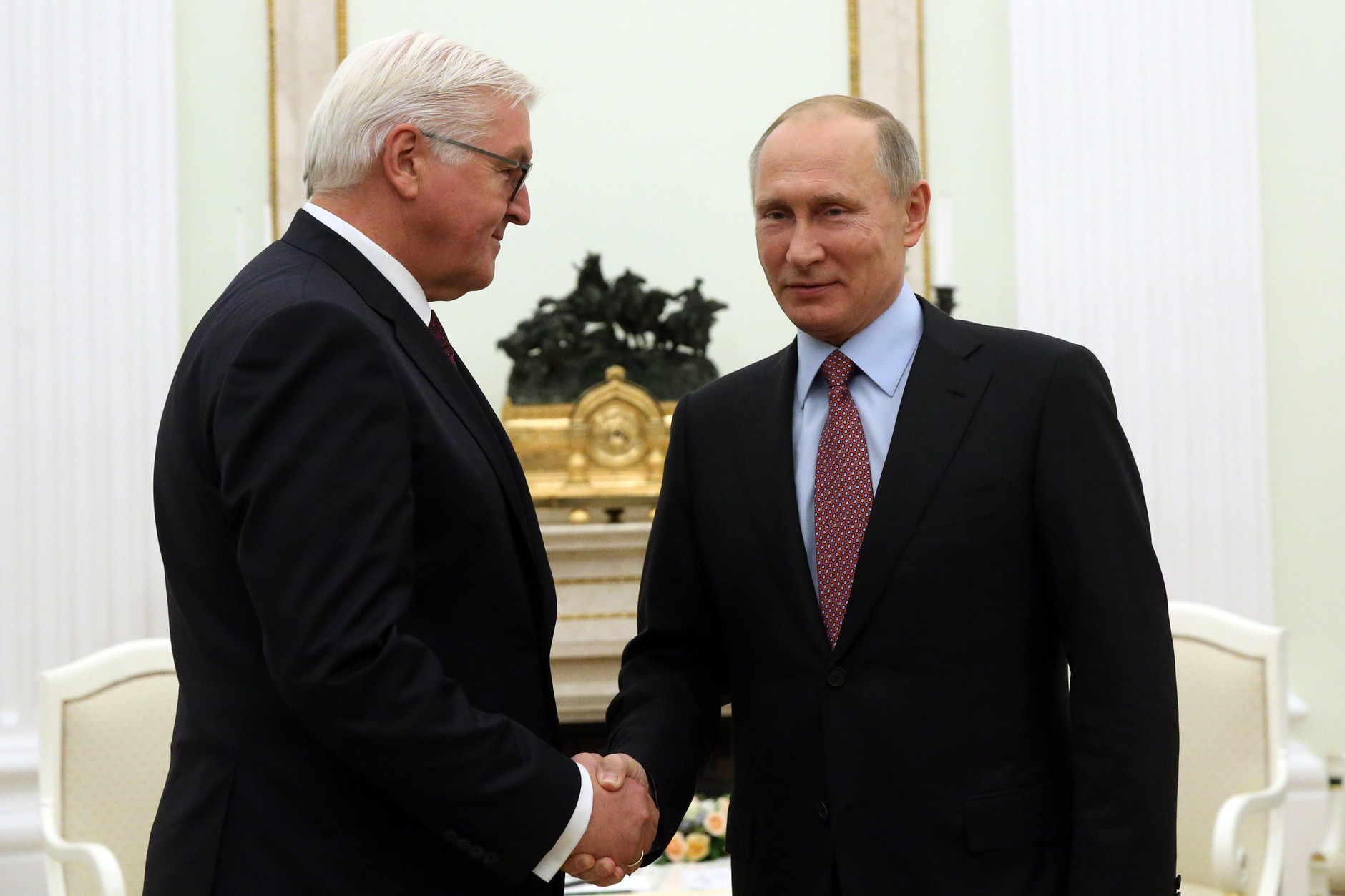
Vladimir Putin and Frank-Walter Steinmeier during a meeting in the Kremlin, October 25, 2017.Mikhail Svetlov / Contributor / Getty Images
It was a policy that simply ignored Russia's aggressive colonial ambitions, which were clearly demonstrated during the Georgian War in 2008 and the First Ukrainian War in 2014. It also provided no measures in case the change-through-trade approach failed, and therefore completely abandoned military deterrents against Russia.
Merkel has played an undisputed leadership role in the EU for many years. The fact that Europe has not demanded any significant payment from Russia for either the 2008 or 2014 war is therefore also Merkel's responsibility. Instead of deterring Moscow, Germany tried to return to normality as quickly as possible after each Russian aggressive war so as not to jeopardize its own economic interests.. Moscow therefore did not have to fear any political or economic consequences. Putin took this as an invitation to attack Ukraine again in 2022 because he believed he could get away with it this time – a direct consequence of Merkel's appeasement policy in previous years.
When the former chancellor now suggests that a new negotiation format could prevent Putin's war against Ukraine, she is simply making a fool of herself. It also shows that she has not learned any lessons from her own failures. And that he still adheres to completely unrealistic assumptions from his time in office about what actually motivates Putin. This is a German tragedy.