The solution of an anthropologist for the education budget: “All politicians should be forced to enroll their children in the public system”


How are the money from a country budget divided? Anthropologist Radu Umbreș argues that the funds allocated in fields such as education, health, justice reflect the private interests of the elites leading the country. He has a solution for increasing the education budget.
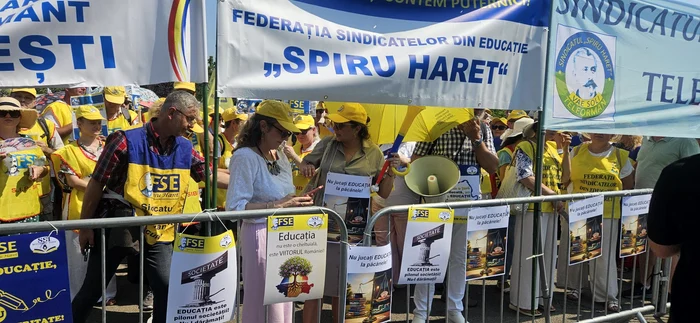
The teachers protested against the austerity measures. Photo: Truth
Radu Umbreș, an anthropologist and university lecturer at SNSPA, presented a hypothesis about the financing and reform of some state fields that can start from the private interests of the elites, where politicians, great officials, businessmen enter.
The key being: how much these elites benefit directly from these fields.
The anthropologist comes with three examples:
“Education: the least because they have the alternative of private education and studies abroad for their children. Teachers are, therefore, to be neglected.
Health: Something more because the private health system and the services abroad cannot always be replaced by the services offered by the public system (in terms of emergency, special operations, etc.), but they are an option for many situations. Doctors will receive higher salaries, but the expenses will be concentrated especially in the big cities.
Justice and Police: Most because there is no alternative to which the elites can call (or which they can escape in the case of crimes), so the judges / police must be satisfied and grateful to the elites.“
“The investment in these areas will be correlated with the degree to which the elites affect”
The hypothesis, says umbrella on Facebook, proposes that the investment in these fields (especially at the level of wages and pensions) will be correlated with the degree in which it affects the elites. Thus, the amounts for education are smaller than those for health that are smaller than those for justice.
“It would be interesting to study what is the percentage of children of the elites studying in the state compared to the general population”details the anthropologist.
He proposes an experiment: “All politicians and civil servants are forced to enroll their children only in the public system, possibly with random allocation in a local school. To see then how the percentages of GDP for education are found, how to reform the system overnight, etc. I know that it is impossible and, in some ways, non-ethic, but the main idea I think.
Protests against austerity measures
The teachers reacted vehement this fall to the adoption of Law 141/2025, considering that the austerity measures included in it seriously affect the education and rights of the teachers.
One of the main reasons for protest is the increase of the teaching norm, which means several hours taught by each teacher, without the proper compensation or without improving the facilities and working conditions.
The combination of the school units and the modification of the threshold of students needed for a school to be recognized with legal personality (lifting the threshold from 300 to 500 students) are seen as measures that will lead to the closing of schools, the loss of management positions and the weakening of access to less populated areas.
The unions demand the repeal of these measures and the responsibility of the authorities, including the dismissal of the Minister of Education. Also, it is taken into account the triggering of a general strike, and the protests continue through various forms – pickets, the boycott of the beginning of the school year, marches to the Cotroceni Palace.
The students joined the protests, arguing that education should be viewed as an investment, not as an expense, and that the measures taken endanger equity and quality of education.
On the other hand, the authorities have requested realism and warned that it is not possible for all measures to be modified immediately, invoking budgetary constraints and obligations to the international evaluation institutions.