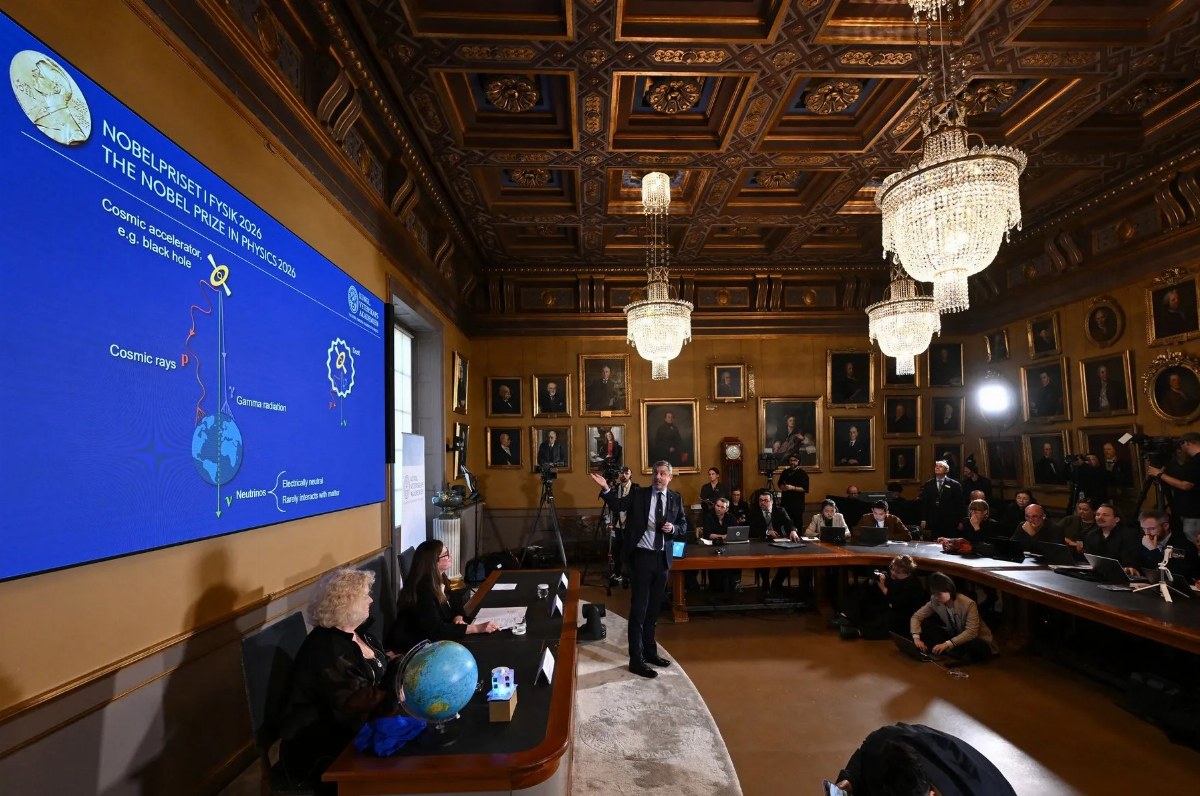
The Royal Swedish Academy of Sciences has broken from decades of tradition by awarding the 2026 Nobel Prize in Physics to a single scientist, Francis Halzen, an American of Belgian descent. The announcement was made on Tuesday afternoon in Stockholm.
Halzen received the prestigious award for his “decisive contributions to the IceCube Neutrino Observatory and for the discovery of high-energy neutrinos of astrophysical origin.” This marks the first time since 1992 that the prize has been awarded to an individual, with the last recipient being French physicist Georges Charpak for his invention and development of particle detectors.
In recent years, the Nobel Prize in Physics has typically been shared among two or three researchers. The Nobel Prize in Chemistry also has not been awarded to a single researcher in many years; the last was German scientist Gerhard Ertl in 2007 for his studies on chemical processes on solid surfaces.
Understanding Neutrinos: The Focus of the 2026 Nobel Prize in Physics
The Academy noted that scientists have long known that the universe contains natural particle accelerators that emit particles with energies up to a million times greater than those achievable in Earth laboratories. However, many aspects related to these sources remain a mystery, including their nature, location, and the primary processes occurring within them.
High-energy neutrinos are produced in the same environments as other types of particles, but they travel to us without changing direction or losing energy. This unique property allows them to provide information that cannot be obtained in any other way.
Francis Halzen: The 2026 Nobel Laureate in Physics
Born in 1944 in Tienen, Belgium, Halzen earned his PhD in 1969 from KU Leuven and is currently a professor at the University of Wisconsin-Madison. In 1988, he first presented his vision for neutrino detection at the South Pole. When a neutrino interacts with an atomic nucleus, it produces a flash of light that can be detected by sensors placed in the clear glacial ice.
The ice at the South Pole offers numerous advantages, being shielded from various types of interference and geologically stable, unaffected by earthquakes. Halzen’s concept gained support from other researchers, leading to preliminary tests with sensors installed in the ice just a few years later.
Due to the rarity of high-energy cosmic neutrinos, a vast volume of ice is necessary to observe a sufficient number of collisions. The IceCube Neutrino Observatory, completed in 2011, spans a cubic kilometer and soon led to the discovery of the first high-energy neutrinos. A few years later, researchers published findings of neutrinos that must originate from regions far beyond our solar system.
This marked the true beginning of the search for the sources of neutrinos in the universe, as highlighted by the Royal Swedish Academy of Sciences. Last year, the Nobel Prize in Physics went to researchers John Clarke, Michel Devoret, and John Martinis for their contributions to the development of the next generation of quantum technologies.