Data from the Central Statistical Office (GUS) reveals that out of 339 hospitals operating in Poland, 165 experienced financial losses during the first half of 2026. Collectively, these hospitals reported a staggering loss exceeding 1 billion PLN. The primary driver behind these deficits is categorized as ‘external services,’ which notably includes doctors working excessive hours across multiple hospitals simultaneously.
Despite increasing annual allocations for healthcare, the financial health of hospitals remains precarious, suggesting that no amount of funding guarantees financial stability. According to GUS’s recent findings based on F-01 forms, the 165 hospitals reported a combined net loss of 1 billion 36 million PLN. After accounting for the profits of the 174 profitable hospitals, the net loss across the board stood at 452 million PLN. Additionally, the finances of 250 large hospitals, each employing over 50 staff members, resulted in a net loss of 511 million PLN.
The situation appears even bleaker when considering that these hospitals received a total of 405 million PLN in subsidies over six months, likely from local governments or directly from the state treasury. Without these subsidies, their real loss would have amounted to 857 million PLN within just half a year.
High Costs of External Services
The root of these losses is tied to operational costs, which reached 18.7 billion PLN against revenues of only 18 billion PLN. Many hospital directors find it challenging to balance expenses with incoming revenue primarily funded by the National Health Fund (NFZ).
Key components of the hospital costs include employee benefits at 7.6 billion PLN and external services at 6.5 billion PLN. Material consumption accounted for 3.3 billion PLN, with energy expenses totaling 340 million PLN. Financial costs, including loans and credits, added another 269 million PLN.
A particularly notable category is ‘external services.’ Recent scandals have highlighted cases where doctors, earning substantial sums in public hospitals, reported hundreds of unmonitored hours. Some doctors averaged 72 ‘worked’ hours a day across various hospitals. This occurred under B2B contracts classified as ‘external services’ alongside regular employment.
The 6.5 billion PLN attributed to external services includes 3.1 billion PLN for subcontracting services, with hospitals accounting for the salaries of physicians and nurses operating as sole proprietorships. Meanwhile, salaries for employees on employment contracts are recorded under ’employee benefits.’
Contrasting Financial Outcomes
Analysis of data from the 60 largest hospitals in Poland shows that 54 have published their 2025 financial statements. Of these, 53 are public entities, while one is a private hospital, serving as a notable example of profitable operations within the healthcare sector. The combined financial outcome for public hospitals in 2025 revealed a loss of 102 million PLN, whereas the private entity, the Mazowiecki Oncology Hospital, generated a profit of 53 million PLN.
Excluding subsidies, the total loss for the 53 public hospitals would have soared to 1 billion 237 million PLN. The private hospital also received nearly 5 million PLN in subsidies but would still have posted a net profit of 48 million PLN without them.
The Mazowiecki Oncology Hospital, which provides NFZ-funded services, employs only 111 staff members, although the number of doctors and nurses is unspecified. It maintains an average salary of 12,100 PLN gross, positioning it around the median in our analysis. This indicates that while salaries are in line with averages, the workforce appears to be utilized more effectively.
Moreover, there are public hospitals that, under current conditions and NFZ’s payment rates, demonstrate the capability to generate significant profits. The University Clinical Hospital of Jan Mikulicz-Radecki in Wrocław would net 50.5 million PLN even without subsidies. Their report indicates they held 203 million PLN in bank deposits at the end of the previous year, with revenue exceeding 1.8 billion PLN compared to the 276 million PLN of the private hospital.
The University Clinical Center in Gdańsk, without considering subsidies, would have reported a net profit of 81 million PLN (105 million PLN net profit and 24 million PLN in subsidies). This facility is recognized as the most profitable hospital in Poland, despite not having the highest profitability rate, with revenues of 2.5 billion PLN and a workforce of 17,000.
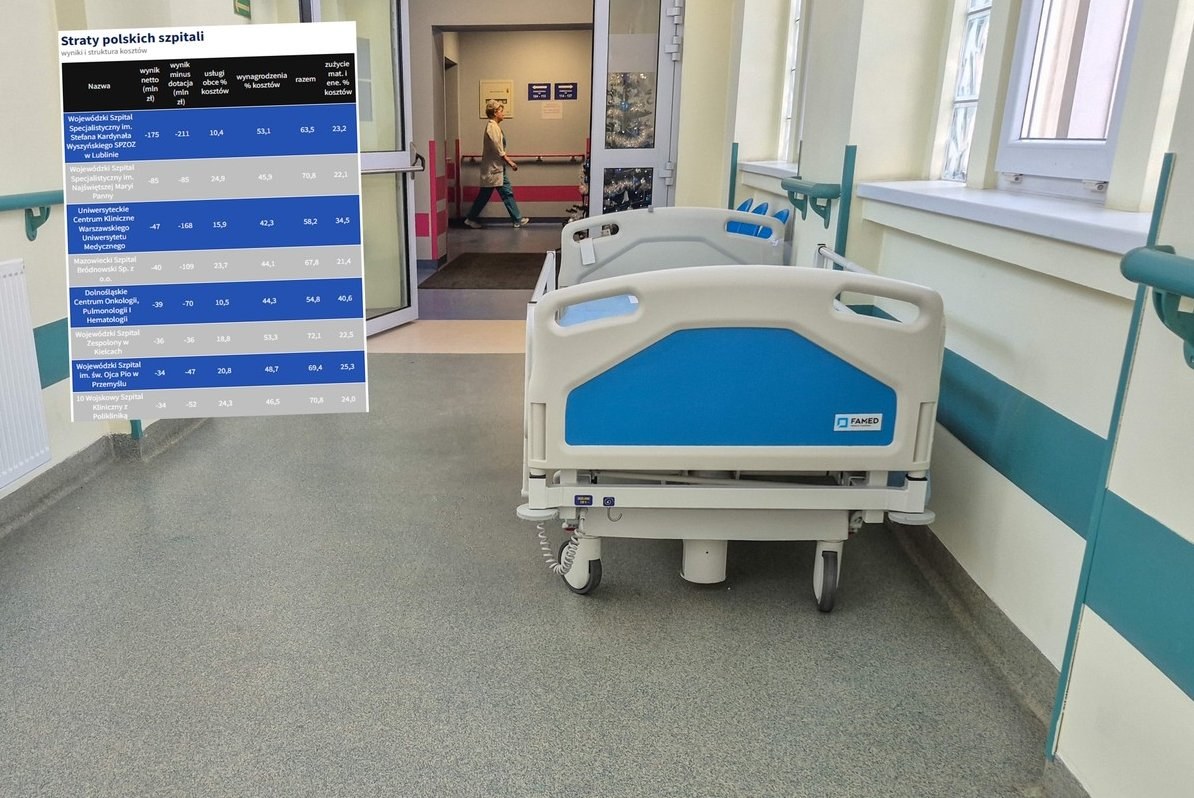
Conversely, several hospitals are facing substantial losses. The Stefan Cardinal Wyszyński Specialist Hospital in Lublin reported a net loss of 211 million PLN (175 million PLN net after adjusting for subsidies), with operational costs exceeding revenues by 405 million PLN. It was saved by a subsidy of 121 million PLN.
The Mazowiecki Bródno Hospital in Warsaw reported a net loss of 109 million PLN (40 million PLN net and 68 million PLN in subsidies), with operational costs outpacing revenues by 16%.
A common factor among these hospitals is that expenditures on external services and salaries account for 58.2% to 67.8% of their budgets. Despite this financial crisis, these expenses have risen by 14% to 16%. At the University Clinical Center of the Medical University of Warsaw, the cost of external services surged by 27.3% year-on-year, while salaries increased by 16.3%. The net loss for this institution was reported at 47 million PLN, adjusting for subsidies results in an even more alarming 168 million PLN loss, coinciding with a revenue drop of 15% year-on-year.
Interestingly, in the loss-making hospitals, staffing levels have also risen, except for the aforementioned hospital in Lublin, which experienced a 0.6% decline in personnel—an anomaly not indicative of cost-cutting or efficiency efforts.
In profitable hospitals, the costs for salaries and external services usually do not exceed 55%. One exception is the Independent Public Provincial Hospital of Pope John Paul II in Zamość, where this figure reaches as high as 70%. However, this facility also saw a 1.7% decrease in employment over the year, while revenues grew by 10%.
The private MSO hospital allocates only 37% of its costs to salaries and external services (B2B for doctors and nurses as well as external tests), with 57% directed towards materials and energy. Such costs surged by 29% compared to the previous year, whereas salaries rose by an average of 13%. The expenditure on medications may play a more significant role for an oncology facility.
The profitability gap between private and public facilities remains stark. A hospital operating under NFZ contracts, akin to public entities, can achieve high efficiency. A comparative analysis of cost structures indicates a probable excess in staffing costs within state and local government facilities, pointing to organizational errors. Conversely, private entities cannot afford such inefficiencies, as directors risk losing their positions if shareholders notice these discrepancies. This scrutiny appears less stringent in public organizations.