The Alternative for Germany (AfD) party has emerged victorious in the regional elections held in Saxony-Anhalt, becoming the first far-right party to approach regional power since World War II, as reported by Reuters.
Although it did not secure an absolute majority, the AfD garnered approximately 44% of the votes, resulting in a crushing defeat for Chancellor Friedrich Merz’s conservative party. This outcome reflects the deep unpopularity of Germany’s governing coalition amid a fragmented political landscape.
Already the most popular party nationwide, the AfD aims to solidify its support base to advance its agenda, which includes stringent immigration restrictions, re-establishment of relations with Russia, reduced aid to Ukraine, and abandoning the euro.
Preliminary Election Results in Saxony-Anhalt
The AfD received nearly 44% of the votes in the Saxony-Anhalt elections, according to preliminary official results quoted by Deutsche Welle.
Six parties will occupy seats in the 83-member regional parliament of Saxony-Anhalt:
- Alternative for Germany (AfD) — 43.8%, 39 seats
- Christian Democratic Union (CDU) — 17.2%, 15 seats
- Social Democratic Party (SPD) — 9.3%, 8 seats
- Green Party — 8.9%, 8 seats
- The Left Party — 8.6%, 8 seats
- Sahra Wagenknecht Alliance (BSW) — 5.3%, 5 seats
The business-oriented Free Democratic Party (FDP) managed only 2.6% of the vote, failing to surpass the 5% electoral threshold.
According to preliminary reports, voter turnout reached nearly 78%, the highest in Saxony-Anhalt since German reunification in 1990.
AfD Leader Ulrich Siegmund: “We Made History”
While it remains uncertain if the AfD can form a government, the broader political implications are clear: turnout was impressively high at 77%, according to ZDF.
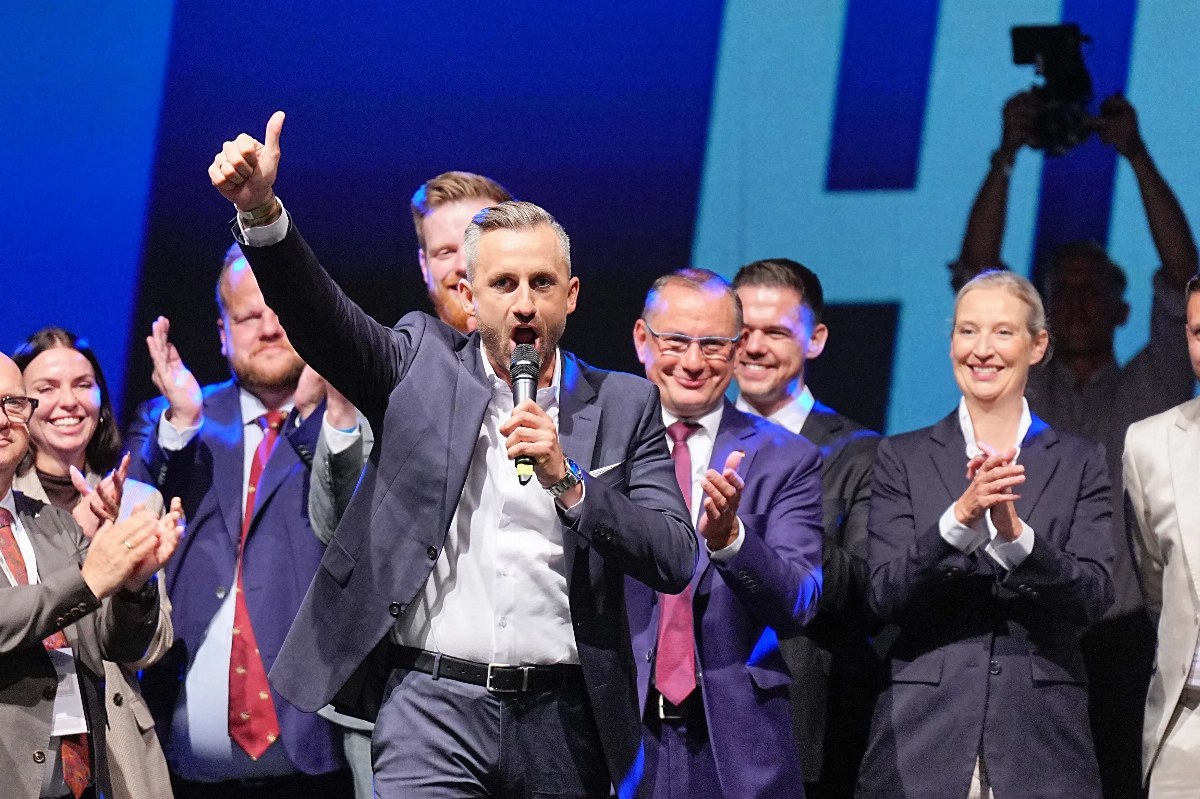
“We made history in this country,” declared Ulrich Siegmund, the AfD’s lead candidate in Saxony-Anhalt, who attracted thousands to his campaign rallies. He framed the victory as a crucial step towards gaining power nationally in the upcoming federal elections scheduled for 2029.
“The people have made it clear they desire a political change, and above all, they want it alongside us,” Siegmund stated.
Joyous celebrations erupted at the party’s gathering on election night in Magdeburg, where supporters waved German flags and embraced triumphantly.
U.S. President Donald Trump shared a screenshot of the election results on his Truth Social platform, while far-right leaders from other European nations hailed the elections as a mandate for change.
A Vote of No Confidence in the Federal Government
The result represents a significant setback for Merz, whose personal popularity has plummeted to historic lows as voters turn away from his attempts to revive Germany’s stagnating economy and his personal communication style.
A survey by ARD indicated that 87% of voters in Saxony-Anhalt expressed dissatisfaction with the federal government. Siegmund labeled Merz as the AfD’s best electoral agent, given his unpopularity in the state.
“This electoral outcome is above all a vote of no confidence in the federal government,” stated Marcel Fratzscher, president of the German Institute for Economic Research, speaking to Reuters.
Merz has pledged to rejuvenate Europe’s largest economy through business-friendly reforms and increased spending, while warning that an AfD victory in Saxony-Anhalt could harm the state’s reputation and deter foreign investment.
One Party Open to Collaboration with AfD
All major parties in Germany have refused to collaborate with the AfD, which has been classified as extremist by the local intelligence agency.
However, the smaller Sahra Wagenknecht Alliance (BSW) appears poised to surpass the electoral threshold to enter parliament. They have proposed that Saxony-Anhalt be led by a non-affiliated premier relying on fluctuating majorities, including votes from the AfD.
Nevertheless, Siegmund dismissed the BSW’s idea as nonsensical, ruling out any agreements with other parties that would hinder the AfD’s promise of change. “If it comes to an extreme situation, new elections will simply be held,” he said.
Merz’s conservatives indicated they would explore discussions with other parties, though this could require uniting groups with vastly different political agendas. In the adjacent eastern German state of Thuringia, conservatives currently lead a minority government with the passive tolerance of the Left Party.
Despite being one of the smallest German states with just over 2 million residents, the results underscore the rapid rise of the AfD since its founding in 2013.
Currently, the AfD is the most popular party in Germany, polling at 28% according to a recent INSA survey, far ahead of the conservatives who stand at 20%.
What the AfD’s Program Entails
While far-right parties have gained ground in other parts of Europe, Germany’s Nazi past has led mainstream parties to hesitate in cooperating with the AfD.
The AfD has denied accusations of extremism, asserting that such claims are alarmist and an insult to its millions of supporters.
During the campaign, the AfD capitalized on growing discontent with established parties, which it characterized as tired and out of touch, offering instead a series of radical policies and a nostalgic vision of cleaner, safer streets and national pride.
“It is clear that we need change in Germany and Western Europe. And I believe the starting signal certainly comes from here – whether you like it or not,” said Antony Lee, one of the participants at the AfD’s election celebration. “I am a father, I am an entrepreneur, and I know things cannot continue as they are in Germany,” he added.
The AfD’s program includes plans to steer schools and cultural institutions towards what it deems more traditional values, limit immigration, and reform public broadcasting.
The party wants refugee children to be taught in separate classes.
It has called for a ban on rainbow flags in schools and for the daily raising of the German national flag.
The national anthem should be sung by students and school staff during school celebrations. Other proposals include citizen patrols, enhancing Russian language instruction in schools, and halting the construction of new wind farms.