
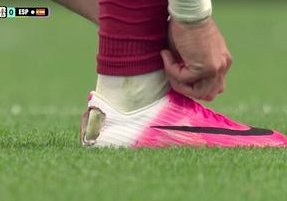
In the recent match between Portugal and Spain, which ended with a score of 0-1, an intriguing moment occurred when Portuguese player Pedro Neto was seen complaining about a foul while holding his cleat. Close-up footage revealed a unique detail: the right cleat was intentionally cut out at the heel. This modification is reportedly a strategy to ease symptoms of Haglund’s deformity, a condition affecting the heel, according to The Athletic.
As Neto held the cleat, some spectators speculated that it had torn during the match. However, this was not the case; the alteration had been made well before the game. Neto is not the first player to use such modifications to cope with medical issues. Notable players like Philippe Coutinho, Mats Hummels, Daniele De Rossi, and Roberto Firmino have also been seen wearing specially cut cleats.
The Reason Behind Heel-Cutting: Haglund’s Disease
The Athletic provided insight into this practice, stating that players often deal with Haglund’s disease, characterized by a bony prominence at the back of the heel where the Achilles tendon attaches. This deformity can cause significant pain by irritating the surrounding soft tissue and leading to inflammation of the retrocalcaneal bursa, a fluid-filled sac located behind the heel.
Bartholomew Hudson-Gill, a physiotherapist at Opus Biological clinic in London and a specialist in elite athlete rehabilitation, explained the condition: “That bursa acts as a shock absorber. The tendon thickens, the bursa irritates, and then the bone becomes affected. Players apply increasing pressure on that area, which intensifies the pain. This sensitivity leads to changes in bone structure that further amplify discomfort.”
Cutting the back part of the cleat helps reduce pressure on the heel and limit symptoms. According to Hudson-Gill, this modification “prevents the cleat from physically pressing on the tendon and bone, thus stopping irritation.”
Treatment Options and Personal Experience: “Slow and Painful Recovery”
In most cases, this syndrome is managed rather than completely eliminated. For footballers, the focus is on alleviating pressure in that area and calming the tendon and calf before progressing to exercises aimed at rebuilding muscle strength and endurance for football demands.
Treatment methods may include changing footwear, physical therapy, shockwave therapy, injections, and adjusting activity levels. Surgery is considered only if conservative treatments fail, but it is generally avoided. The procedure involves removing the bony nodule and, if necessary, damaged sections of the tendon.
Notably, Stuart James, one of the authors of the article from The Athletic, also grapples with this condition. He shared from personal experience that “on good days, it was just a dull pain. But on bad days, my heel would throb intensely, and I dreaded putting on any shoe with a rigid back.” He opted for surgery to address the issue and described the recovery as “slow and painful,” adding that he still experiences pain eight months post-operation. “Later, I was advised to undergo a second surgery involving detaching the Achilles tendon, removing a larger bone portion, and then reattaching the tendon. No, thank you!” he recounted.


