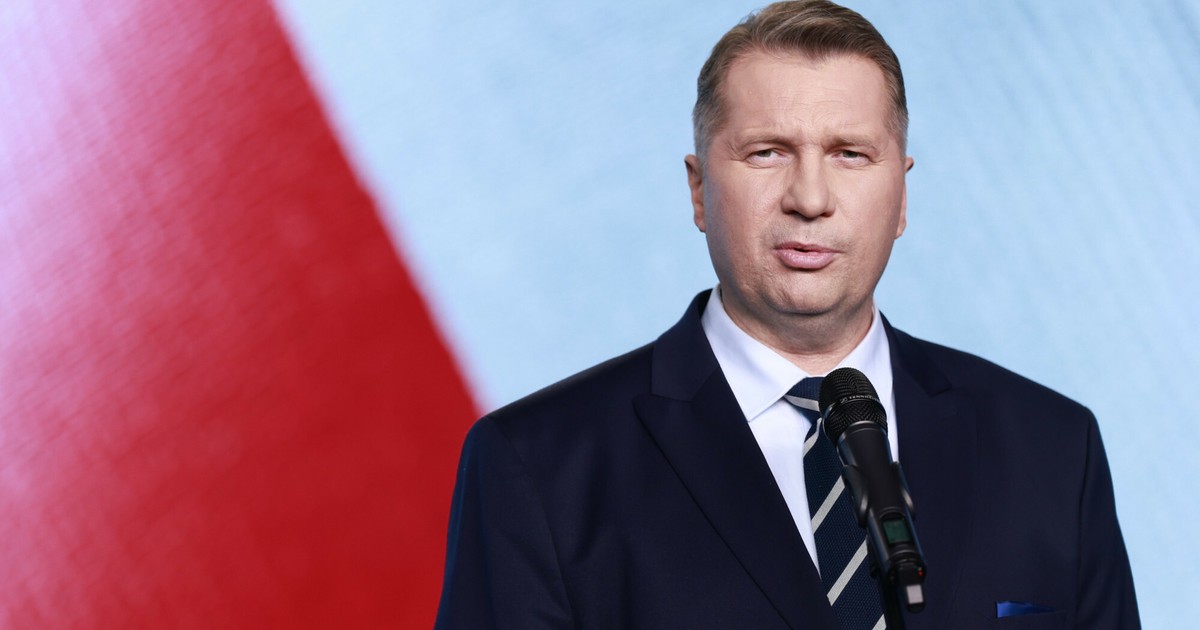
Last weekend, Jarosław Kaczyński and Przemysław Czarnek met with voters in Kalisz. The latter presented some of his election promises. Among them, Poland's declaration of leaving the CO2 emissions trading system (ETS).
Even the current government knows that the ECJ is a difficult topic – economically and politically. Discussions on revising this solution have been going on in the European Union for months. — It is in the interest of some EU countries that the ETS system be as restrictive as possible – admitted Deputy Minister of Climate Krzysztof Bolesta in an interview for Business Insider Polska in April. As he assured, in this case Poland – which is the most affected by the ECJ in the EU – is not in a losing position.
Read also: The revision of the ECJ directive is getting closer. “The atmosphere is getting thicker”
Is it possible to leave the ETS system without Polexit?
Przemysław Czarnek, however, does not want to discuss the revision of the system and once again emphasized that the ECJ is simply not supposed to be a Polish problem. But it won't be an easy matter, and even the right wing knows it.
In March, we talked about this in Business Insider with Jadwiga Emilewicz, now an expert on economy and energy at the Sobieski Institute, who in 2018-2020 sat in Mateusz Morawiecki's government as Minister of Entrepreneurship and Technology, Minister of Development and Deputy Prime Minister.
— It must be clearly said that the demand for a unilateral exit from the ECJ would be politically and economically very risky. In practice, it would mean a frontal collision with the entire EU regulatory system in climate policy. In an extreme scenario, it could lead to the logic of Polexit in the area of climate policy, and this would mean costs for the Polish economy many times higher than those generated today by the ETS itself. It would mean the risk of losing the single European market, which would mean bankruptcy for many Polish companies. It is worth learning the lesson of Brexit – a much wealthier economy that cannot recover from an 8% decline after 10 years – Emilewicz told us.
— A much more reasonable strategy for Poland is to build a coalition for the reform of the ECJ, rather than trying to dismantle it. In recent months, there have been more and more voices from important EU countries that indicate that the current model requires correction. This shows that there is room for reform if Poland works within the European coalition of industrial countries, added the former deputy prime minister.
Her slogan is: “reform yes, destabilization no”.
She is not the only one who believes that it is impossible to abandon the ETS system without leaving the European Union. — There is no way to leave the ECJ without Polexit — Marta Anczewska, manager of energy policy at the Reform Institute, also told us. — If we really left the EU, which the vast majority of Polish society does not want, we would be doomed to pay customs duties, including CBAM fees [granicznego podatku węglowego, którego wartość jest równa cenom uprawnień w ETS i który ma wyrównywać szanse dla producentów z Unii i tych spoza niej — przyp. red.]and besides, we would lose all the benefits related to access to the common market and EU funds that have been driving Poland's development for over 20 years, she added.
Read also: The ETS reduces emissions, but it is controversial in Poland. The expert explains the details
History of the ETS system
The EU Emissions Trading Scheme was launched in 2005 as the main tool to fight climate change in Europe. Its creation was a response to the obligations arising from the Kyoto Protocol and the growing pressure to reduce greenhouse gas emissions. Initially, it mainly covered energy and energy-intensive industries, but over time it was also extended to aviation, and in subsequent years also to maritime shipping. Today, the ETS is the world's largest carbon market.
Read also: The government's nuclear plans without key answers. Big money and politics in the background [ANALIZA]
The system works according to the “cap and trade” principle. The European Union sets the maximum number of CO2 emission allowances, which decreases every year. Companies covered by the system must have an appropriate number of allowances corresponding to the volume of their emissions. They receive some of the allowances free of charge, and some they buy at auctions or from other market participants. Companies that reduce emissions faster than their competitors can sell unused allowances, achieving additional profit.
The aim of the ETS is to create an economic incentive to invest in clean technologies and move away from fossil fuels. In practice, the increase in allowance prices increases the operating costs of the most emissive sectors of the economy, especially coal-based energy. Supporters of the system emphasize that it accelerates the energy transformation and helps achieve the EU's climate goals. Critics, however, point out that it may lead to an increase in energy prices and burden the economies of countries that still base their energy production on fossil fuels.