On Thursday, June 11, 2026, a great sports holiday started, the FIFA World Cup. Over the next month, teams from 48 countries will take to the pitch. It consists of them 1,248 footballers whose market value (according to Transfer Markt) is estimated at over EUR 17 billion.
The 48 countries playing in the World Cup include large countries like the United States and Germany, as well as small islands such as Cape Verde and Curacao. Representations of economies whose size is estimated at almost EUR 26 trillion and less than EUR 3 billion will compete against each other. In fact the nominal gross domestic product (GDP) in 2025 of all countries participating in the championship according to data from the International Monetary Fund (IMF) is approximately EUR 63 trillion.
Interestingly, in many cases the value of football teams is significantly different from the economically large or small countries they represent.
World Cup 2026. Economic powers and tiny islands
If we looked at economic potential (including financial, human and organizational potential), the United States would be the clear favorite of the FIFA World Cup. Their GDP in 2025 is estimated at less than EUR 27 trillion. Germany is far behind, the second World Cup country in the ranking, whose economy is worth approximately EUR 4.4 trillion. The third place on the podium in this respect would be Japan (EUR 3.8 trillion).
In total, 14 countries whose GDP exceeds EUR 1 trillion are represented at the World Cup. They include, among others: England, France, Brazil and Spain.
Click to open in a new window (table created using the Flourish tool)
|
Damian Słomski / Business Insider Polska
If Poland got to the World Cup, it would be in 17th place economically. With a result of EUR 898 billion, we would be just behind Switzerland (EUR 905 billion), but clearly ahead of Belgium (EUR 628 billion).
By far the weakest economic potential is in island countries such as Cape Verde and Curacao, whose GDP is less than EUR 3 billion.. Ahead of them, in the lower part of the table, are: Haiti, Bosnia and Herzegovina and Senegal (approx. EUR 30 billion each).
World Cup 2026. The most and least valuable national teams
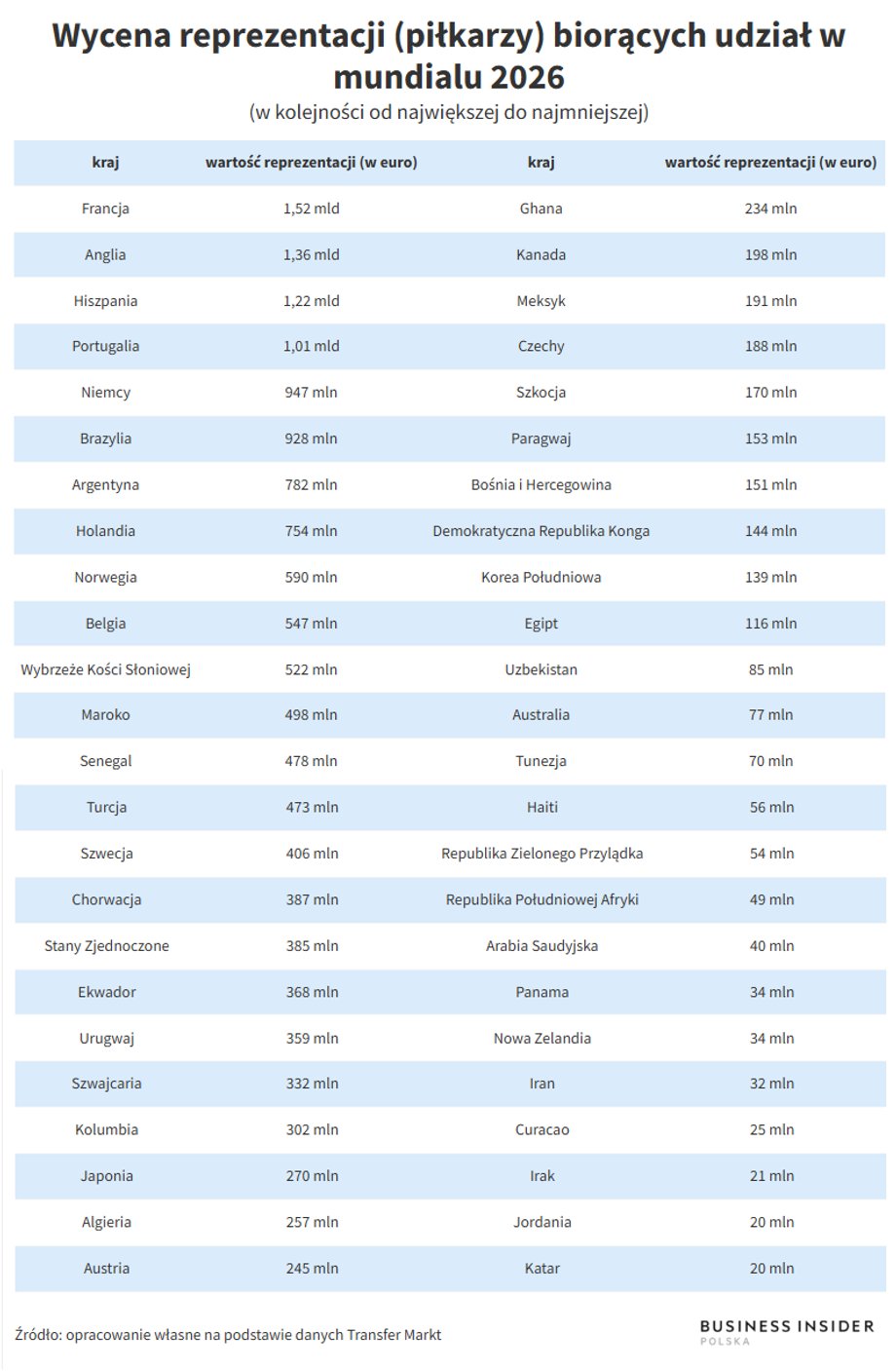
There are major changes in the ranking of the 48 countries taking part in the World Cup, if we take into account the valuations of players. Number one is the French national team, which the transfer market values at approximately EUR 1.52 billion. Behind it is England, whose players' value at the championship is estimated at EUR 1.36 billion, and the podium is closed by Spain (EUR 1.22 billion).
Only one other national team can boast a result exceeding EUR 1 billion. This is Portugal. Only behind it are Germany, Brazil and Argentina.
Click to open in a new window (table created using the Flourish tool)
|
Damian Słomski / Business Insider Polska
If Poland got to the World Cup, it could be in 26th place in terms of national team value. Transfermarkt estimates the value of our players at EUR 231 million. This result is slightly worse than Ghana's and clearly better than Canada's.
By far the weakest players (in terms of transfer valuations) are Qatar, Jordan and Iraq. All three have representations valued at approximately EUR 20 million each. Interestingly, Curacao and Iran are slightly higher.
World Cup 2026. The value of the national team in relation to GDP
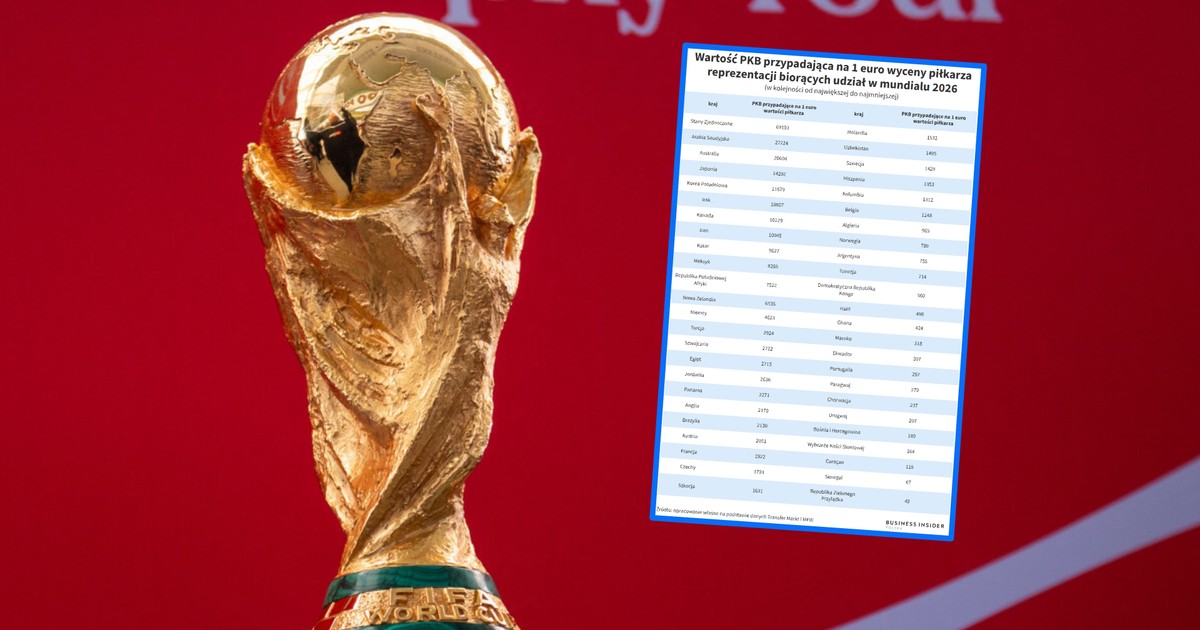
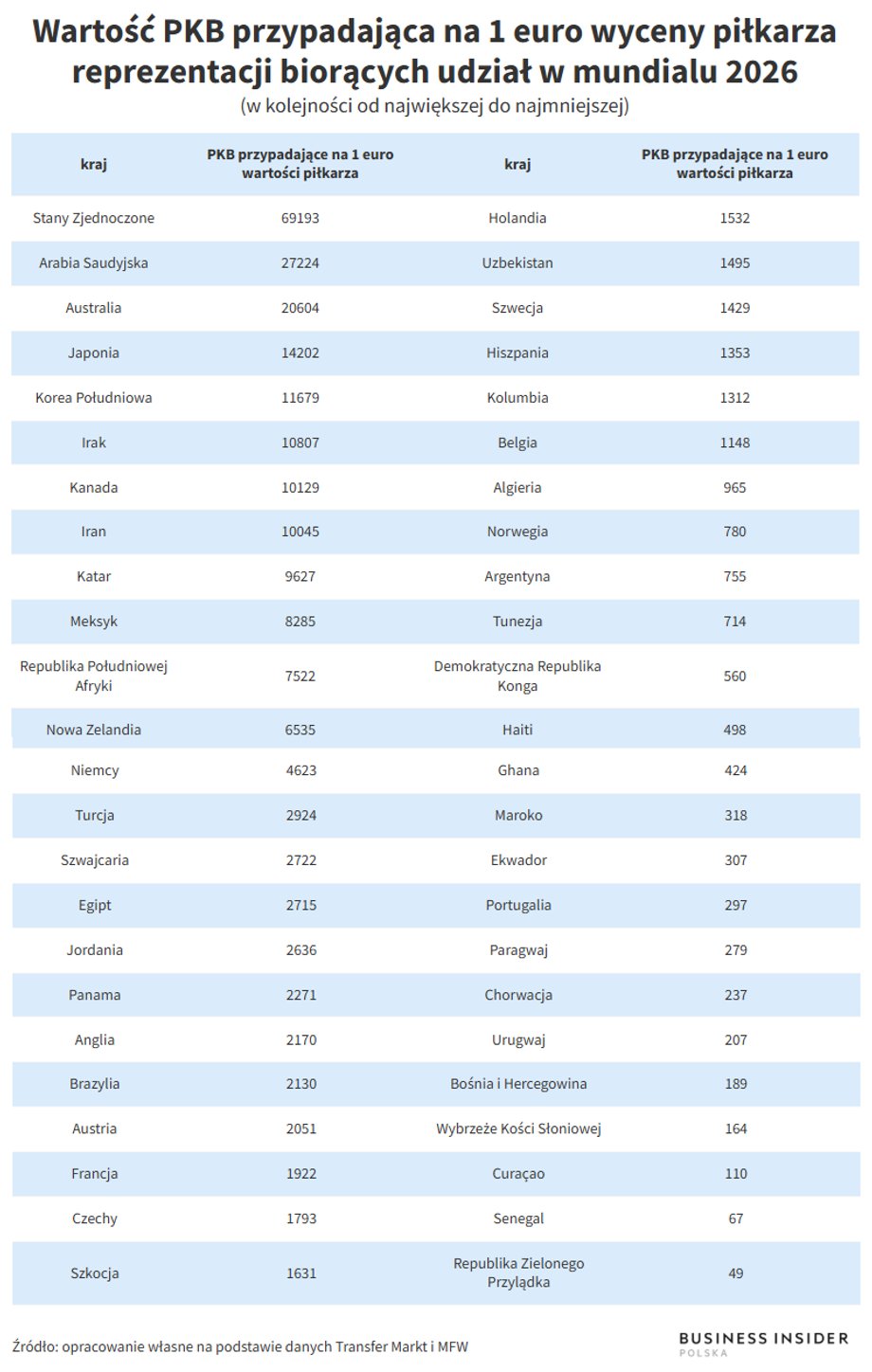
Having data on the GDP and the value of players of all countries participating in the 2026 World Cup, it is possible to calculate the ratio of relative football power to economic power. It shows whether a given country makes good or bad use of the sports potential brought by the strength of the economy.
If there is a huge amount of GDP per 1 euro of a footballer's value, it means one of two situations:
- Economic powers with a low football culture: countries such as the USA, Saudi Arabia or Australia have a large GDP, but their national teams are not of the same quality
- Countries rich per capita (e.g. Qatar) that generate great income but do not train the most expensive players in the world
If the amount of GDP per 1 euro of footballer is low, it means that the national football team is “worth” relatively much in relation to the size of the entire economy. This is the result they have small countries like Cape Verde or Curacao and the African teams: Senegal and Côte d'Ivoire.
Countries that make the most of their economic potential through football have results at the level of several dozen euros of GDP per 1 euro of player value. On the other side, there are countries where it is tens of thousands of euros.
Click to open in a new window (table created using the Flourish tool)
|
Damian Słomski / Business Insider Polska
Poland with a result of EUR 3,878 (this is the amount of GDP per 1 euro of the value of a national team player) would be among the countries that do not fully use their potential. We would find ourselves between Germany and Turkey.
Author: Damian Słomski, journalist of Business Insider Polska