The stakes behind the appointment of Adrian Veștea. How Nicușor Dan wants to block the anticipated and isolate AUR

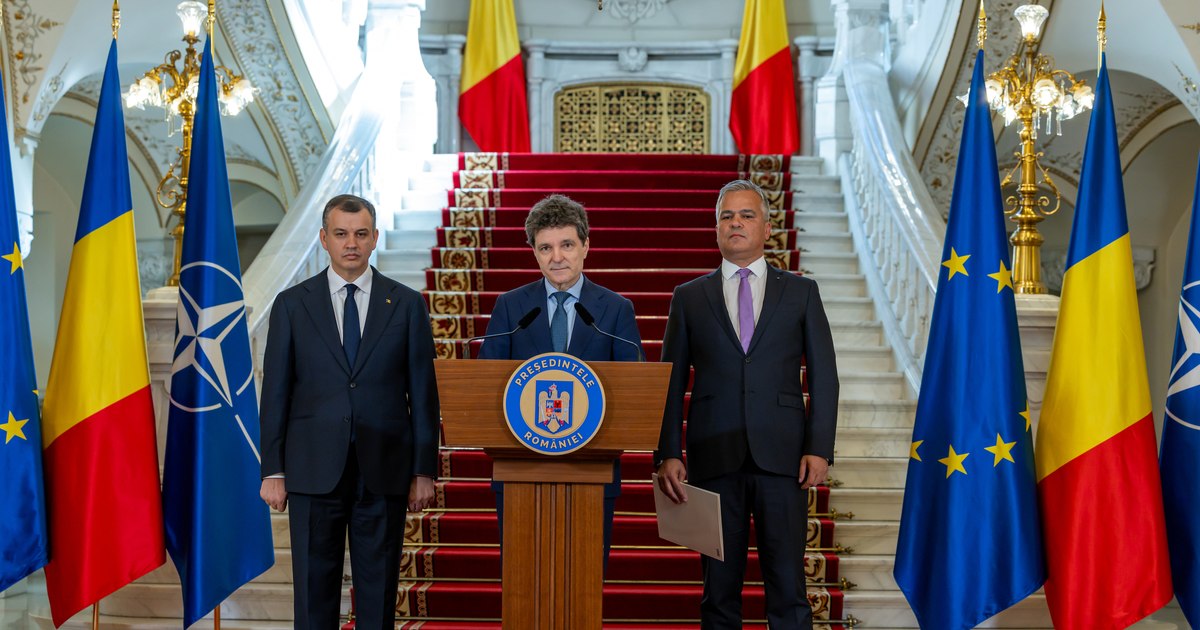
Adrian Veștea is the surprise proposal of Nicușor Dan for the position of prime minister. The quick appointment of the PNL first vice-president opens a race against time to form the government, with the major stake being to block a protracted political crisis that could propel the AUR and radical forces in the polls.
Nicușor Dan, at the announcement of Adrian Veștea's appointment as prime minister. PHOTO: Presidency
In an analysis for “Adevărul”, George Jiglău, political science professor at Babeș-Bolyai University, explains the political stakes of this move and warns of the effects that the prolongation of the government crisis may have.
An acceptable liberal prime minister for the PSD
By abandoning the option of a technocrat prime minister, Nicușor Dan chose a solution with a precise political logic, the appointment of a liberal who can also be accepted by the PSD. According to some political sources, Adrian Veștea is perceived as a politician with functional relations in the area of local administration, including with social democratic leaders, consolidated during the period in which he led the Ministry of Development. George Jiglău believes that the choice is not completely surprising, even if part of the public space expected a name from the PSD.
“There is, however, an element of surprise in that many expected a nomination from the PSD area. Instead, a variant from the PNL was chosen. But this is not entirely unexpected either. There was already a camp in the party that had demarcated Ilie Bolojan's line since the period after the censure motion. I would not say that we are talking about a politician close to the PSD, that would be an exaggeration. Rather, he is the exponent of a type of politician formed in the classical parties, very well connected to the mechanisms of local and central administration“, explained George Jiglău.
The tensions within the PNL have older roots, the analyst explains, fueled by the dissatisfaction of local elected officials with Ilie Bolojan's leadership style.
“For more than half a year, tensions have been building up around Ilie Bolojan. In the PNL there was an important category of local elected officials, mayors and presidents of county councils, who believed that his leadership style limited their access to resources and funds. This discontent grew in parallel with PSD discontent and became one of the main fault lines in the party“, explained the professor of political science.
A move that reconfigures the balance of power in PNL
The appointment of Adrian Veștea is interpreted as a direct challenge within the PNL and as a repositioning in a party marked by internal tensions. The stake is whether the camp favorable to the newly appointed prime minister will manage to coagulate enough support to influence the formation of a parliamentary majority.
“If the camp that supports Veștea manages to coagulate enough support, then am could have a new government. But if Bolojan, together with leaders like Ciprian Ciucu and Adrian Veștea, manage to keep this group in a marginal position, then the whole movement could turn against the president. In that scenario, Ilie Bolojan would come out even stronger politically than he is today.” said George Jiglau.
The first signs of cracks in the PNL: the liberals who broke ranks around Bolojan are supporting Vestea. “How to be excluded?”/”A solution for the current political crisis and a solution for the PNL”
Will USR support Nicușor Dan or go into opposition?
In this context, USR is in a difficult position, caught between its loyalty to President Nicușor Dan and the position of its own electorate. George Jiglău believes that the formation led by Dominic Fritz is unlikely to fully support this nomination.
“If the PNL breaks up, a political construction between the wing of Bolojan and the USR becomes very plausible. If the PNL remains united around Bolojan and only a few MPs leave with Veștea, the question of the positioning of the USR remains equally important. Personally, I don't think that the USR will go all the way with this nomination. And that would mean a break between the party and Nicușor Dan”appreciated the professor from Babeș-Bolyai University.
The danger of early elections
If the appointment of Adrian Veștea does not lead to the formation of a government, Romania could enter the scenario of early elections, with political effects difficult to anticipate.
“After what happened today, I think the chances of early elections are increasing. If the PNL does not break up and the USR does not support the president's proposal, the chances of the new government passing the Parliament become reduced. Of course, the composition of the cabinet, the government program and the position of the UDMR also matter. But, at this moment, the scenario of early elections is more likely than it was yesterday“, explained George Jiglău.
According to him, the real stake goes beyond the mere formation of a functioning government.
“The big problem of this period is not only the delay of some reforms or some European funding. The problem is the general climate of uncertainty. There have been security incidents, institutional tensions and a lack of clarity regarding who communicates and who takes the important decisions. This sense of insecurity accumulates both in society and in the relationship with external partners”warned the professor of political science.
GOLD, the main beneficiary of political instability
George Jiglău points out that the prolongation of the political crisis may favor anti-system formations, especially the AUR, but its rise is not exclusively determined by the current context.
“I do not believe that its eventual electoral success would be directly caused by the current political crisis. AUR operates in a distinct electorate area, with its own dynamics and mobilization channels. Even under the conditions of a stable and effective government, I believe that the party would continue to grow. Therefore, the causal relationship between the current crisis and the electoral score of AUR must be viewed with great caution”explained George Jiglău.