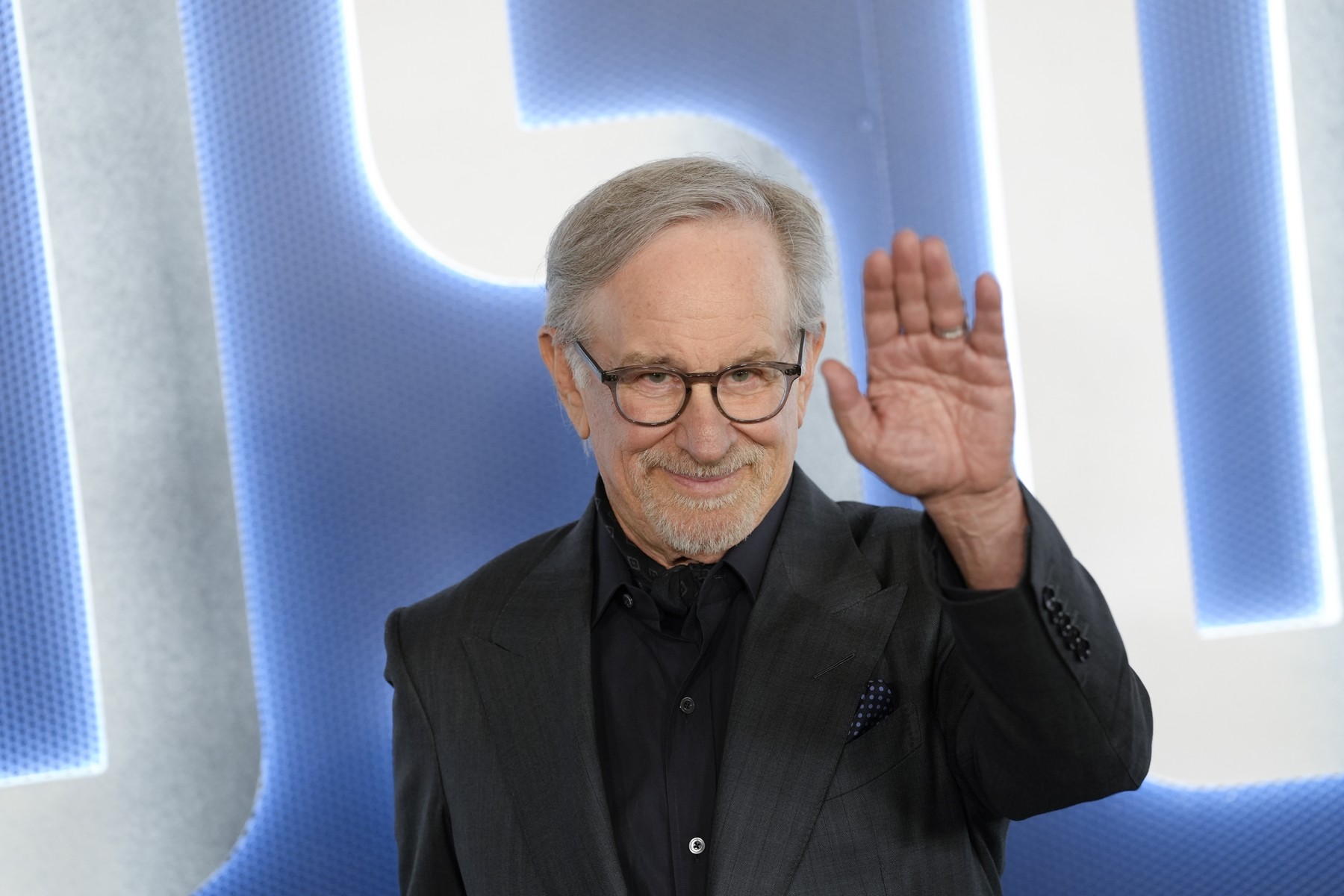
“Day of Truth,” Spielberg's new movie, isn't about aliens. It's about the only commodity that really matters: information.
Steven Spielberg returned, at 79 years old, to the land that consecrated him: the sky. “Disclosure Day,” written by David Koepp and released June 12, starring Emily Blunt, Josh O'Connor and Colin Firth, tells the story of a cyber security expert and a Midwest weather anchor who try to reveal the existence of extraterrestrial life to the world, while a para-government agency created precisely to keep this secret tries to stop them by any means necessary.
On the surface, a classic sci-fi thriller. However, viewed through the eyes of an economist, the film becomes something else: an allegory about the information economy. The conspiracy, the stalking, the institutional conflict – it all boils down to one question: who controls the most valuable piece of information in history, and who decides when the rest of the world learns it?
Jjournalist Dan Popa sends the “EconoMix” newsletter every Thursday morning. If you are interested in personal finances and want to receive economic recommendations, you can subscribe here:
Asymmetry as power
One party holds information of incalculable value; everyone else trades, votes, prays and plans in ignorance. Economists have a name for this: information asymmetry. And their lesson, validated by a century of crises, is that markets built on massive asymmetries aren't markets – they're just extraction mechanisms.
The agency's monopoly of a single fact is the source of all its power. And the moment of disclosure is the moment when this rent evaporates. “Rent”, in economic parlance, is the income obtained from privileged access, not from productive activity. Whoever monopolizes the knowledge of a world-changing discovery can extract political and economic advantages from that monopoly—just as, on a smaller scale, do holders of insider information in the stock market, trade secrets in technology, or proprietary data in the digital economy.
The arithmetic of secrecy
But keeping the secret is not free. Maintaining silence on a planetary (or national, as you like) scale requires ever-increasing institutions, enforcers, wages, and marginal costs as the number of those to be silenced increases. Here the film touches, without intending to, on an intuition that any central banker knows: you can defend a level of the exchange rate of the lion only as long as the cost of defense remains below the cost of capitulation. Soros can confirm.
Economic history is full of moments when this arithmetic has suddenly reversed. Sterling in 1992. Bank reserves 'intact' in 2008. Regimes and corporations alike discover sooner or later that suppressing the truth becomes more expensive than admitting it. The difference between the two moments is not the truth: it is its price.
The shock of reappraisal
Economists have a weakness for what happens to asset prices in the seconds after a news surprise emerges. The film's premise is the ultimate study—a single revelation that forces humanity to reevaluate everything: defense budgets, insurance, religion, the future itself.
And here it is worth making a distinction that economics takes very seriously: that between risk and uncertainty. Risk means knowing the possible outcomes and probability of each scenario materializing.
Radical uncertainty, as former Bank of England governor Mervyn King would say, means not even knowing the possible outcomes. “Radical uncertainty” (it's also the title of the book written by King) refers to events that are difficult to explain and sometimes even to understand. Such as, for example, Taleb's black swans, but not only them. In other words, there is a fundamental difference between risk or probability that you can calculate (like rolling a dice) and the profound uncertainty that governs real life.
King says probabilistic models and economic theories often fail to capture reality because the complexity of human behavior and ever-changing circumstances make hard estimates useless.
It is dangerous, he argues, to apply probabilistic thinking to areas such as politics, business or finance that are not governed by scientific laws.
Confirmation that we are not alone in the universe would throw markets into the second category – where investors can no longer price assets because the rules of the game become negotiable.
The film, significantly, does not rely on the optimistic scenario. The planet in “Day of Truth” is on the brink of a world war—a reminder that new information doesn't always produce efficient markets. Sometimes it produces panic and failure of coordination. When everyone learns the same destabilizing fact at the same time, the collective reaction can become chaotic – just like after an unexpected financial shock.
Confidence, the invisible asset
The film's deepest lesson, however, is different. A government found to have concealed something of this magnitude doesn't just lose a secret – it devalues every future statement it makes.
Trust, which economists increasingly treat as a form of social capital, is the invisible infrastructure of any economy: it reduces transaction costs, enables cooperation, makes credit possible (a word that comes, not coincidentally, from the Latin credere – to believe).
The central dilemma of the film can be translated, without exception, into the language of public policy: is today's stability worth the long-term cost of the loss of public trust? It is, in narrative form, the problem of any institution that has spent out of credibility – once spent, everything becomes much more expensive.
Truth as a public good
It remains the question that the film asks, in fact, all along: Who owns the knowledge of humanity's place in the universe? Governments, corporations or everyone? Economists have been waging this debate for centuries—about science, patents, and intellectual property—and have a term for goods whose benefits can be shared by all without being depleted: public goods. The film's slogan – the truth belongs to the seven billion people – is, in essence, the description of a privatized public good, returned to the common domain.
The “Day of Truth” therefore teaches us nothing about economics directly. But as an allegory of information monopoly, the shocks of some revelations, and institutional credibility, it is surprisingly apt for anyone who has understood that economics is not, at bottom, about money. It's about information, incentives and trust. The aliens are just the pretext. The rare commodity, as always, is the truth.