Mammoth centers for people with disabilities are closing, families are waiting for support services. What transitional solutions will work

Romania must reduce, by the end of this month, by 32% the number of adults with disabilities cared for in centers. While the goal – to increase the number of adults living independently in the community – is laudable, an important link in the chain of care is still under construction. From almost 17,000 people with disabilities cared for in centers in 2020, our country must reach approximately 10,350 in 2030.
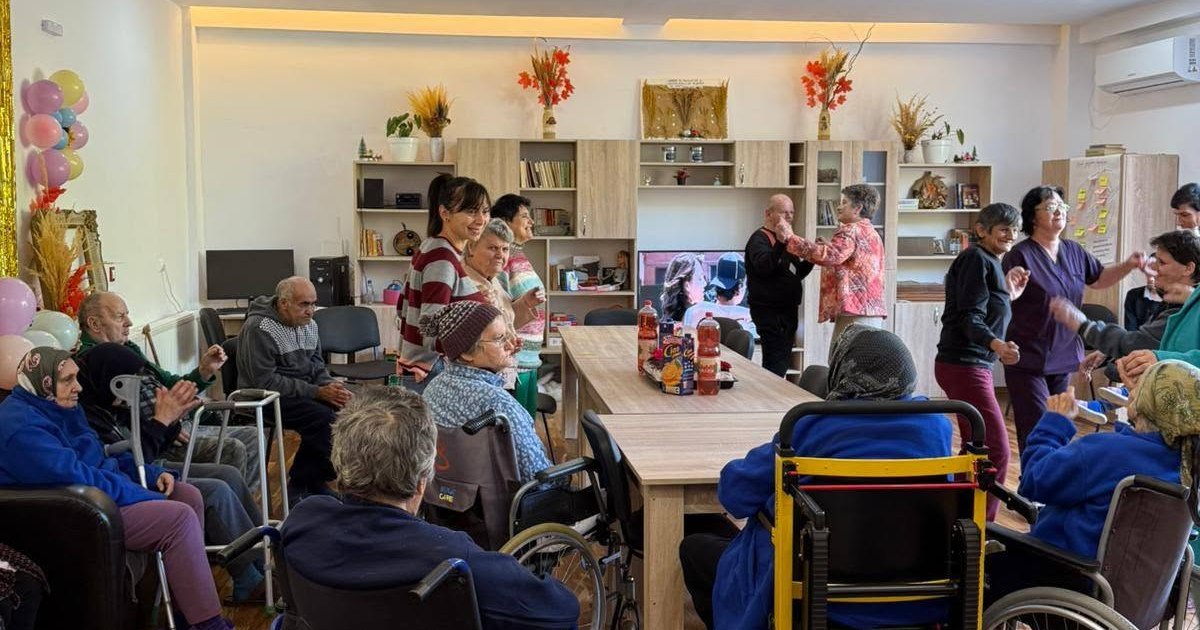
From 2030, access to care centers will be even more difficult PHOTO: FB/ CIA Fălcoiu – DGASPC Olt
The commitment to reduce the number of disabled people institutionalized in care by 32% by 1 July 2026, and by a further 10% between 2026 and 2030, puts the authorities in a race against time. The General Directorates of Social Assistance and Child Protection (DGASPC) are reorganizing their services, the mammoth centers are being abolished, the hiring of personal assistants has begun as part of the deinstitutionalization solution, homes with no more than 5-10 care capacity places are taking the place of the previous centers, etc.. Local authorities are given new tasks, having the attribute of supporting families who care for adults with disabilities through support services. However, this support network seems to be the missing link for now.
And if for the people currently in the care system solutions, in one form or another, will be found, from this point it will be much more complicated for a new case to be admitted into the care system.
The model promoted by the European Union and the United Nations Organization is for large institutions to be abolished, simultaneously with the establishment of community services, with the ultimate goal being independent living for people with disabilities, assisted by the support network.
Families who today care for a person with severe intellectual disabilities, with chronic mental illnesses, with serious disabilities and total dependence on care feel the most cruelly what it means to have a lack of support network, lack of sufficient personal assistants, lack of day care centers, lack of recovery services.
In order to understand how the deinstitutionalization process proceeds, I spoke with Rădița Piroșca, director of DGASPC Olt.
Residential centers of up to 50 places
The first step of improving the quality of life of people with disabilities involved reducing the capacity of mammoth centers to centers with a capacity of no more than 50 places, a measure already implemented.
In 2022, the date that constitutes the reference for many of the objectives in the deinstitutionalization process, in Olt county there will no longer be any center with more than 50 places, Piroșca explains. The 32% reduction in the number of institutionalized adults with disabilities meant for the county that a number of 130 beneficiaries started a new life – in social services, in independent living or in assisted living -, while another 261 were to continue to be cared for in DGASPC centers with a maximum of 50 places.
30 people with disabilities integrated into the family or the community, in 6 years
This year, the National Authority for the Protection of the Rights of Persons with Disabilities developed a legislation that allowed the DGASPCs to establish assisted housing in the community with a capacity of 5, respectively 10 beneficiaries, intended especially for people subject to deinstitutionalization who no longer have family, in the community of origin there are no homes in which they can manage themselves, and on the other hand, as established by the specialists, they do not have the ability to live independently.
“For the 130 beneficiaries, DGASPC Olt has identified social services for assisted living in the community for independent living and people who are in our evaluation to become professional personal assistants (similar to the professional maternal assistant, but for people with disabilities) within a national project in which DGASPC Olt is among the 23 partner directions. The hiring of 10 professional personal assistants is also approved in the evaluation, precisely to support deinstitutionalization and assisted living in the community for an independent life for these beneficiaries.” Pirosca explained.
For the beneficiaries who needed assistance and for whom no solution was identified in the family or in the community, DGSPC Olt established centers for independent living: two in Corabia, one in Cezieni, one in Băbiciu and one in Slatina, each with a capacity of between 8 and 10 places.
It is not simply a move from a large center to an apartment, says the head of DGASPC. “They have a different quality standard, a different type of procedure. They are centers where only support and assistance is given to the beneficiaries, basically to live as children live in family-type houses, assisted by staff hired by the DGASPC”, added Pirosca.
Two other sheltered homes were established in Corabia, with the capacity of 5 beneficiaries each, and another four in Slatina.
Since 2020, since the deinstitutionalization process began, 30 beneficiaries went, on the other hand, to the family or to the community, Piroșca also specified. Another 15 will go to the community, either to a personal assistant (from the staff under evaluation for such positions), or to the family, relatives.
Fiscal burden hits disabled people, who live in fear of tomorrow: “I already had the belt tightened and now it has moved two more holes”
“I remain with a case manager and in monitoring for 24 months”
Deinstitutionalization does not end with the transfer from large centers to assisted housing or sheltered housing or family housing, Piroșca emphasized.
“Beneficiaries remain with a case manager and follow-up for 24 months in all these services in the community. They will be monitored by the DGASPC through the case manager”, the director of DGASPC Olt also said.
Personal assistants, such as foster carers, may also request to care for more than one beneficiary. Each case will be evaluated, because there is also the issue of the existence of space, living conditions, Piroșca explained. “We have not had situations in the assessment of people who could take over more than two beneficiaries”, Pirosca added.
“We must become a more inclusive society”
Although deinstitutionalization, forced by the obligations assumed through the PNRR, has begun, community services are lacking for now, even though this should be the biggest change that citizens and beneficiary families should notice.
“We need to become a more inclusive society, local communities to develop day services, support, home care. But especially day and recovery services, where people with disabilities, young people with disabilities, can access support services. The European Convention obliges us to such things. (…) And sheltered housing services and centers for independent living are only transitional.(…) Basically, the European Commission has established that from 2030 people with disabilities will no longer be institutionalized and that they will benefit from independent living through services in their localities of residence”Piroșca pointed out.
The process will be a difficult one, admits Rădița Piroșca. “It will be quite a difficult process, because there are no social support services and the community hardly accepts their social inclusion”Pirosca also said.
For the time being, there is a lack of both social and medical services in the community, and this in the conditions where most of the people who are institutionalized, people aged up to 65, also have mental health problems. For these, mental health, counseling and support programs must be provided in parallel, “bearing in mind that it is not enough to just take pills, the treatment must be long-term and assisted.”
“It will never deinstitutionalize to a family that doesn't have the resources, that doesn't want the child (n. ed. – the young adult). We will continue on the line of professional personal assistants, we will continue on the line of assisted social services in the community and, at the national level, through programs, through forms of financing, they will support themselves and communities have already started to develop support services for people with disabilities”. Pirosca also said.
It is difficult to say, at this moment, what will happen after 2030, when the institutionalization of new cases will no longer be admitted either in the old-type centers or in the homes admitted today as an emergency solution. And until then, in the coming years, the most difficult thing to find, at least in the DGASPC structure, will be a place for an adult with disabilities, Piroșca admitted.
The story of a disabled woman who worked for a month and a half for 160 lei at a ghost company: “I was told I was worth nothing”
The few institutionalization solutions will address disabled people over the age of 65, who will be able to be cared for in care centers for the elderly. CJ Olt adopted, on Wednesday, June 10, 20226, the establishment of another center for elderly people (with a capacity of 40 places), in addition to the one with a capacity of 80 people that DGASPC already had.
“I set up another one today, because people with disabilities received measures of protection and assistance and care in centers for people with disabilities. Through the DGSPC and the County Council – because we are subordinate and the funding is provided by the County Council for the elderly, only 10% is given by the state budget – we are creating social structures and forms of support to come to the aid of people, in this legislative horizon and that exist at the moment”, said the director of the DGASPC Olt.
For which of the categories of people who need social assistance will it be the most difficult to access a DGASPC home? The answer will disappoint many families who today have no solutions. “For totally dependent disabled people, up to 65 years of age,” DGASPC director Olt also said.
In theory, for a family caring for a disabled adult there are solutions: personal assistant, benefits, recovery centers, mental health programs. In practice, families who care for relatives with disabilities know that they are not available, or not as needed. DGASPC Olt has a day center and recovery centers in its structure, which it will open from now on to the access of people from the community. The problem, however, is the location in the territory, which will not allow those in need to easily access the services offered here.
What is also being considered is the development, at the DGASPC Olt level, of mobile intervention teams in the community. A project will be submitted for this, the availability of services of this type not being immediate.