Can Romania play both sides in the conflict between the USA and Europe? Expert: “It's the worst thing, you risk falling between the boats”


Economic conflicts between the great powers represent the biggest threat to the world, according to a survey by the World Economic Forum that began its work in Davos. An economist and a political analyst explain how Romania should manage the conflict between the US and Europe.
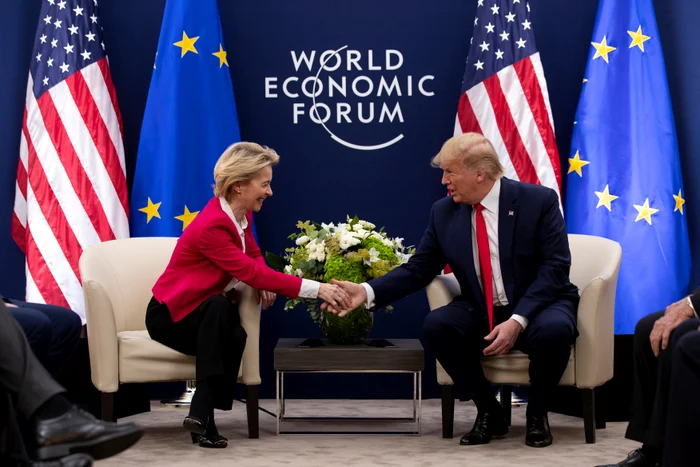
European Commission President von der Leyen and President Trump in Davos. PHOTO: Profimedia
Economic conflicts between major powers are the biggest threat to the world in the next two years, according to a survey by the World Economic Forum (WEF), published ahead of the annual meeting in Davos, which began on Monday in Switzerland.
Armed conflicts have been replaced by economic conflicts as the main concern of more than 1,300 experts surveyed worldwide in the World Economic Forum survey.
Saadia Zahidi, director general of the EMF's annual meeting in Davos, cited rising tariffs, controls on foreign investment and tighter controls on the supply of resources such as critical minerals as examples of “geoeconomic confrontation,” which ranked as the top risk.
“(It is) when economic policy instruments become essentially weapons rather than a basis for cooperation”she stated in a press conference.
In this context, the most important question for Romania is what geostrategic position should it adopt in order not to be the victim of such a conflict between the US and Europe?
“The EU is unfortunately being crushed by the US and China”
Economist Daniel Dăianu, president of the Fiscal Council and university professor at SNSPA in Bucharest, explained to “Adevărul”:
“The erosion of the transatlantic relationship (between the US and Europe/EU) is striking and dismaying to Europeans. American rebukes to Europeans about the low level of defense spending began many years ago. Robert Gates, former US Secretary of Defense, preceded President Trump on this point. But now it is not only about the level of defense spending, but about US military disengagement from Europe, a trade war to all the azimuths triggered by the American administration, by the return to the US foreign policy of relentless realpolitik – as described in the National Defense Strategy and which can be seen in the attitude towards the status of Greenland”.
Everything takes place in a multipolar world, in the context of China's formidable economic and industrial, technological rise.
“Beyond other explanations, also related to spheres of influence, the US sees rivalry with China as the main concern of Washington's long-term strategic thinking. The EU is unfortunately crushed by the US and China from an economic and technological point of view, as shown by figures and even analysis documents of the European Commission (e.g. the Draghi Report)”explains the economist.
A NATO without the USA, dramatic consequences for Romania
Romania, like other EU states, faces big dilemmas, the economist believes. “A very bad scenario would be the disappearance of NATO if the US takes over Greenland and withdraws from the Organization. Another 'NATO' (without the US) would be another organizational 'animal', with much lower relevance. Because NATO means, first of all, the USA”, he elaborates.
The consequences would be dramatic, especially for the countries on the eastern flank of the EU, including Romania – forced to greatly increase defense spending. “A rating agency spoke of a possible downgrading of the sovereign ratings of these countries. We still need these… The breakup of the transatlantic relationship, the passing of NATO into irrelevance would upset the financial markets and economic relations in the world, could destabilize the EU“, says the teacher.
The main winner: China, explains Dăianu, “because the Europeans would try to save as much as they can of the valences of multilateralism, even if the inward turn (illustrated by industrial policies and protectionism) is representative of the last decade and is also found in the Union. And the Mercosur agreement must be seen in this key”.
“It is important that Romania be at the discussion table with balanced positions”
“Romania needs a vital Union and a partnership with the USA that works”, says the teacher.
Can such a thing work if the EU is in bitter confrontation with the US? “The perspective of the war in Ukraine also comes into play, and the Europeans need American support from this point of view. Without the Americans, it is probably not possible to end the war, under the given conditions. Let's hope that this war will end soon and that there will be a “grand bargain” that will prevent the resumption of hostilities. Europe, not only Ukraine, needs security guarantees – as were the Helsinki accords“, claims Dăianu.
It is important for Romania to be at the discussion table with balanced positions and to try to contribute to the approximation of the approaches under debate. “These are very troubled times, with a world engulfed as if in chaos. It was not for nothing that Robert Kaplan likened these times to what was happening in the Weimar Republic in the interwar period (in his book Wasteland). Let's hope that lucidity and what the English call common sense will avoid catastrophes.” details the president of the Fiscal Council.
Economist's conclusion: “In such difficult times, the importance of improving public finances acquires additional arguments for Romania. The cash budget deficit in 2025, of probably 7.7% of GDP, shows that we are moving in the right direction.”
Hrițuc: “Romania will be one of the main forces in the area”
Political analyst Cristian Hrițuc starts from the key conclusion of the survey carried out by the World Economic Forum in Davos – according to which economic conflicts between the great powers represent the biggest global threat in the next two years – and places it directly in the context of Romania's vulnerabilities and opportunities.
Hrițuc describes this stage as a new global race for resources, accelerated by the technological transition and the entry into an era dominated by artificial intelligence. “It's a rush for resources, because we're preparing for another transition… we've entered the age of artificial intelligence,” he says, stressing that the fight is no longer just for oil and gas, but for “rare metals for chips and high-tech technology”. In this context, Romania is not a marginal actor, but one with real strategic potential.
The analyst points out that Romania has important resources, about which “quite a bit is known”, but which can become extremely relevant for the industry of the future.
A central point of his analysis is the Neptun Deep project, which could turn Romania into a major player in the regional energy market. “In 2027, when Neptun Deep will start operating, Romania will be one of the main forces in the area in terms of the ability to sell gas“, says Hrițuc. This positioning can be a huge economic advantage, but it also comes with serious risks.
In a world he describes as “a world of predators”, resources automatically become targets. “If we were in a normal world, we would classify all these things as advantages. As we are in a world of predators, it can be a target“, he warns. In particular, Hrițuc evokes the risk that the Russian Federation is interested in blocking Romania's rise as a regional gas supplier, especially since certain areas of the continental shelf are not directly under the NATO defense umbrella.
“You can't trust an actor who today takes you in his arms and tomorrow throws you out the window”
The most delicate part of the interview is related to Romania's strategic positioning in the great economic and geopolitical conflicts. Asked explicitly “in which boat we should position ourselves”, Hrițuc offers a sharp answer, but not devoid of nuances. “It is extremely difficult, but positioning in Europe's boat is, at the moment, the best solution“, he says. The main argument is the unpredictability of the United States under the leadership of Donald Trump: “You can't trust an actor who today takes you in his arms and tomorrow throws you out the window.”
Hrițuc gives the example of Trump's relationship with European leaders, showing that a solid partnership cannot work based on political whims. At the same time, he formulates one of the clearest syntheses of the Romanian dilemma: “Romania is dependent on America for security, but it is economically dependent on Europe. One can die of war, but one can also die of hunger”.
From this follows the conclusion that Romania cannot afford to play at two ends or to remain ambiguous.
“The worst thing is to stay in “no man's land”, to play double and everyone lets you down, because a partner needs to be reliable, not to play multiple ends”, warns the analyst.
He advocates a pragmatic strategy: “without hostile gestures towards the US, without offending Trump, we must keep close to the EU and strengthen ourselves here. Europe has now proved that it can stand together, it can stand together, including through its support for Ukraine. We are most interested in keeping Ukraine between us and Russia.”
The end of the intervention is a harsh political warning, referring to past mistakes. “Careful that Romania is not like in 1916”says Hrițuc, recalling the strategic hesitations since then. “We were lucky at the end, but I'm glad we didn't adopt the same position and fall right between the boats.” In a world marked by economic confrontations and tough competition for resources, the lack of a clear choice could be, in his opinion, the biggest risk for Romania.