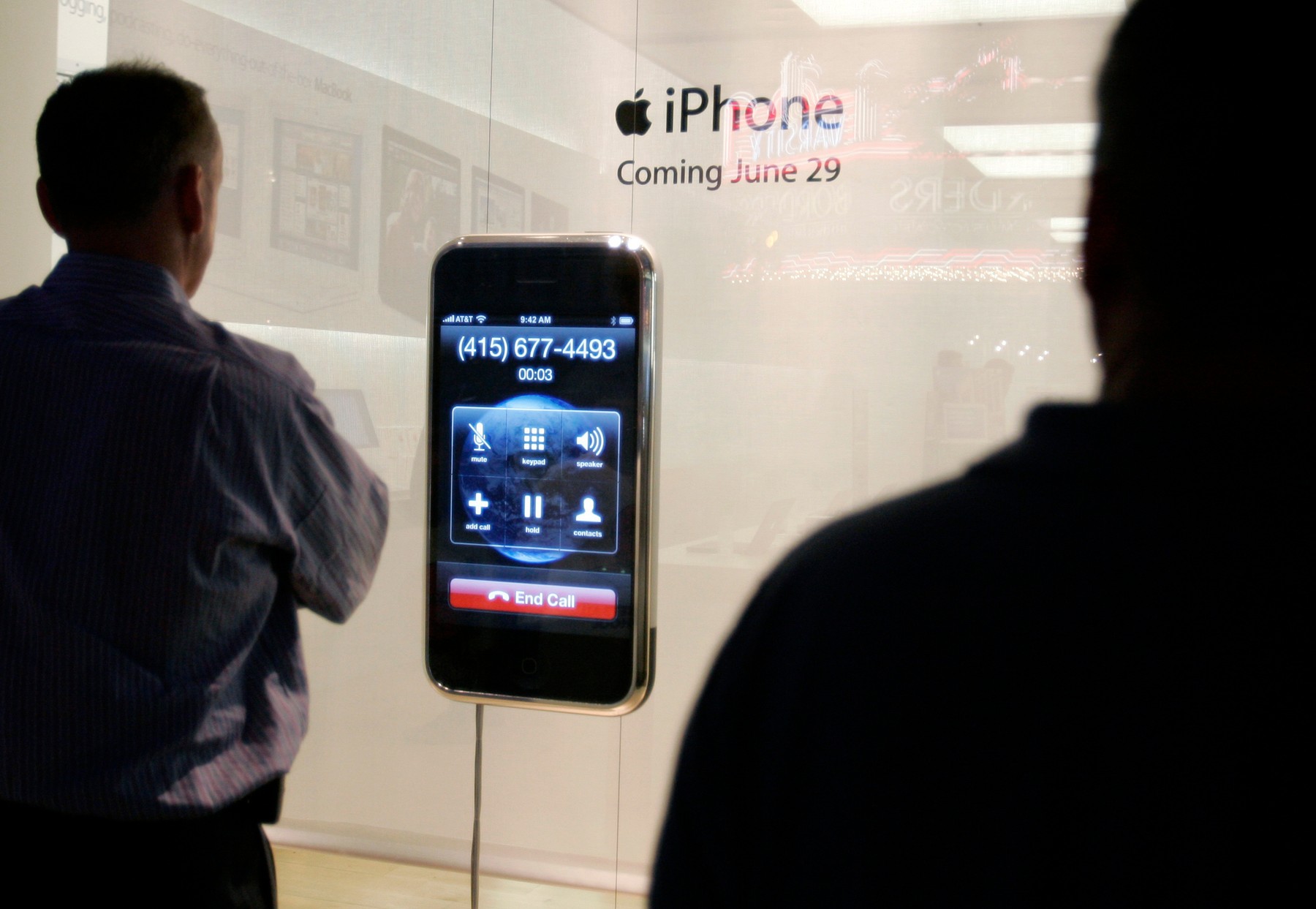
If the phone is too addictive, its user's sex life might not be, writes The Register, pointing to a study that identified one factor for the decline in birth rates in the United States: the iPhone.
As unlikely as it may seem, the study was conducted by the National Bureau of Economic Research, a prestigious private research institution in Cambridge, Massachusetts.
It examined the coverage of AT&T's mobile broadband services from the launch of the iPhone in 2007 until 2011, when the company lost its exclusivity as a carrier for the device.
By comparing birth rates between different counties and taking into account factors that may have influenced the results, the authors concluded that access to the iPhone reduced the number of births, especially among younger women.
The data, the researchers write in their paper, suggests that access to the iPhone led to measurable declines in birth rates for all age groups. The authors found that women between the ages of 15 and 19 in counties that had access to an iPhone through AT&T experienced a reduction in births of up to 8% over the period analyzed, while in the 20–24 age group the decline reached 6.6%.
And older age groups showed “statistically significant but smaller declines,” according to the study.
The authors of the study are convinced that they have discovered a causality, not a mere chance correlation
“It's virtually indisputable that births have declined more rapidly in areas with AT&T coverage,” researcher and economics professor Caitlin Myers, one of the study's authors, told The Register.
“As a scientist, I avoid ever saying that a causal relationship is 'proven'…but I would say that we have identified a compelling natural experiment and that it strongly indicates a broad causal relationship between the iPhone and fertility.”
In counties where AT&T had strong coverage, people had access to the iPhone as early as 2007. In counties dominated by rivals Verizon and Sprint, the iPhone was not available, and modern smartphones using rival Android's operating system only began appearing in 2009.
The researchers compared these two types of counties. After the release of the iPhone in 2007, birth rates declined in AT&T areas, but not in Verizon/Sprint areas. This suggests that the effect was related to smartphone access and not to other general factors.
Later, when Android phones became widely available in the Verizon/Sprint areas as well, the researchers saw signs that the birthrate began to decline there as well. However, the data for this period are fewer and less clear, so the conclusion is less certain.
“Taken together, these cohort effects suggest that the spread of the iPhone accentuated the decline in births among women under 30, while limiting the increase in births among older women,” the study explains, adding that the release of the iPhone could explain up to 52 percent of the overall decline in fertility in the United States over the period analyzed.
How the iPhone “killed” your sex life
Ezekiel Hooper, the study's other author, wrote in a message posted on LinkedIn that the people he spoke with about the results were not at all surprised by the paper's conclusions.
“Some counties got a working iPhone; neighboring counties didn't,” Hooper noted. “We found that births among teenagers and young adults fell much faster in places where the iPhone worked. And in the counties left on Verizon? No effect. It's hard to explain this timing by anything other than the advent of the iPhone,” he pointed out.
The study data does not include information on why the introduction of the iPhone led to the decline in birth rates, but Myers and Hooper point to other research to suggest three possible explanations.
First, smartphones represent an alternative to face-to-face interactions, meaning people spend less time in physical proximity and are therefore less likely to have sex. If we add another factor identified by the authors – instant and easy access to online pornography – people who stay at home instead of socializing are more likely to satisfy their sexual needs alone.
“The iPhone is the always available alternative to time spent together in person; its social media applications are designed to maintain users' attention; both features reduce time spent with friends, which is the context in which sexual encounters occur,” the two authors wrote.
Accessing the Internet via the iPhone also had another effect
Third, the iPhone gave people easy access to information about contraception and termination of pregnancy.
“We do not argue that the iPhone is the sole cause of the decline that began after 2007,” the two conclude in the paper. Research looking at the more recent effects of connected technologies on fertility also found that while the iPhone may have been the first alarm, internet connectivity, social media and ubiquitous access to pornography continue to influence birth rates.
The fertility decline that began in 2007 has become a concern worldwide, not just in the United States, and Myers and Hooper conclude their study by looking at government programs in various countries that provide financial incentives to encourage citizens to have children.
The two researchers say these programs target the wrong problem, even though for many people the cost of raising a child is indeed too high.
“Our estimates suggest that the introduction of the modern smartphone played an important role in the decline in births in the United States,” they conclude in the study.
“The public policy instruments in which governments have invested the largest sums … do not, by themselves, address the behavioral change that our estimates suggest we observe,” the two researchers wrote.