“Star Wars”. Russian military satellites have approached a Finnish commercial one that provides images to the Ukrainian military

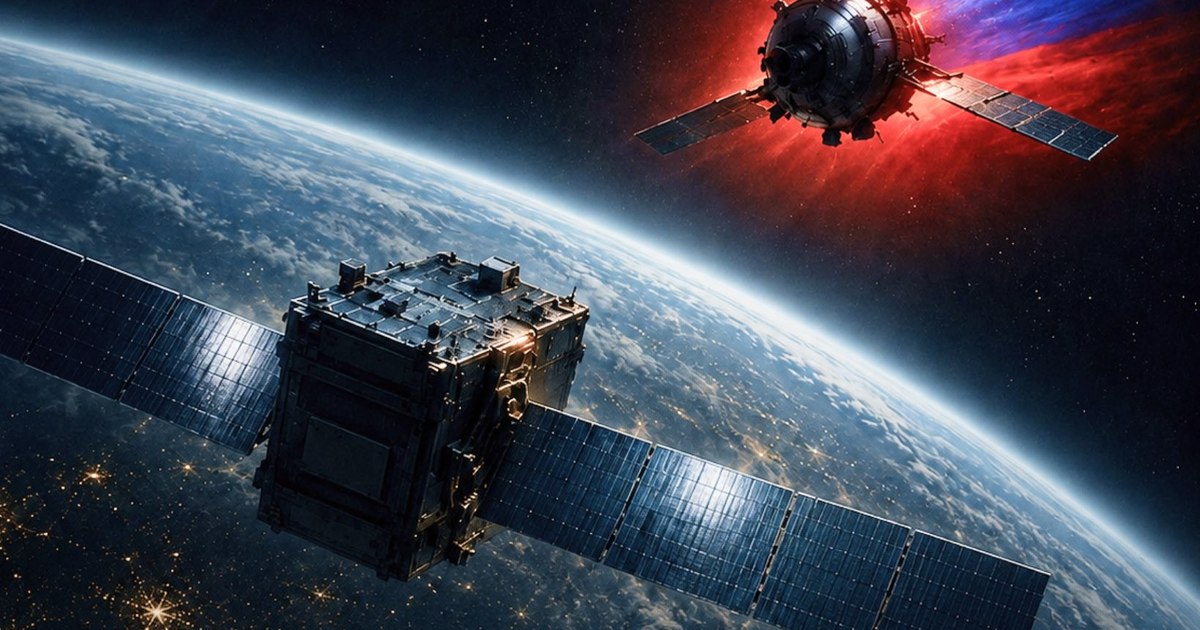
While the world's attention remains focused on the Ukrainian front, a much more discreet confrontation appears to be taking place hundreds of kilometers above Earth. Several Russian military satellites recently approached a commercial device that provides images to the Ukrainian military, fueling speculation about a new chapter in the rivalry between Moscow and the West: the competition for control of outer space.
Finnish satellite, followed by a Russian one/PHOTO: X
Several experts in monitoring space activities are drawing attention to unusual maneuvers by Russian military satellites that have approached a commercial satellite used to provide images to the Ukrainian military.
Although there is no clear evidence that it is a hostile operation, the incident raises the possibility of transforming outer space into a new front of confrontation between Moscow and the West, writes the independent Russian publication meduza.io.
Russian satellites have changed their orbit
According to space analytics company Integrity ISR, four Russian military satellites — Kosmos-2610, Kosmos-2611, Kosmos-2612, and Kosmos-2613 — altered their orbital paths in May and entered an orbit very close to that of the ICEYE-X36 satellite.
The device belongs to the Finnish-American company ICEYE, which specializes in high-resolution radar images and has been collaborating with Ukraine since the first months of the Russian invasion.
The maneuvers took place just months after the expansion of cooperation between ICEYE and the Ministry of Defense in Kyiv, an agreement that gives Ukrainian forces additional access to satellite images used for reconnaissance and planning of military operations.
Who are the “Kosmos” satellites?
The four satellites are part of a group launched by Russia in April 2026 from the Plesetsk cosmodrome using a Soyuz-2.1b rocket.
As in most launches with a military purpose, the Russian space agency did not provide details regarding their mission, limiting themselves to specifying that the satellites were placed in orbit in the interest of the Ministry of Defense.
Independent experts say the type and role of these devices remain unknown.
Dutch researcher Bart Hendrickx, who specializes in the Russian space program, believes it could be a new generation of satellites, given the unusual configuration used at launch.
A closeness that raises questions
Between May 14 and 20, the Russian satellites changed their orbital inclination and reached practically the same orbit as ICEYE-X36.
In late May, some of the machines came within just 13 kilometers of the Finnish satellite, a small distance on the scale of space operations.
Public data shows that the satellites continue to evolve in the same orbital zone, meaning that new approaches are possible at any time.
Several analysts have noted that the pattern of behavior resembles that of so-called “surveillance satellites” used by major powers to monitor other devices in orbit.
WEAPON FROM SPACE: How Russia jams an entire continent's GPS — and what it means for Romania (get the unofficial proof of the Constanța operation)
Such systems have been under development for years by Russia, the United States and China and can be used for observation, electronic interception or, in some scenarios, neutralizing other satellites.
Why is ICEYE important for Ukraine?
ICEYE operates one of the most advanced commercial radar satellite constellations in the world.
Unlike traditional optical satellites, SAR (Synthetic Aperture Radar) technology allows images to be obtained regardless of weather conditions, the presence of clouds or the time of day.
This capability is extremely valuable in military operations as it provides up-to-date information on troop movements, defensive positions, critical infrastructure and logistics activities.
Since the beginning of the war, ICEYE has provided Ukraine with access to radar images used to identify military bases, airfields, fuel depots and other strategic targets located in Russian-controlled territory.
The company currently operates more than 50 active satellites and collaborates with several Western countries, including the United States, Finland, Germany and Poland.
Is this a deliberate operation?
Here the opinions of experts are divided.
American astronomer Jonathan McDowell believes that the proximity could be purely coincidental. He points out that the altitude of 500-550 kilometers is one of the most used for Earth observation satellites.
In his opinion, if Russia were actually tracking the ICEYE-X36 satellite, it would be necessary to maintain a much smaller constant distance, which the current data does not indicate.
A similar position is held by the Dutch researcher Marco Langbroek, who considers it premature to conclude that Moscow is conducting a surveillance operation.
On the other hand, there are also arguments that support the hypothesis of a deliberate action.
First, Russian satellites have altered their orbit after launch, using their own fuel—an expensive and relatively rare maneuver because it shortens the lifetime of the instruments.
Zelenski, telephone conversation with Trump's emissaries, during the stopover in Chisinau. Kiev hopes for the relaunch of peace negotiations with Russia
Second, of all nearby objects, ICEYE-X36 is one of the most militarily relevant, given its known collaboration with Ukraine.
Space, the new field of confrontation
The concerns are not new. In 2022, Russia's representative to the United Nations, Konstantin Vorontsov, warned that commercial satellites used for military purposes could become “legitimate targets” in the event of a conflict.
At the same time, Russia has anti-satellite systems, including missiles capable of destroying devices in orbit and satellites specially designed to intercept or neutralize other space objects.
However, Bart Hendrickx cautions that it is too early for definitive conclusions.
“There is still a high probability that the closeness is a coincidence. If the goal was to monitor or influence an ICEYE satellite, it is legitimate to ask why five machines would have been needed for this mission.” says the researcher.
In his opinion, the behavior of Russian satellites in the coming weeks will provide clearer clues about the real nature of these maneuvers.
Until then, the episode illustrates how the strategic competition between great powers is increasingly expanding beyond conventional fronts, turning Earth's orbit into an increasingly contested space of military and geopolitical interest.