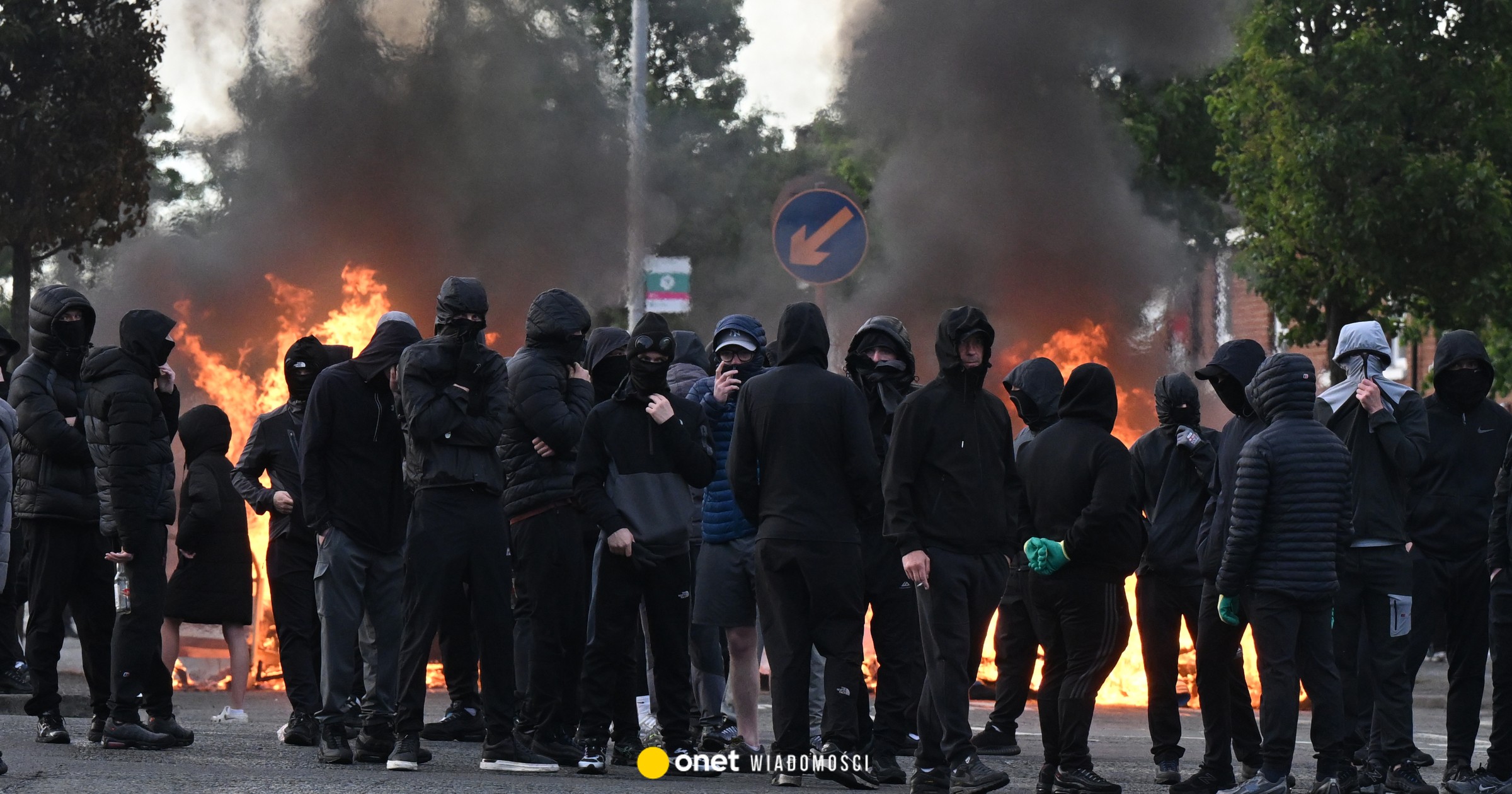
In several parts of Belfast, police and firefighters struggled until the early hours of Wednesday morning to control crowds of anti-immigrant militants who attacked ethnic minority homes, restaurants and shops.
Police reported that dozens of houses, many immigrant cars and at least one city bus were set on fire, and that the authorities were focused primarily on ensuring the safety of those at risk rather than confronting and arresting the attackers.
British Prime Minister Keir Starmer has promised that hundreds of rioters, most of them teenagers and men in their 20s with their faces covered, will be identified and brought to justice in the coming weeks and months.
— It is clear that people were attacked last night because of their ethnicity and I will not tolerate it. Those responsible will feel the full severity of the law, he announced.
This wave of vandalism and intimidation was in response to a knife attack on Monday evening, when a Sudanese asylum seeker attacked a local resident in the middle of a street in north Belfast. This macabre and surreal event was captured and spread around the world on social media accounts run by far-right agitators.
The alleged attacker, 30-year-old Hadi Alodid, appeared in court in Belfast on Wednesday after being charged with the attempted murder of Stephen Ogilvie, who lost an eye as a result of the attack.
The Ogilvie family issued a statement urging the public not to take out their anger on innocent immigrants.
“Many migrants make incredibly valuable contributions to our country, including our healthcare system and hospitality sector, and we rely on them to keep our country running,” the family stressed. “We do not want this terrible tragedy to be used to divide people or fuel hostility.”
Extremist reaction reflects what has been happening in parts of Northern Ireland over the last two years: in August 2024, when police reinforcements had to be brought in from Scotland to quell week-long anti-Islam riots, and in June 2025, when two Romanian teenagers were accused of sexually assaulting a teenager. In both cases, anti-immigrant groups organized protests primarily via Facebook and WhatsApp, which escalated into predatory attacks on immigrant homes and businesses.
Analysts say social media posts promoted by foreign instigators can easily inspire and intensify this locally organized violence — but only because The lines of conflict are already so deeply rooted in a city with specific divisions and paramilitary traditionsespecially in the poorest Protestant neighborhoods.
PA Images/PA Images via Getty Images/Getty Images
Vehicles set on fire by protesters during riots in Belfast, June 9, 2026.
This is primarily where the violence broke out on Tuesday evening – in areas still controlled by one of the two main illegal pro-British groups: the Ulster Defense Association (UDA) and the Ulster Volunteer Force (UVF). They once killed Catholics in retaliation for violence by the Irish Republican Army (IRA). It was a terrible era that faded somewhat into memory with the Good Friday Agreement of 1998. But since then, the rival UDA and UVF have evolved into full-time criminal organizations with thousands of members who share the values of far-right firebrands in England and beyond.
These so-called loyalist groups began as grassroots gangs whose goal was to prevent Catholics from settling in Protestant areas. Today, when an event that triggers strong emotions occurs, their main targets are immigrants from Asia and Africa, who, despite the increase in migration in recent years, still constitute only 3 percent. population of Northern Ireland, a region that remains by far the most “white” part of Great Britain.
Is history repeating itself?
The focus on defending Protestant territory against newcomers goes back to act one, scene one of the conflict in Northern Ireland. The Troubles broke out in Belfast in August 1969 with loyalist attacks on Irish nationalist homes, driving out thousands of Catholics to create exclusively Protestant areas – the map of sectarian divisions is still clearly visible.
Near the sites where Catholics were driven from their homes two generations ago, 12-meter-high walls called “peace lines” divide working-class neighborhoods in two: on one side of the fortifications are Catholic neighborhoods marked with the green, white and orange colors of the Irish tricolor, and on the other side are Protestant areas marked with the red, white and blue colors of the British flag.
The article continues below the video
In the generation since the 1998 peace agreement made Northern Ireland a more attractive place to live, the lowest-rent properties on both sides of these security barriers have become home to rapidly growing populations of migrants from Eastern Europe, Asia and Africa.
Because in the so-called contact areas as the Irish nationalist population grows and the Protestant unionist community shrinks, non-white asylum seekers are more likely to find housing on the Protestant side of the fence.
Monday's stabbing occurred near one of these “contact areas,” but on the Catholic side of the divide, where immigrants often say they feel slightly safer.
The feeling that history is repeating itself, with age-old tensions colliding with new demographic changes, was not lost on Paul Doherty, a councilor representing the Catholic west of Belfast.
“I grew up hearing stories about my own community in west Belfast whose houses on Bombay Street were burned down in the 1960s,” Doherty said, referring to the site where the first “peace line” was born.
— People still carry the trauma from those times. We know where this road leads. We cannot allow reckless mobs to repeat some of the darkest chapters of our past in 2026. That's how I felt last night, he admitted.
I’m Ashley Davis as an editor, I’m committed to upholding the highest standards of integrity and accuracy in every piece we publish. My work is driven by curiosity, a passion for truth, and a belief that journalism plays a crucial role in shaping public discourse. I strive to tell stories that not only inform but also inspire action and conversation.