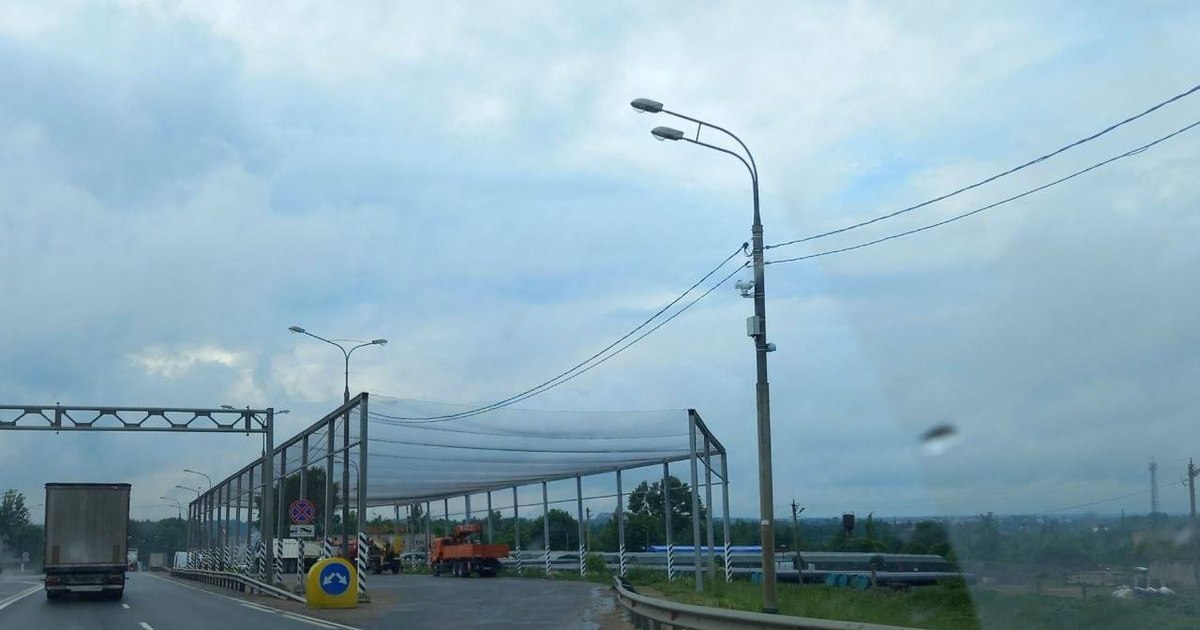
Security measures surrounding Russian President Vladimir Putin appear to have reached a new level of alert, extending beyond the strict perimeter of government targets. Recently, anti-drone protective nets were installed above the parking lots intended for TIRs in the Valdai district of the Novgorod region, a strategic area in the vicinity of one of the most secure presidential residences, writes the independent Russian publication meduza.io.
Anti-drone nets above parking lots for trucks in the Valdai district of the Novgorod region
The photos showing the new defense structures were published by journalist Oleg Kașin, and an analysis by the independent publication Agentstvo indicates that they are located on a highway, approximately 9 kilometers from the official residence of the leader in the Kremlin. Although military analysts point out that this type of netting is used on the frontline to protect military equipment from light kamikaze drones, the logistical reasons behind this decision could be completely different inside the Russian Federation.
The “Spider Web” strategy and the new logistical vulnerabilities
Ruslan Leviev, founder of the Conflict Intelligence Team (CIT) investigative project, offers a different perspective on these road fortifications. In his opinion, the role of the wire nets is not to protect the trucks, but, on the contrary, to protect the area from heavy vehicles.
This hypothesis is based on the precedent of the Ukrainian operation codenamed “Spider's Web”. As part of that tactic, Ukraine's defense forces camouflaged attack drones inside cargo trucks. As the vehicles approached Russian military airfields – the designated targets – the trailer roofs opened automatically, allowing the aircraft to be launched directly from the road. The presence of nets in the Valdai area would physically block such a vertical launch attempt from the immediate vicinity of the presidential residence.
Putin is increasing his public presence amid declining popularity
The leader's increasing isolation from the Kremlin comes amid complicated domestic political dynamics. According to research by the Faridaily platform, which monitored the president's official agenda, Putin saw a significant increase in public appearances in April and May 2026, attending 60 events, compared to just 55 in the first three months of the year.
This image offensive – which included highly publicized meetings with his former teacher or a Chinese citizen he met in 2000 – is seen by analysts as an attempt by the Kremlin to counter the steady decline in popularity indices recorded by public opinion polling institutes such as FOM and VCIOM.
However, its public presence remains strictly geographically controlled.
In the first five months of 2026, Putin left the Moscow region only twice, both trips to St. Petersburg. For comparison, in the same period of 2024, he had made 14 regional visits.
Government sources cited by Faridaily indicate that visits to Russian regions have been suspended for strict security reasons. Paradoxically, the security apparatus believes that the infrastructure in foreign capitals such as Beijing or Astana (where Putin recently made state visits) offers higher security guarantees than Russian cities such as Reazan or Kemerovo. During the visit to Kazakhstan, the presidential motorcade was also escorted by an armored vehicle equipped with a heavy machine gun on the roof.
Fear of attacks and digital paranoia
The information regarding the increase in protective measures is also confirmed by sources in the Western intelligence services. In early May, a report by a European intelligence service showed that the Federal Protective Service (FSO) had drastically tightened protocols around Vladimir Putin amid severe fears of a possible assassination attempt. Among the new rules imposed is a ban on officials wearing wristwatches during direct meetings with the head of state.
Moreover, the Financial Times recently revealed that Russian special services have temporarily shut down some electronic road surveillance systems used to monitor official convoys. The decision was taken as a direct reaction to the assassination of Iran's Supreme Leader Ali Khamenei. From the data collected, the Israeli secret services were able to prepare the attack against the ayatollah precisely by breaking into the traffic video camera systems to which he was connected.
Although the appearances in the public space are less and less, sources from the Russian governmental environment claim that the executive activity of the president has not diminished, but has moved into the shadow area. It currently prioritizes confidential meetings with soldiers returning from the front in Ukraine and with the families of the deceased, but also shows increased interest in technical meetings dedicated to cutting-edge technologies and artificial intelligence, areas considered vital to the economic and military survival of the regime.