Nightmare in the air: a plane full of passengers, violently shaken towards Germany. Stewardess thrown into ceiling and four injured due to wake turbulence

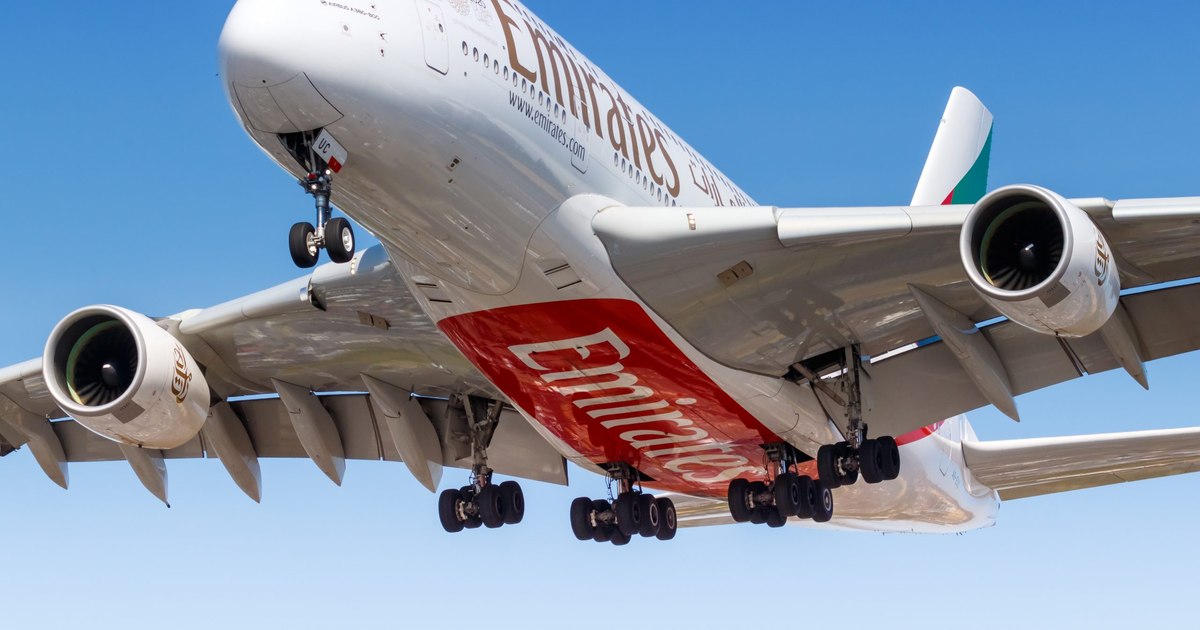
A plane full of passengers was violently shaken during a flight to Germany after running into extreme turbulence generated by an Airbus A380. A flight attendant was thrown into the ceiling and several people were injured.
An Airbus A320 Eurowings entered strong turbulence PHOTO: X
An Airbus A320 flight operated by Eurowings was involved in a serious turbulence incident on May 30, after the aircraft crossed the wake turbulence left by an Emirates Airbus A380 in the airspace of Bosnia and Herzegovina, writes aerospaceglobalnews.
Flight EW-635, en route from Rhodes (Greece) to Cologne (Germany), was cruising at approximately 36,000 feet when air traffic control cleared the climb to 38,000 feet. At the same time, Emirates flight EK-1 Dubai – London Heathrow, operated by Emirates, was in the same upper flight level.
According to data cited by Aviation Herald, the two aircraft respected the minimum separation recommended by the International Civil Aviation Organization (ICAO) – approximately 7 nautical miles between a superjumbo and a medium-sized aircraft. However, the distance was not enough to eliminate the risk generated by wake turbulence.
During the climb, at approximately 37,600 feet, the Eurowings aircraft suddenly entered the area of severe turbulence generated by the Airbus A380 flying ahead. The impact was violent enough that a female flight attendant in the cabin was thrown into the ceiling of the aircraft and four other passengers suffered minor injuries.
Immediately after the incident, the pilots decided to rapidly descend the aircraft back to 36,000 feet, with a descent rate of up to 3,000 feet per minute. The flight later continued under normal conditions and landed safely in Cologne, where medical teams attended to care for the injured.
The Eurowings aircraft remained on the ground for approximately four and a half hours after landing, during which time the flight recorders (CVR and FDR) were secured. The plane was later returned to service.
Aviation experts point out that wake turbulence is naturally generated by all aircraft, but that produced by the A380 is significantly stronger due to its size. For this reason, ICAO recommends a minimum separation of 7 nautical miles between an A380 and lighter aircraft.
However, the European Aviation Safety Agency (EASA) has previously stated that these minimums reduce the risk, but do not completely eliminate it, as turbulence can vary depending on atmospheric conditions and their dissipation in the air.
A known risk in modern aviation
The phenomenon of wake turbulence is well documented in civil aviation. In January 2017, a Bombardier Challenger business jet entered a similar area of turbulence generated by an Emirates A380, temporarily losing approximately 9,000 feet of altitude, resulting in several injuries.
Several similar incidents were also reported between 2009 and 2012, including situations involving Boeing 747 and Antonov An-124 aircraft.