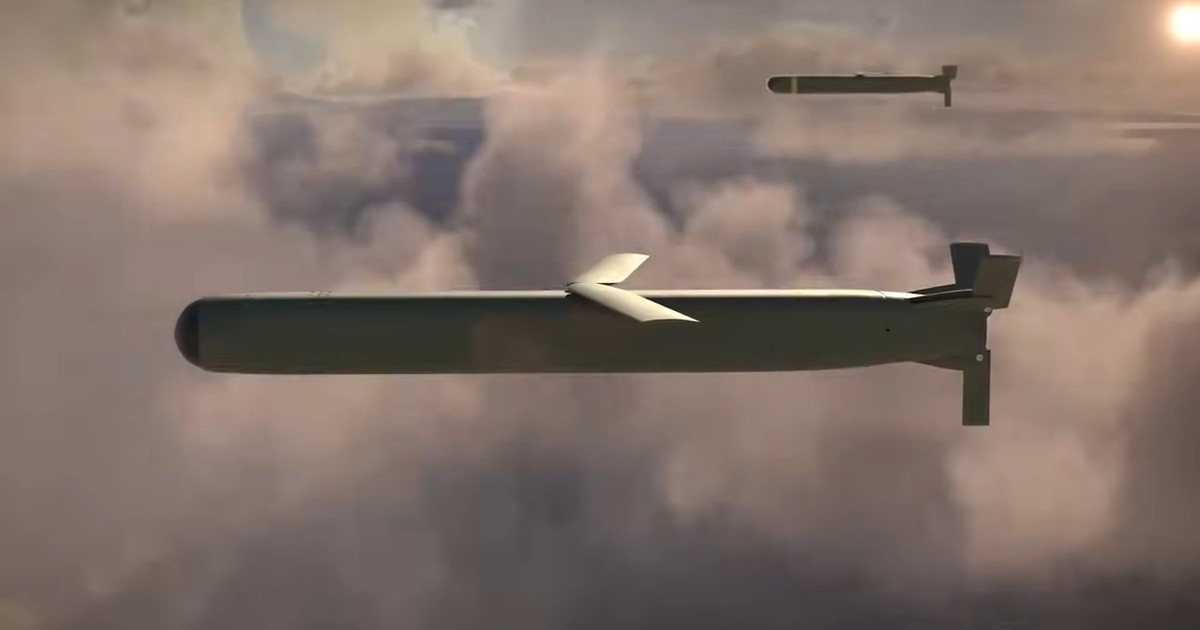
Northrop Grumman announced the success of the most important flight test of the Jackal missile to date. Automatic turbojet engine start, precise autopilot control, high-speed maneuvering and fully autonomous navigation of waypoints were tested in flight.
The test confirmed the strength of the hull, the power of the drive and on-board systems. Jackal is not a classic drone or a large cruise missile, but a hybrid that combines the range and speed of a missile with the intelligence of a modern drone. At a time when the enemy is building dense air defense systems (IADS), Jackal gives ground forces the ability to strike precisely from a safe distance, without the risk of sending manned aircraft into the danger zone. These weapons are designed to be mobile, easily transportable and ready for rapid deployment from light tactical vehicles or air platforms. Its appearance may change the balance of power on the battlefield, where not only striking power is important, but also reaction speed and resistance to interference.
From secret work to public premiere
Work on the Jackal began in 2017 as part of Northrop Grumman's internal research and development program in cooperation with AeroVironment, the creators of the famous Switchblades. The first public presentation of the missile took place in May 2022 at the SOFIC conference in Tampa. From the beginning, it was designed as a multi-platform weapon (launched from the ground, air and sea) and multi-role, capable of carrying both kinetic warheads and electronic warfare and reconnaissance modules.
The main goal was to quickly close the capability gap of the US army: in conditions of strong enemy air defense (Russia, China), manned aviation becomes too vulnerable, and land forces need their own, mobile long-range strike means. Due to this early focus on autonomy, low detectability and ease of use from light platforms, Jackal stood out from the beginning from other weapons programs. It was not a simple development of another missile, but a conscious response to the changing realities of the 21st century battlefield.
Why is Jackal needed now?
The main problem of the modern battlefield is integrated air defense systems, which prevent effective air support. Jackal solves this problem radically. Launched from light tactical vehicles or air platforms, it flies at an altitude of less than 50 meters, camouflaging itself with the terrain. Its range is 100 km from ground take-off and 125 km from air take-off, and its speed exceeds 480 km per hour.
At a distance of 100 km, it reaches the target in just 12-15 minutes, which is fast enough to hit moving, time-sensitive targets before they have time to move. The greatest strength is resistance to interference: the missile operates in an environment without GPS, using autonomous waypoint navigation, and in the final phase, artificial intelligence independently recognizes and attacks the target.
- Read also: Putin launches Satan 2. The Kremlin says it is an unstoppable power
Thanks to these capabilities, Jackal not only gives ground forces an independent means of long-range strike, but also completely changes the balance of power. One light vehicle equipped with eight launchers can cover an area of over 31,000 square meters. square kilometers, forcing the enemy to disperse and weaken its own defense.
What makes Jackal better than existing solutions?
Jackal weighs only 36.5 kg, is 1.6 m long and 15.2 cm in diameter – one light off-road vehicle can carry as many as eight launchers. Logistics are simple, training is quick, and the combat footprint is minimal. The effectiveness of such a system is enormous: Jackal is much cheaper than JASSM or Tomahawk, and at the same time much more powerful and has a longer range than Switchblade 300/600.
The dual-mode warhead weighs 3 kg, and the system can generate up to 1 kW of power for electronic warfare. 8 missiles from one place cover an area of over 31,000 square meters. km², forcing the enemy to disperse his forces. Low flight altitude and high speed combined with autonomy make it a very difficult target for air defense. Thanks to these features, Jackal is a weapon that allows for long-range, precise strikes, placing them in the hands of ordinary land units without the need to engage expensive aviation.
Jackal versus drones and classic cruise missiles
Compared to loitering ammunition (Switchblade, Lancet), Jackal does not hover over the target for hours. It reaches him faster, has a longer range and a stronger head. Unlike drones, it does not require a permanent radio link, which makes it resistant to interference.
In turn, compared to large cruise missiles, it is much smaller, lighter, cheaper and easier to use from land vehicles. It doesn't need precise GPS coordinates in advance. In the last phase, he “sees” and recognizes the target. Thanks to this, Jackal creates a completely new class of weapons. It is a weapon that not only fills the gap between these two categories, but also creates a completely new quality on the battlefield – fast, autonomous and resistant to enemy countermeasures.
Close to series production
The June 2026 test was a key milestone. Northrop Grumman confirmed the readiness of the most important systems and announced the transition to the next stages: guidance accuracy tests, AI verification and full operational evaluation. The program remains in active development.
The company has not yet announced a specific date for entry into service, but the pace of work and the success of the last flight indicate that Jackal is very close to the border of operational readiness. Now the program is entering a more demanding phase, in which the final guidance systems and the operation of artificial intelligence responsible for autonomous target recognition will be verified.
A new type of weapon
Jackal is a symbol of a paradigm shift: precise and fast strikes over 100 km are becoming available to ordinary battalions and brigades, and not only to aviation. In the era of hybrid wars, drones and dense air defense, such mobile, autonomous and interference-resistant weapons can become a real game changer.
- Read also: The key US weapon in a new version. Javelin has a lighter version
After further accuracy and autonomous guidance tests, as well as full operational evaluation, the Jackal has a real chance of quickly entering service with the US Army and its allies. If the program maintains the pace, Jackal will soon be delivered to units and will become one of the most important tools for tactical destruction of the armed forces of the 21st century.