The limits of Donald Trump's power are becoming more visible. Congress and the courts echo the White House leader's “aura of omnipotence.”

America's democratic institutions – from the courts to the Capitol – dealt a series of tactical blows to President Donald Trump. These developments began to crack the “aura of omnipotence” that surrounded him since the beginning of his second term in the White House, notes the Financial Times.
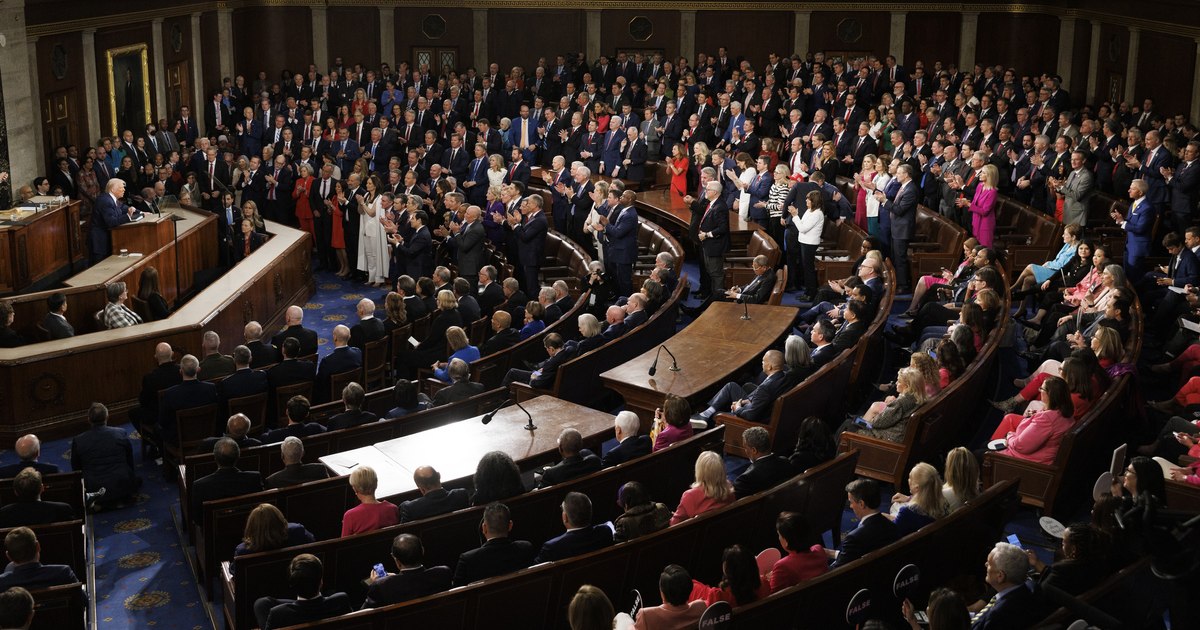
Donald Trump in the US Congress/PHOTO: EPA/EFE
Signs of institutional resistance multiplied rapidly. A court ordered the removal of Trump's name from the official title of the prestigious John F. Kennedy Center for the Performing Arts. Almost simultaneously, the House of Representatives, although under the theoretical control of its own Republican Party, voted on a resolution to limit US military action in Iran. In turn, the Senate — also dominated by Republicans — cut funding for a symbolic project of the White House leader: the construction of a new ballroom within the Presidential Complex.
Under the pressure of these events, Trump was also forced to abandon plans for the establishment of a controversial $1.8 billion fund, officially intended to “combat abuse of power”, through which he intended to compensate his political allies who suffered convictions or investigations in the justice system.
These legislative and legal failures come amid a noticeable drop in opinion polls, with polls indicating a gradual loss of American confidence in his economic and foreign policies. However, beyond the percentages, we are witnessing the beginning of a new phase of the Trump presidency, in which judges and elected Republicans are beginning to draw clear red lines in front of the executive.
“His policies are fueling inflation. He's unpopular, and Americans don't like it. The whole world doesn't like it, and more recently, not even a faction of his own Republican Party”, explains Matt Dallek, historian and professor of political management at George Washington University. “All of this has opened up, in my view, a new era of limitations for Trump.”
The complicated equation of midterm elections
Just five months before the mid-term parliamentary elections, the signals received by the leader from the White House are deeply ambivalent. On the one hand, Trump has achieved resounding domestic victories in recent weeks: candidates directly supported by his movement, MAGA (Make America Great Again), eliminated moderate Republicans with old states in the primaries, with political victims including Senators John Cornyn (Texas) and Bill Kelsey (Louisiana), and Congressman Thomas Massie (Kentucky).
On the other hand, the price of this domestic purge could be the loss of control over Congress. Most analysts predict that the Republican Party risks losing its majority in the House of Representatives in November. Experts warn that by imposing “radical” candidates, Trump has weakened constituencies that were once considered safe fiefdoms for Republicans. Even the majority in the Senate is no longer guaranteed.
The revolt in Congress, the alarm signal around the Iran file
Particularly painful for the White House are the criticisms brought to some key initiatives. The passage in the House of Representatives of a resolution blocking military action against Iran without the express approval of Congress is a heavy symbolic slap in the face of a deeply unpopular conflict. Even if the measure did not find an echo in the Senate and has a rather symbolic character, it was adopted after four Republican congressmen crossed the camp and voted with the Democrats.
Trump is nominating his former lawyer Todd Blanche for US Attorney General
“The time has come for Congress to clearly define the scope of the mission and the corresponding limitations on the use of force in Iran”the Republican Tom Barrett sent on the X platform, in a clear delimitation of the line imposed by the president.
The friction between Trump and his congressional base also extends to the area of national security. The controversial nomination of businessman Bill Pulté—a loyal ally of the president but completely inexperienced in the security establishment—as Director of National Intelligence (DNI) caused consternation and outspoken opposition among Republican senators. Faced with a deadlock, Trump had to step back, saying it was only “a temporary appointment.”
Between blind loyalty and constitutional reality
Despite the vehement posts on his network, Truth Social, Donald Trump appears to have accepted, on the face of it, court decisions blocking his special fund or reform at the Kennedy Center. But his tactics continue to test the resilience of the constitutional system.
“Trump does not follow standard political logic. He is willing to risk constitutional stability, is unburdened by remorse and behaves like a political adventurer”, believes Julian Zelizer, a political historian at Princeton University. “It's possible that the Iran dossier and the freeze on that private fund represent watershed moments where the imperatives of party power have separated from blind loyalty to Trump. But we can just as well imagine how Republican lawmakers will quickly return to order.”
From the presidential camp, the reply remains unchanged. “President Trump will continue to successfully implement the agenda for which he was elected by the American people, and anyone who claims otherwise is just promoting another false media narrative,” White House spokeswoman Abigail Jackson countered.
The myth of the absolute leader falls apart at the age of 80
However, the reality on the ground indicates a paradigm shift. The myth of his invulnerability fades just as Trump prepares to celebrate his 80th birthday with a UFC gala at the White House.
“A year ago, most observers believed that Trump was ignoring any limitations on his power. Now, little by little, these mechanisms of control are making their presence felt again. Trump is neither God nor king, although he likes to pose as such.”concludes Professor Matt Dallek.
The president's strategy of building an “army” of loyalists by eliminating moderate Republicans from the primaries is a double-edged sword. There is no guarantee that these radical candidates will win the November general election over the Democrats. But if this risky bet succeeds, the future US Congress will be shaped entirely in the image and likeness of Donald Trump, and dissent within the party will become a mere historical memory.