How the chemical plant in Târnăveni disappeared. It had thousands of employees, but it had turned the city into a toxic zone

In the past, the city of Târnăveni oriented its economy around the chemical plant, the only producer of carbide in Romania. The industrial complex had thousands of employees, but it had turned the town into one of the most polluted.
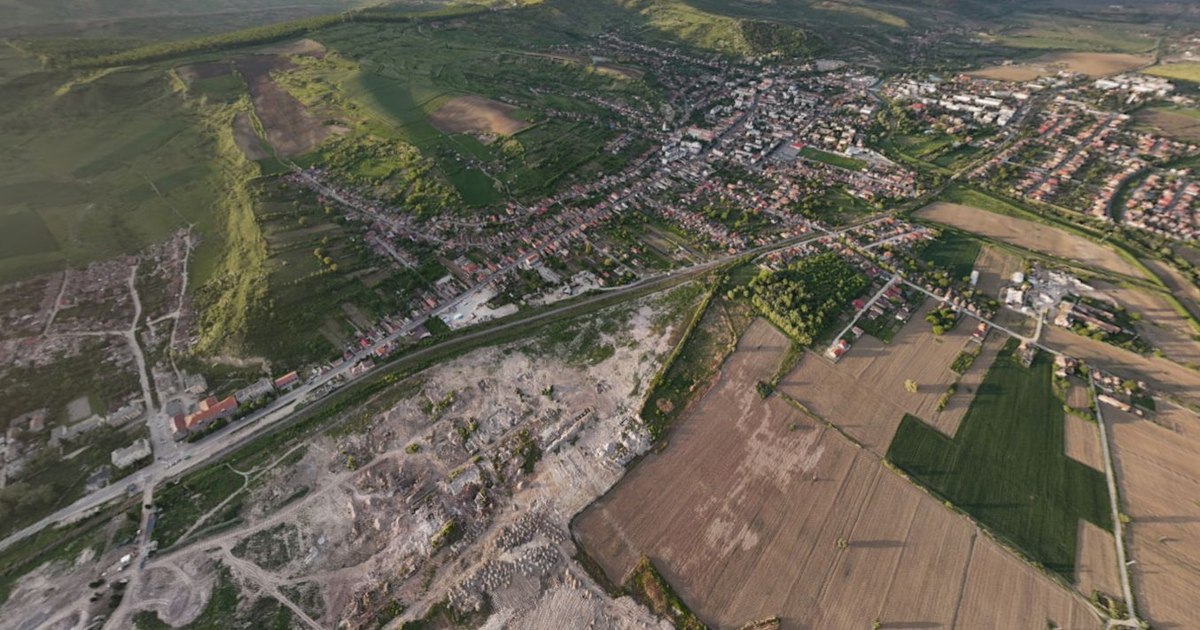
The town of Tarnăveni and the old chemical platform. Photo: Ilie Olar. Google Earth
The remains of one of the largest chemical plants in Romania can be seen on the outskirts of Târnăveni, in Mureș County, a town with over 20,000 inhabitants, developed in the 20th century thanks to the large natural gas resources in the area and the industry that exploited them.
The ruins of the chemical plant
The secondary railway 307 Blaj–Târnăveni crosses the industrial area of the Transylvanian city, accompanying the Blaj–Târnăveni road, before reaching the CFR station. Along them, the border districts of Târnăveniu offer a desolate sight. Beyond the lines, between the railway and the Târnava Mică river, the former platform of the chemical plant was transformed into an empty land stretching over almost 100 hectares.
In the abandoned industrial landscape, the battlements of the former factories remained, warehouses set up for decanting and keeping the residues resulting from the production processes. These stockpiles contain hazardous chemical waste, including chromium compounds, and have been described over the years as some of the worst environmental problems inherited by the city after the factories closed.
The area of the complex in Târnăveni. Photo: Ilie Olar. Google Maps
However, the chemical plant in Târnăveni was considered a “pearl” of Romanian industry for a long time. Outside of the battles, few places on the old industrial platform still remember its factories today. Since the early 1990s, the facilities have been gradually decommissioned as industrial activity has contracted and the number of employees has steadily declined. In the 2000s, BICAPA and Carbid Fox, the two companies left behind by the old combine, definitively ceased their activity. Their buildings and facilities gradually turned into ruins and rubble, scattered over the contaminated industrial land.
In recent years, the greening plans of the former platform have been linked to the Mureș Magnesium project. The company, which took over part of the assets of the former BICAPA plant, proposed reprocessing waste from the battles and greening the land.
“During its nearly 90 years of operation, until its closure in 2001, the platform saw numerous chemical production activities: nitrates, fertilizers, carbide, caustic soda and ceramic products. It was also where precious metals such as gold and silver were refined into ingots.” the company's website shows.
Battles with toxic waste and precious minerals
The activity also included two facilities for the production of sodium dichromate and a purpose-built warehouse for the resulting residues. Initially, the platform occupied more than 120 hectares. Mureș Magnesium preserved 42 hectares, including Battles 2 and 3.
“They cover approximately 19 hectares and contain approximately 1.92 million tonnes of waste that can be recovered. Historically, the landfills were known to contain environmentally hazardous waste, having been built to the standards of the time”the company states.
Image 1/7:
The factory in Târnăveni Photo Vatra 1976 jpg
The darkest city in Romania in the 90s hides a disturbing story: “It looked like it was taken out of a fireplace”
The project aims at excavating waste, extracting minerals and reintroducing the remaining residues, which have become inert in the meantime, into rehabilitated battlements according to current European standards.
“The inert material would account for approximately 54 percent of the initial amount of waste processed,” the company's website also shows.
In September 2025, the company asked the Government to modify the financing framework of the Just Transition Fund, so that private companies can also access European funds for the ecological rehabilitation and conversion of contaminated industrial sites.
“A simple public policy decision could transform one of Romania's most pressing environmental problems into a European flagship project for the green transition, creating jobs, protecting the environment and strengthening the economy”company representatives said in a press release.
According to the same company, the project could lead to the production of about 24,000 tons of magnesium per year, equivalent to about 18 percent of the European Union's demand, and the investment would create 270 direct jobs and more than 1,000 indirect jobs in related industries.
The hidden pollution of Tarnăveni
Târnăveni's industrial era brought thousands of jobs to the city, but turned it into one of the most polluted localities in Romania. Since the 80s, in a period when industrial pollution was often minimized, the authorities drew attention to the problems in Târnăveni.
“In the city of Târnăveni, atmospheric pollution is produced by carbide dust, emitted into the air by the furnaces of the chemical plant. The composition of this dust includes calcium and magnesium oxide. Following the analyzes carried out by the Tîrnăveni Epidemiological Laboratory, it appears that the most affected area is the one near the plant, the concentration of carbide dust being reduced, in general, below the maximum allowed in the central area and, especially, in the area of the hospital. in view of a considerable reduction of atmospheric pollutants, the management of the Chemical Plant in Târnăveni must continue to intensify its efforts”, noted the doctor Tokes Bela in 1989.
After 1990, sections of the plant were gradually closed, but environmental problems caused by toxic substances and heavy metal residues did not disappear with them.
Studies confirm pollution from the industrial area
Several researches published in recent years show that the industrial activity in Târnăveni continued to affect the environment even after the closure of some production units. Scientific studies have identified chromium, lead, manganese and cadmium in the soils of residential areas, but also in the vegetables grown by the locals, such as beetroot, and in the spontaneous vegetation near the former chemical platform.
Făgăraș, the strategic city in the middle of Romania, full of disturbing secrets. What his factories were hiding in the 50s
Other research has indicated the contamination of groundwater with hexavalent chromium and the need to remediate the residue deposits left after the closure of the former Bicapa plant.
“The former Bicapa factory in Târnăveni, where sodium bichromate was produced, was closed in 2001, after almost 50 years of operation. Its activity left groundwater contaminated with hexavalent chromium and a waste deposit exposed to the elements. The deposit contains residues resulting from the processing of chromite ore, consisting of residual hexavalent chromium, partially processed chromite ore and other waste. During the operation of the plant, these residues were pumped in the form of suspension into the warehouse, where they were dehydrated. The recovered water was then reintroduced into the production circuit.” showed a study published in 2015.
Another research, published in 2025 by the University of Petroșani, showed that the manufacturing process of sodium and potassium bichromate generated a residue called “green sludge”.
“The waste deposited in the landfill is heavily contaminated with dichromate ions, as a result of the process of manufacturing chromium salts”, inform the study.
Another comparative study, carried out in several industrial centers in Transylvania, indicated in Târnăveni the highest concentration of chromium among the analyzed areas.