Ukrainians cut off Russia from Crimea. The route to the peninsula became a death trap

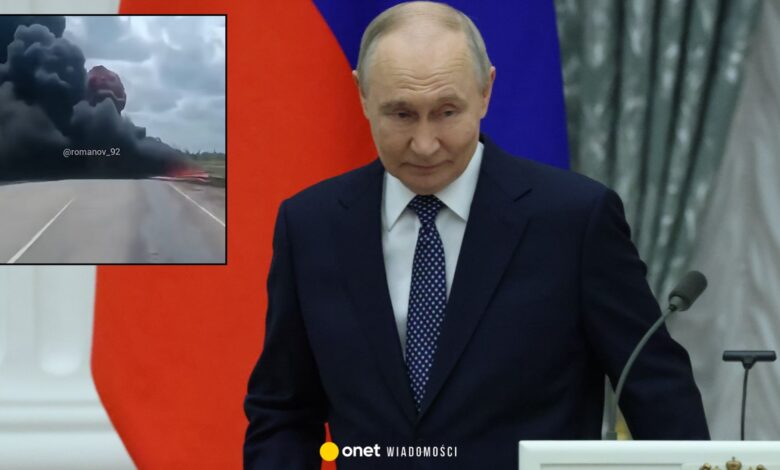
Just a few months ago, this road was considered relatively safe. However, the Ukrainian military's progress in drone development has dramatically changed the situation. American unmanned aerial vehicles equipped with computer vision systems have appeared in the arsenal of the Ukrainian Armed Forces, which can basically independently track moving targets.
The route to Crimea became a danger zone for Russian trucks literally within a few weeks. Hundreds of vehicles have already been attacked. In the second half of May, the Ukrainian Armed Forces rapidly intensified drone attacks on truck transport on the R-280 “Novorossiya” route, which connects the Rostov Oblast with the annexed Crimea. This area is more than 100 km from the front line and is classified as “medium rear”. Previously, Ukrainian forces did not have the means to destroy moving targets at such a depth. However, the situation has changed – today they are capable of destroying hundreds of vehicles a week.
The attacks mainly affected tankers – both civilian and military – and other heavy goods vehicles. Their ability to cross the Crimean Bridge was limited after the explosion in October 2022. Therefore, there is no route from Russia to the peninsula through the Zaporizhia and Kherson oblasts.
According to estimates by French OSINT researcher Cleman Molen, an analysis of videos published by the Ukrainian armed forces and civilian drivers showed that Ukrainians attacked about 200 vehicles over the last month. 80 were located on the recordings. Even more telling is the fact that at least 120 trucks were hit in the period after May 20. This spike in attacks quickly led to an oil crisis in Crimea. In addition, Ukrainian drones carry out attacks on railway infrastructure in the Kherson and Zaporizhia regions and on the peninsula itself.
Ukrainian Defense Minister Mykhailo Fedorov calls the May campaign of the Ukrainians “logistical isolation” of the Russian armed forces. However, it is not yet clear to what extent the Ukrainian strikes have impacted Russian military logistics.
Role reversal
The roads in the occupied part of southern Ukraine are mainly used by the Dnieper group (it occupies an extensive section of the front from the mouth of the Dnieper in the Kherson Oblast to the Orichiv region and the famous Mala Tokmachka in the Zaporizhia Oblast). Russian troops that had previously attacked the city of Zaporozhye along the Dnieper had to go on defense (and in some places retreat). However, this happened even before the intensification of attacks by the Armed Forces of Ukraine on the “central rear” of the Armed Forces of the Russian Federation.
The East group attacking at the junction of the Dnipropetrovsk and Zaporozhye oblasts is also partially supplied through the Taganrog – Mariupol – Volnovakha line. For now, there are no signs of logistical exhaustion. Most of Russia's armed forces convoys travel on secondary roads, where the Ukrainian Armed Forces also conduct attacks, although they are less frequently captured on video.
While problems with military logistics are not very visible for now (both in southern Ukraine and near Donetsk), it is clear that civilian supplies to Crimea have been significantly disrupted. This is probably related not only to the physical destruction of tankers and trucks, but also to the fact that civilian drivers and truck owners, unlike drivers of military vehicles, do not want to take the risks associated with traveling on a dangerous route.
How did the Ukrainian Armed Forces manage to increase the number of attacks on targets far from the front line so dramatically?
Both armies have long been developing rear strike technologies. These require broadband, two-way connectivity to the drone in order to transmit video. At the beginning of the year, the Russian Ministry of Defense unit “Rubikon” was at the forefront of implementing such technologies. It delivered dozens of strikes a week to the main supply line of Ukrainian Armed Forces groups near Pokrovsk (the Dnieper-Pokrovsk road) using drones controlled by Starlink space communications (exactly in the same way the Ukrainian Armed Forces struck – and continue to strike – targets located in Crimea).
The Ukrainian command has come up with an effective way to neutralize the threat. It appealed to SpaceX owner Elon Musk, presenting the Russian attacks as illegal use of Starlink. As a result, all terminals in the officially recognized territory of the country, except those registered with the Ministry of Defense of Ukraine, were disabled. In this way, “Rubikon” temporarily lost the ability to strike at distances of tens and hundreds of kilometers. Since then, the Russian armed forces have been trying to replace space communications with mesh networks (retransmitter drones play the role of communication nodes), but this only partially solved their problem.
Unexpected offensive
The shutdown of Russian Starlink terminals coincided with the launch of a massive Ukrainian campaign of strikes against the “middle rear” of the Russian army. The success of the Ukrainian Armed Forces was the result of a breakthrough in the development of unmanned aerial vehicles (UAV) with machine vision elements. The main tool is the Hornet drone produced by former Google CEO Eric Schmidt's company and its German and Ukrainian counterparts. At the beginning of spring, they began to attack objects located dozens of kilometers from the front line, mainly around Donetsk.
For example, the city of Horlivka became the object of mass attacks. The armed forces of the Russian Federation storming neighboring Toretsk fought for a long time to move the front away from this town and make Horlivka a safe base. In 2026, the goal seemed to have been achieved – Ukrainian troops were pushed out of Toretsk and the surrounding area, and the Russian army took over the logistic corridors leading to Konstantynówka to the north.
Shortly thereafter, however, the targets in Horlivka were again attacked by drones of the Ukrainian Armed Forces – this time by autonomous aircraft-type unmanned aerial vehicles. This is probably the Hornets (the Russian side called them “Martian-2”). According to Russian military officials who examined downed unmanned aerial vehicles, machine vision is used in them at the stage of targeting a target at low altitudes. The target itself is selected by the operator controlling the drone via the Mesh network (some drones – not all – also use Starlink).
It is at low altitudes (when the drone is searching for a target) that communication is usually the worst – both because of the enemy's use of electronic warfare measures, and because of the altitude itself, where the spread of the radio signal is hindered by the terrain (radio horizon effect).
A few weeks later, hundreds of such drones began attacking targets along the same route to Crimea, which had until then been considered safe. It was actively used not only by fuel carriers, but also by Russian tourists to bypass the unreliable Crimean Bridge.
Mass appearance of high-precision Ukrainian unmanned aerial vehicles at the rear of the Armed Forces of the Russian Federation had a powerful propaganda effect – It is in this zone that Russian war bloggers, volunteers and other war supporters with a wide media audience most often stay. For years, some of them have been “selling” readers the narrative that the Russian army is still fighting against the resistance of corrupt commanders. And the dominance of the Ukrainian Armed Forces in the air is a bluff.
Defense measures
The Armed Forces of the Russian Federation tried to use drones with machine vision elements as early as 2022–2023. In this way, Russian Lancet drones gained the ability to autonomously target a target, which increased their range, but – at least in the initial stage – reduced accuracy.
Since then, the Russian military and defense industry have continued to develop artificial intelligence technologies. The fact that Russia is not among the leaders in developing AI models does not matter: its military focuses on creating tools based on existing Western and Chinese models. Taking into account the technological base of the Russian army, it is expected that it will try to catch up and overtake the Ukrainian Armed Forces in the use of Hornet drones.
How can Russia try to defend itself against a wave of attacks that has made the route to Crimea dangerous? As with protection against other drones, there are passive and active measures to counter attacks. The former include physical security (e.g. installation of nets over roads) and defense in the electromagnetic spectrum.
The first method could be very effective – low-maneuver Hornet drones are unable to fly into gaps in networks (unlike FPV drones attacking on the front line, which often even get inside the net fence). However, it is difficult to imagine that the Russian armed forces would be able to operationally cover with nets over 300 km of the road from the border with Russia near Mariupol to the entrance to Crimea near Chonhar.
In the second variant, the problem is that Hornet drones have several communication systems: satellite navigation, radio signal, and sometimes – satellite communication and control (these include fully autonomous unmanned aerial vehicles).
In addition, the Russian armed forces are trying to deceive artificial intelligence, i.e. the machine vision systems of enemy drones. This is how photos of trucks painted “zebra” appeared. Probably the command of the Armed Forces of the Russian Federation believes that since zebras can make it more difficult for predators to “aim” thanks to their striped coloring, the Hornet drone guidance system can be hampered in the same way.
Active assets – i.e. various air defense systems – could be effective if they didn't have to protect a huge area from attacks by hundreds of drones a week. To effectively combat this threat, enormous forces will be needed: traditional short-range air and missile defense systems, mobile fire groups with machine guns and anti-aircraft cannons, patrol helicopters, and perhaps the most effective means – groups with unmanned aerial vehicles designed to intercept drones. The latter also use machine vision for target acquisition.
There are reports that “Rubikon” has already transported such groups with interceptor drones and other means of “small air defense” from the front to the Taganrog-Crimea route. However, such maneuvers weaken the anti-drone groups at the front and in the “near rear” – that is, at a distance of 10-15 km from the line of contact, where the Russian armed forces must face tens of thousands of drones.